- Title
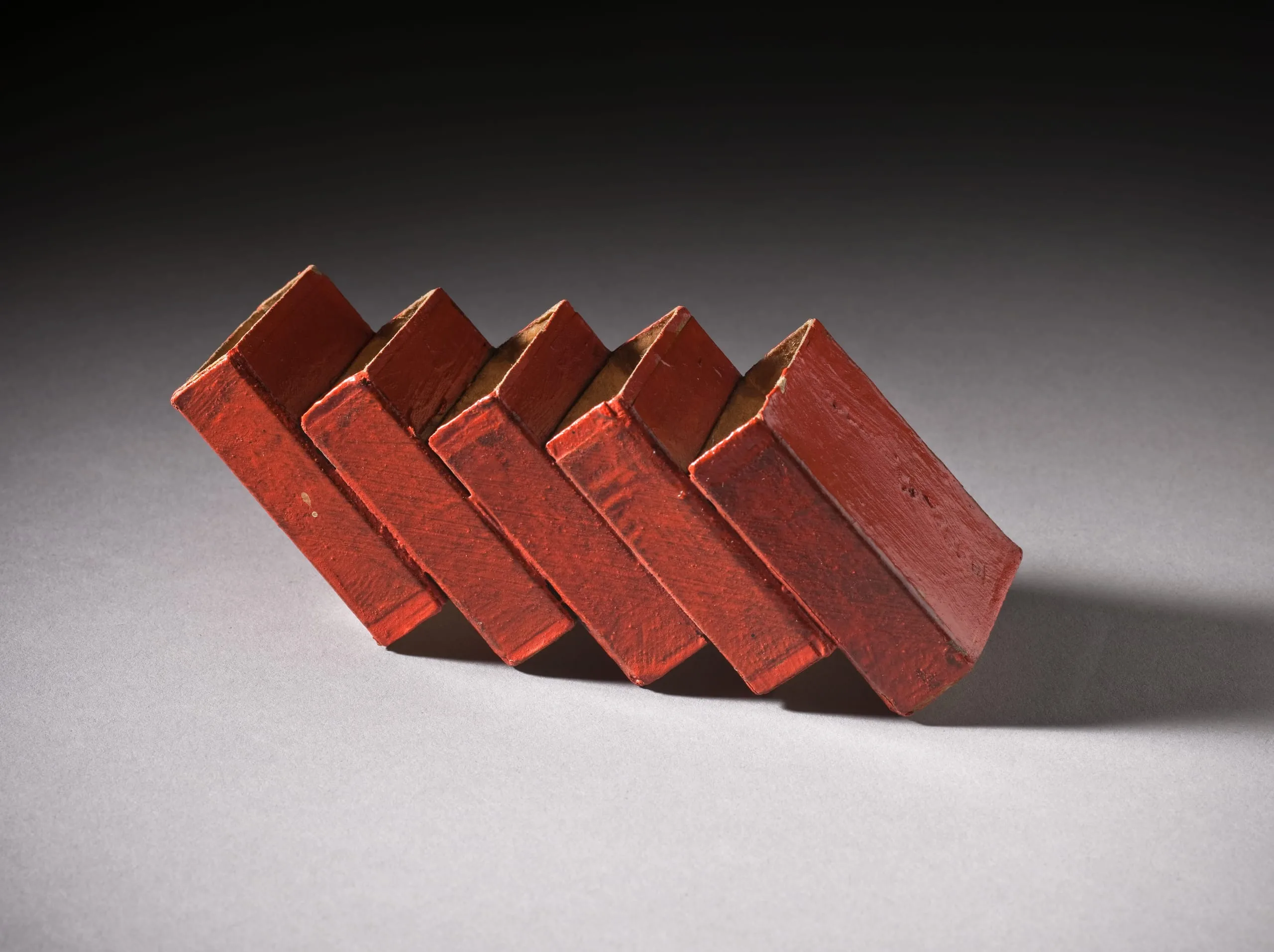
- Five Matchboxes Staggered Diagonally
- Date Made
- 1970
- Medium
- Matchboxes, glue, paint, and varnish
- Dimensions
- Overall: 3 3/8 x 5 3/8 x 3 3/4 in. (8.57 x 13.65 x 9.53 cm)
- Accession Number
- M.2010.21.2
- Curatorial Notes
Hermann Glöckner participated in progressive artist associations such as the Dresden Secession and Deutsche Künstlerbund (Association of German Artists) in the aftermath of World War I, and cultivated a mostly abstract visual language through his Tafelwerke (“panel works”) during the 1930s. These works systematically examined basic forms and materials of painting on double-sided wooden panels, but the Nazi vilification of abstract art as “degenerate” forced the artist to transform his practice into an entirely private affair. During these years Glöckner and his wife earned their living by working as contractors specializing in wall ornamentation. However, after World War II, the newly founded socialist republic in East Germany likewise proved an inhospitable environment for Glöckner’s art until state cultural policies began to soften in the late 1960s. Professionally marginalized, Glöckner supported himself by painting decorations and carving on building façades.
Five Matchboxes Staggered Diagonally is one of his small-scale sculptures called modelli (“models”), for which Glöckner manipulated materials from his household to create unique, intimate objects that he kept private, rarely exhibiting them during his lifetime. While the repetition of regular, rectangular volumes in Five Matchboxes Staggered Diagonally may recall the work of Donald Judd—a pioneer of Minimalism—for contemporary viewers, the modest scale and fragility of the material distinguish Glöckner’s work from Judd and his American contemporaries. However, Glöckner and the Minimalists were all indebted to Constructivism; a 1974 exhibition in West Germany titled “Constructivism and Its Legacy” addressed this shared lineage and included the East German artist’s work alongside that of El Lissitzky, Alexander Rodchenko, Carl Andre, Sol Lewitt, and Donald Judd.