Hermann Glöckner participated in progressive artist associations such as the Dresden Secession and Deutsche Künstlerbund (Association of German Artists) in the aftermath of World War I, and cultivated a mostly abstract visual language through his Tafelwerke (“panel works”) during the 1930s. These works systematically examined basic forms and materials of painting on double-sided wooden panels, but the Nazi vilification of abstract art as “degenerate” forced the artist to transform his practice into an entirely private affair. During these years Glöckner and his wife earned their living by working as contractors specializing in wall ornamentation. However, after World War II, the newly founded socialist republic in East Germany likewise proved an inhospitable environment for Glöckner’s art until state cultural policies began to soften in the late 1960s. Professionally marginalized, Glöckner supported himself by painting decorations and carving on building façades.
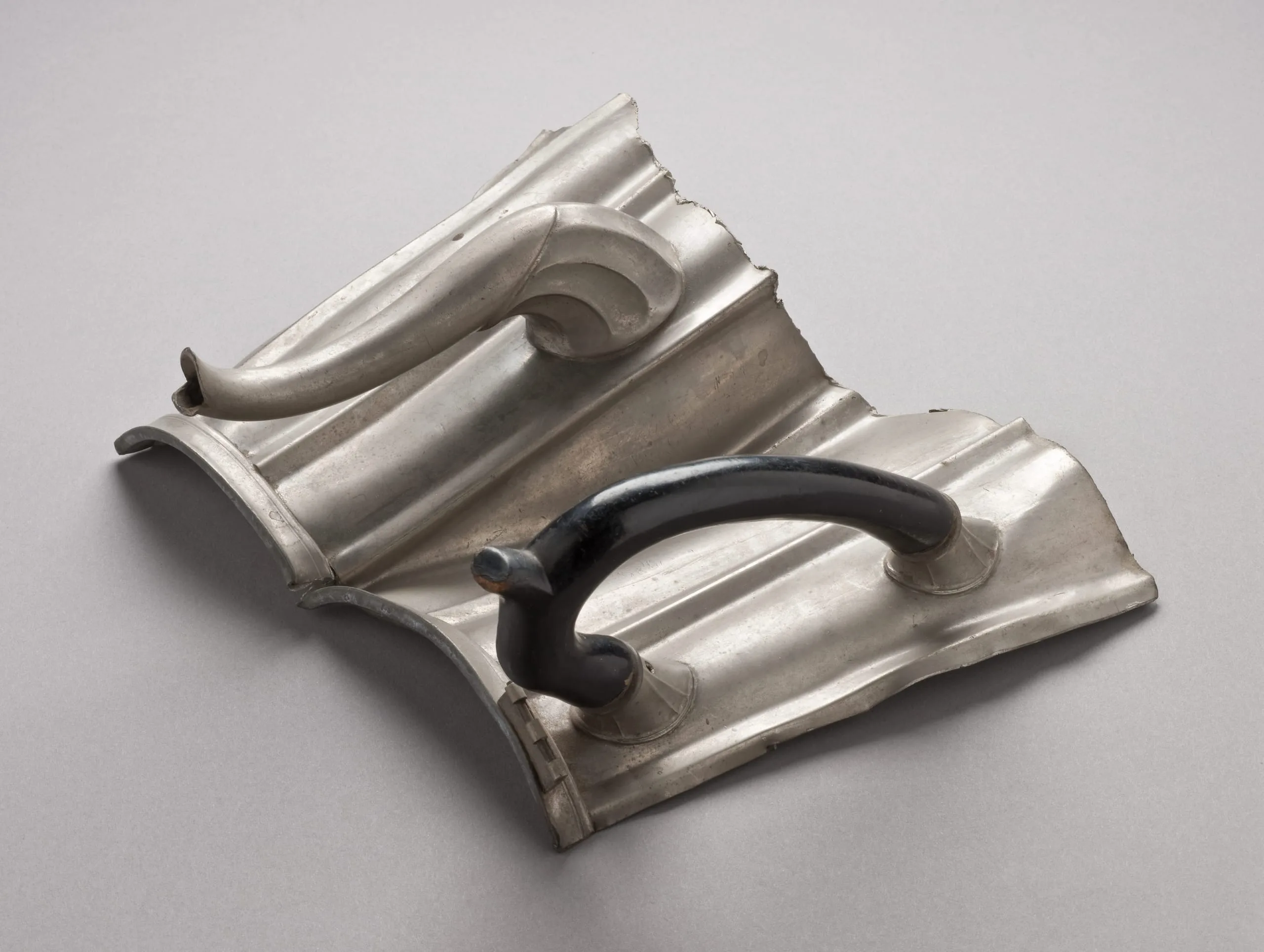
Cut-Open Tin Pot is one of his small-scale sculptures called modelli (“models”), for which Glöckner manipulated materials from his household to create unique, intimate objects that he kept private, rarely exhibiting them during his lifetime. In Cut-Open Tin Pot, Glöckner has removed the bottom of a turn-of-the-century teapot and made a longitudinal cut across the vessel with the help of metal shears. Once the tea pot is splayed open on a flat surface, its spout and handle lose their function, and the aesthetic decisions that went into the creation of their forms—the formal similarities and differences—come into focus. Thus, Glöckner intimates that abstraction is a series of processes that can be activated at any point for concrete, functional objects but requires a tacit agreement between the artist and the viewer to be recognized as “art.”