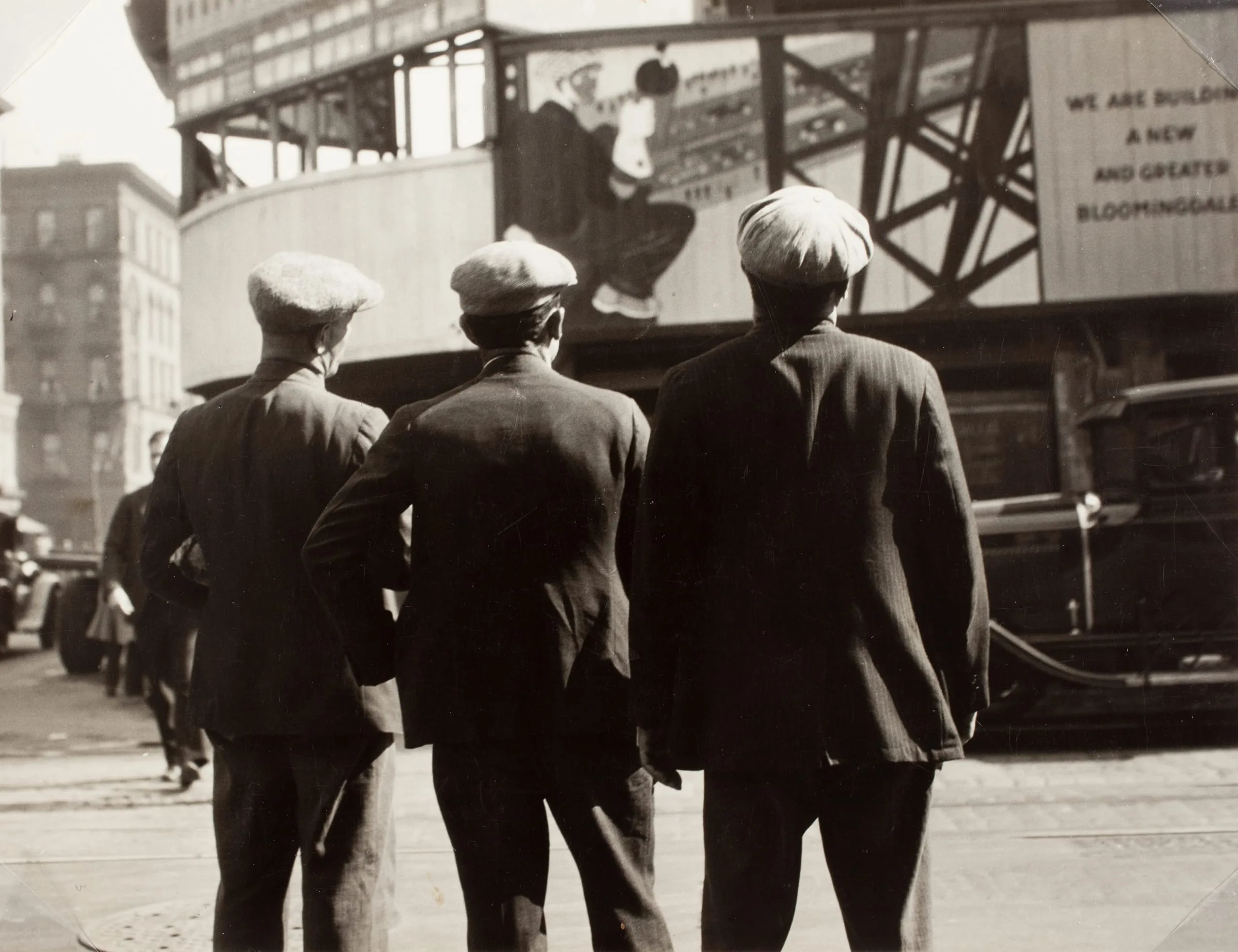
Walker Evans made this small-scale gelatin silver print in 1929, at the beginning of his career. Fascinated by the architectural transformation that was occurring throughout New York City, here Evans photographed the backs of three well-dressed men in suits and hats who look toward a building under construction. The billboard to the right announces: “We are building a new and greater Bloomingdales.” Founded on the Lower East Side in 1861, Bloomingdales moved north to Third Avenue and East 59th Street in 1902 and by 1927 controlled an entire city block. The men in this photograph are witnessing the expansion of the department store to 84,000 square feet. The image combines Evans’s two interests at the time: street life and the changing cityscape. The viewpoint, captured from behind the men, is typical of his early work, as he was a timid person and sought to catch people unaware.
Born in St. Louis, Evans was raised in the affluent suburbs of Chicago and Toledo, Ohio, before moving to New York in 1919 with his mother when his parents separated. He bounced around boarding schools and colleges, then in 1926 moved to Paris, where he enjoyed the bohemian life but was too shy to engage with the intellectual scene. Two years later, back in New York, he took up photography, interested in the practicality of the medium. During the spring of 1929, Evans and his roommate, the architect Paul Grotz, traveled about the city together making photographs—Grotz of skyscrapers with his Leica, Evans exploring new construction in Midtown. He would go on to make important contributions to the history of photography through his work with the Farm Security Administration and his innovative photo-reportage produced with the writer James Agee, Let Us Now Praise Famous Men (1941).
Rebecca Morse, Curator, Wallis Annenberg Photography Department
2024
Bibliography
Walker Evans. New York: The Metropolitan Museum of Art, 2000.