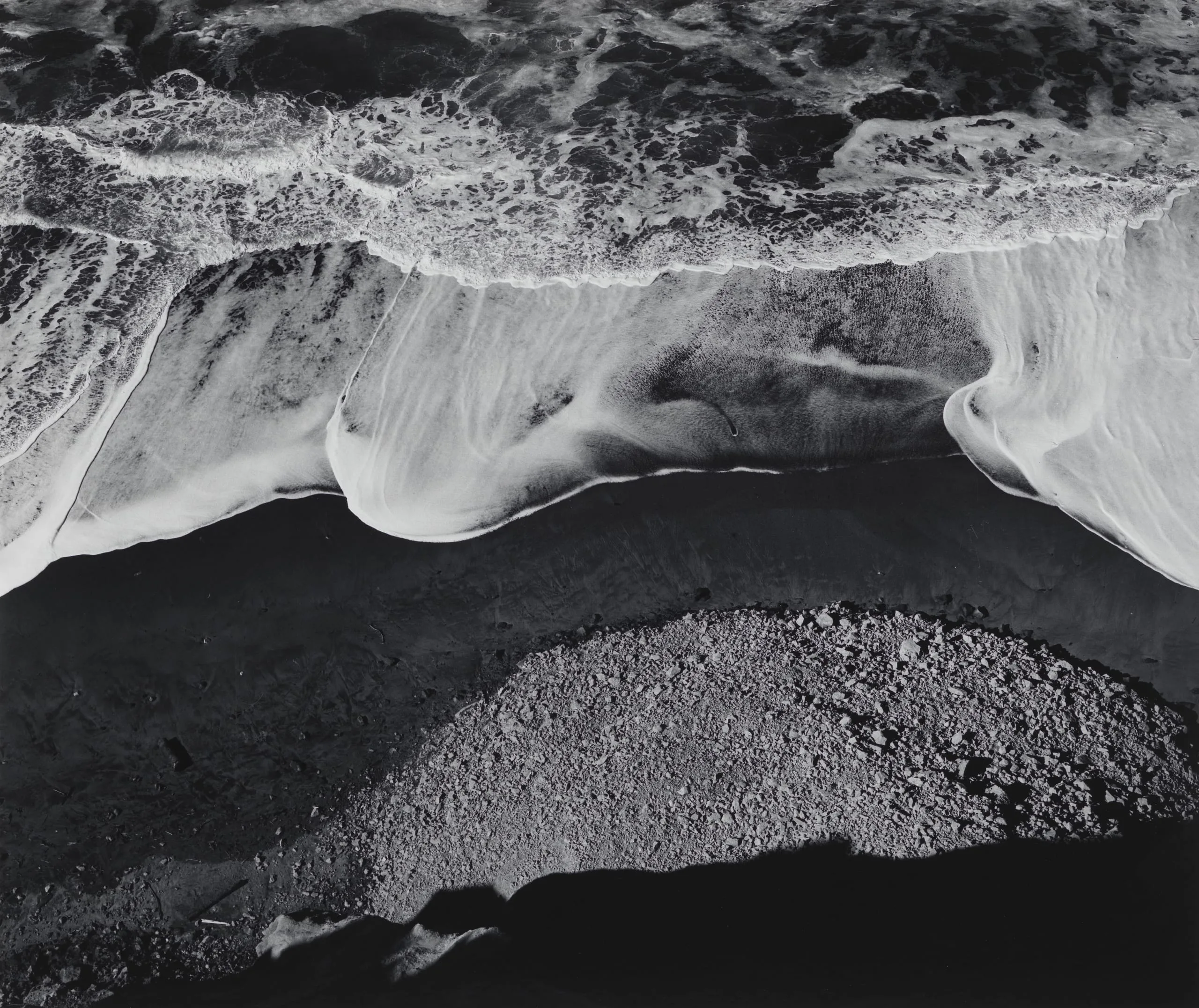
Surf Sequence consists of five 11 x 14 gelatin silver prints that abstract the larger seascape of the Pacific Ocean (see also M.2008.40.49.1, .2, .4, .5). Driving along Highway 1 in San Mateo County, California, early one morning in 1940, Ansel Adams stopped to see “the surf . . . streaming over the beach, barely touching the rocks and creating one beautiful pattern after another” (Adams 1983: 23). Using a 4 x 5 view camera, he made nine images with a sequence in mind, selecting five and discarding the rest due to the “disposition of the surf in the picture area” (ibid.: 24). He wanted all five pictures to be precisely the same size, so when one needed cropping along the right margin for compositional purposes, so too did the remaining four for consistency. While the order in which he shot the images can be determined based on the rock’s shadows, the photographs can be installed in any sequence desired.
Adams famously once said, “the negative is the score and the print the performance,” which connects his photographic work to his early training in the piano. He would say that his piano studies taught him the nature of perfection, and that only through constant practice and relentless repetition could one master a craft. In a musical sequence, a pattern is repeated to create a hook, an idea that echoes visually in Surf Sequence.
A giant in twentieth-century photography, Adams is known for his black-and-white landscape images of the American West, particularly Yosemite, and his role in nature conservation. Home-schooled due to his hyperactivity, he turned to the family piano and began to teach himself the instrument. His formal musical training began in 1916, about the same time he made his first trip to Yosemite and was introduced to the medium of photography—forever linking the two. Adams also formulated the Zone System, a method for creating the desired tonal range in a black-and-white photograph. Through previsualization, the maker decides what element of the scene will be middle gray (zone 5), then the other tones, black to white (0−10), will fall into place. Adams’s system is similar to a scale on the piano and how a musician might move up or down an octave, keeping the notes the same but creating a higher or lower pitch.
Rebecca Morse, Curator, Wallis Annenberg Photography Department
2024
Bibliography
Adams 1983. Ansel Adams. Examples: The Making of 40 Photographs. Boston: Little, Brown, 1