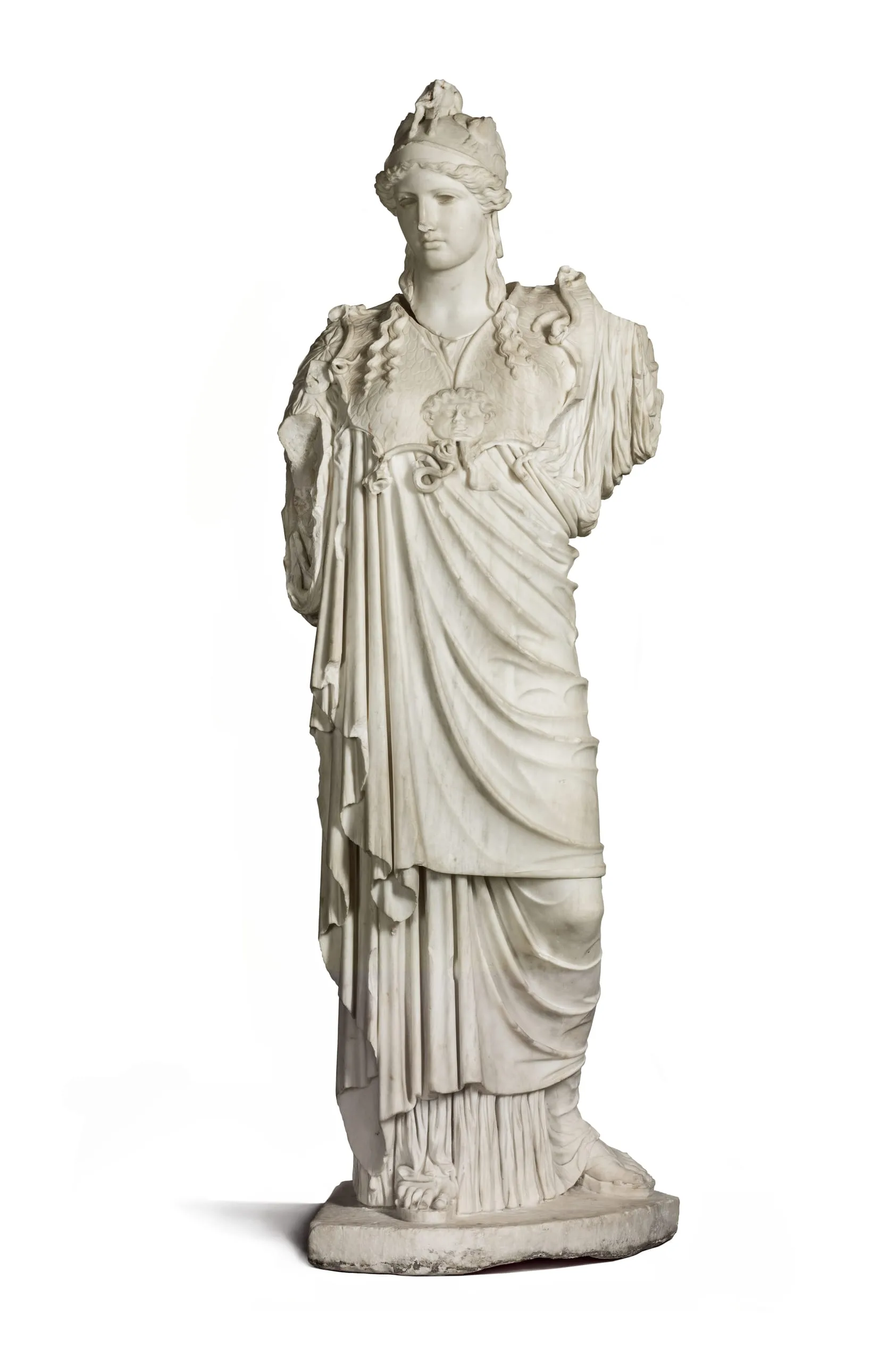
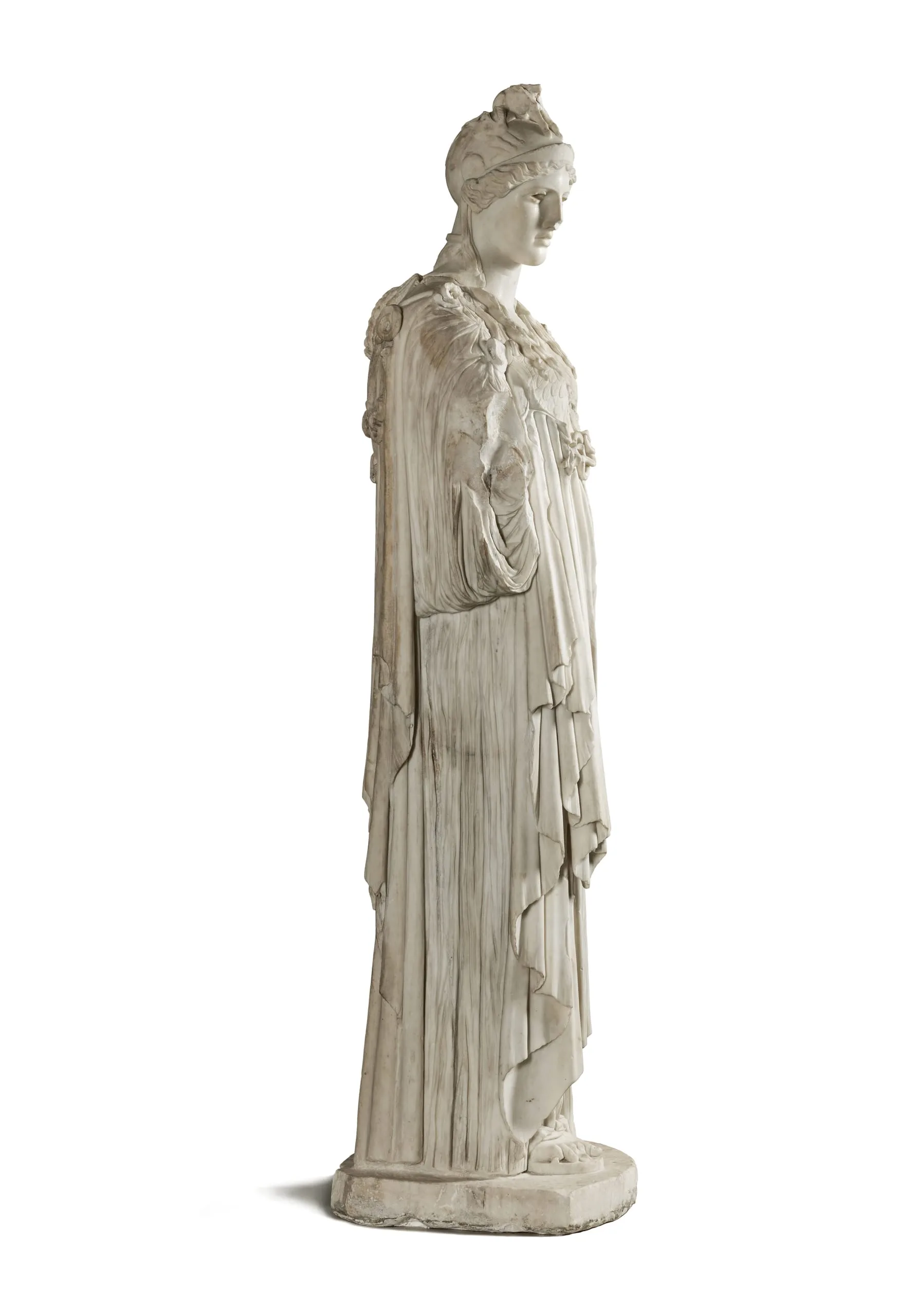
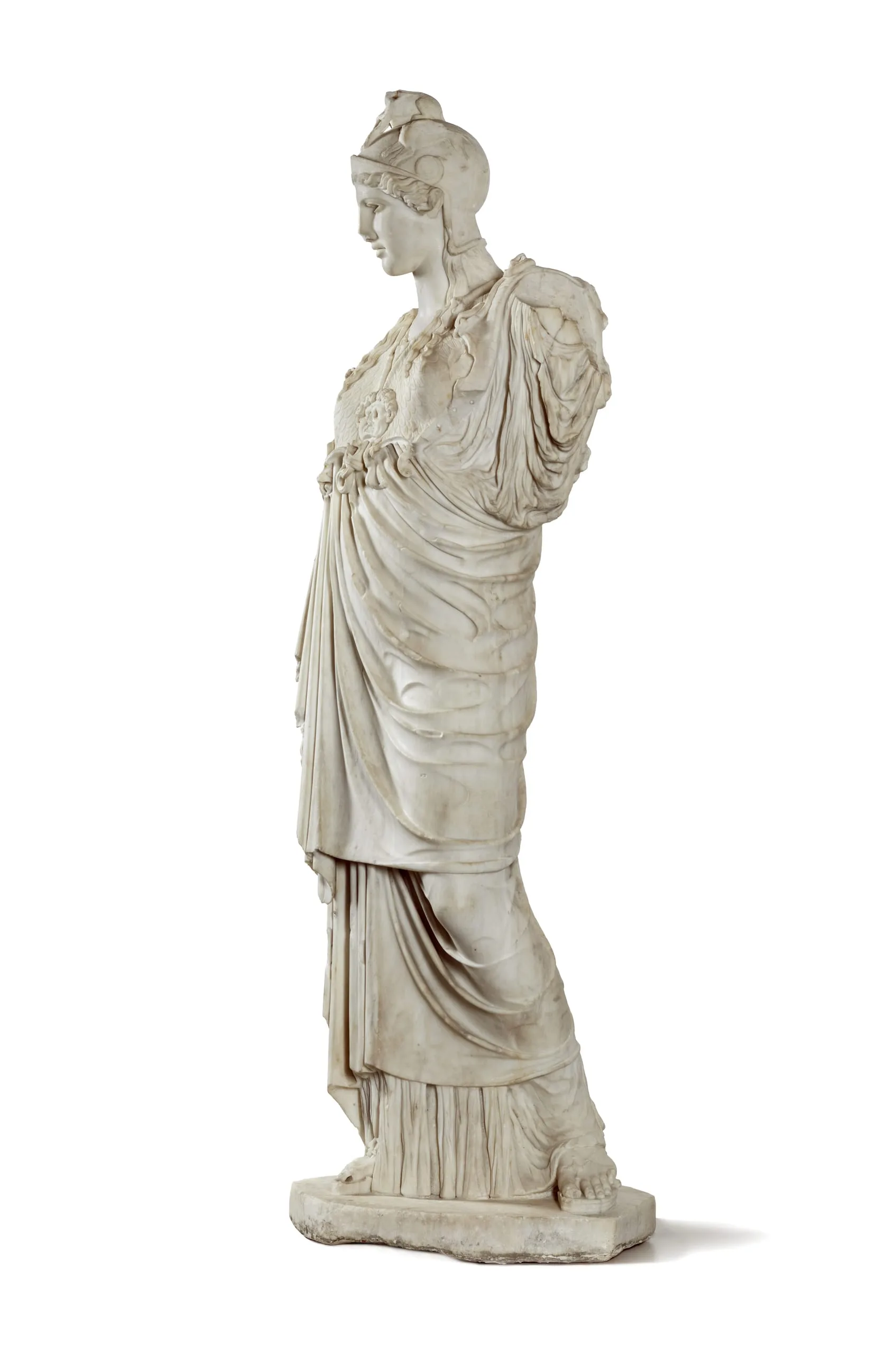
Athena, the Greek goddess of war and wisdom, is immediately identifiable by her protective aegis, a snake-fringed garment on which is fixed the head of the Gorgon Medusa. Her helmet is another distinctive attribute, topped here by a sphinx and griffins. She wears a heavy mantle (himation) over the lighter chiton, which is visible as crinkled drapery around her shoulders and ankles. Gemstones would probably have been inlaid for her eyes, and bronze eyelashes were reportedly found when the statue was excavated in 1797, at Ostia on the mouth of the Tiber. Another sculpture in LACMA's collection, the Hope Hygeia, was found with the Athena here among the ruins of a magnificent palace, buried under the niches in which they had once been placed.
It is remarkable that these two statues still remain together today, over two centuries after their discovery. They were first acquired by Thomas Hope (1769-1831), who displayed them in the Statue Gallery of his London mansion. Later, they were moved to the Hope family's country residence, the Deepdene, near Dorking in Surrey. In the sale of the collection in 1917, the Athena obtained the highest price among the antiquities, and the glowing comments in the auction catalogue attributing it to the celebrated fifth-century Greek sculptor Pheidias testify to the esteem in which it was held. The Athena entered the collection of Viscount Cowdray, only to be sold again in the 1930s, when it was purchased by William Randolph Hearst. Shortly afterwards, Hearst acquired the Hope Hygeia, and later gave both statues to LACMA.
The Athena is a Roman copy of a Greek original. Many Greek statues were made of bronze and no longer survive. Some idea of their appearance can be formed from the Roman marble copies that are preserved. In the case of the Hope Athena, there are a number of similar versions, including another full-length copy in Naples (the Athena Farnese), and it is likely that they derive from a Greek fifth-century original, perhaps by one of Pheidias' followers. Following the statue's discovery, it was heavily restored by Thomas Hope, as was typical practice in the nineteenth century. He added a figure of Nike, the spear and eyes. These were removed after the statue was acquired by LACMA.