Image
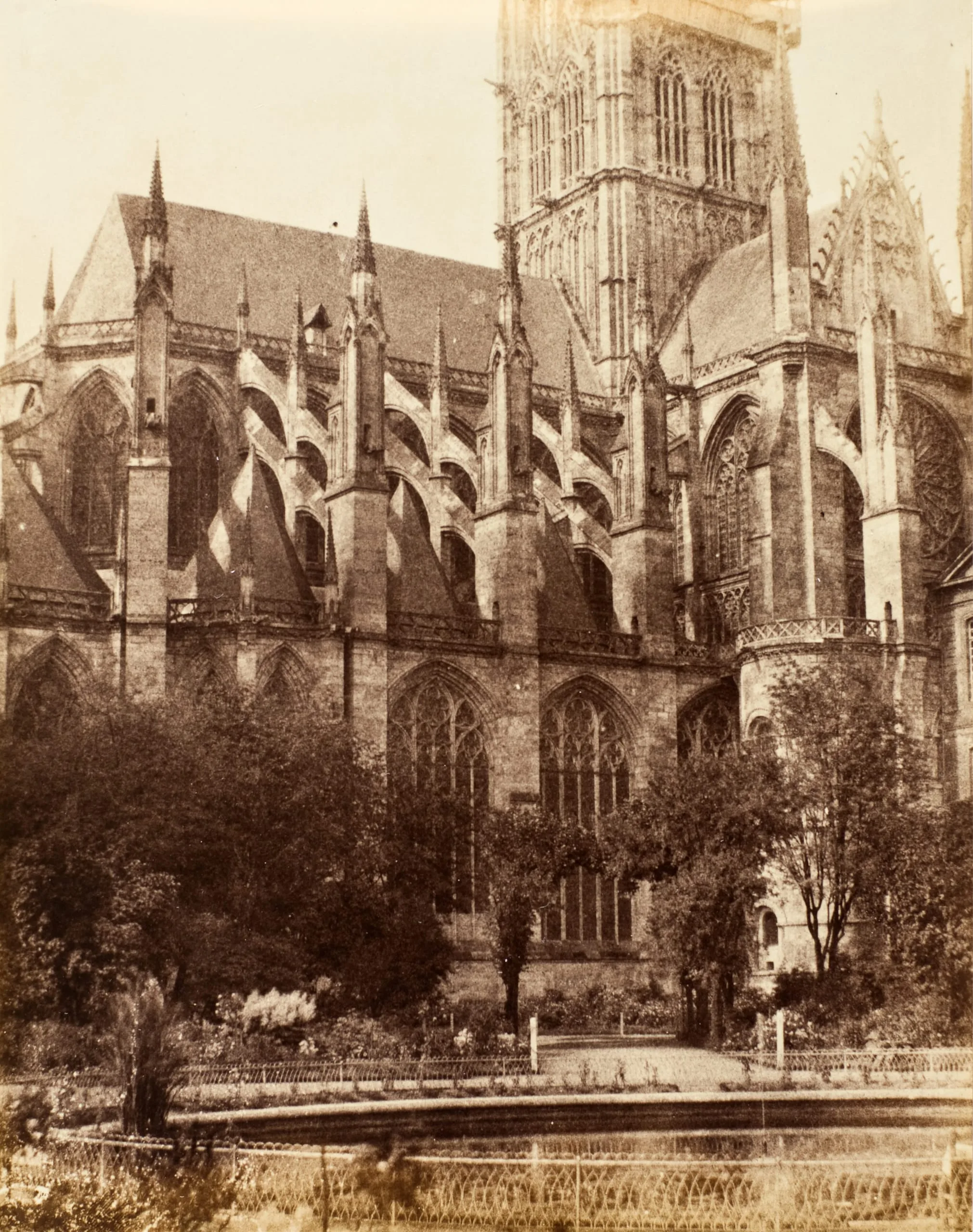
Alfred Capel-Cure approached his subject—the Church of St. Ouen de Rouen in France—with a photographic clarity that captured every detail of the architecture. He framed the church to show the facade as it would be seen from ground level by slicing off the top of the nearest spire. By not including the entire structure, Capel-Cure emphasized the viewer's experience of standing in front of the church.
Technique
Because the silver emulsion was suspended above the paper in a layer of egg white (albumen) instead of embedded in it, the albumen print traded the softness and depth of salt prints for more detail. Calotypists chose albumen over salt prints to achieve maximum clarity in a photograph. Like salt prints, albumen prints were developed by sunlight transmitted through paper negatives. Waxing the negative to reduce the visibility of the fiber in the paper, as Capel-Cure did here, gave the final print more detail as well. Albumen prints would become most popular when used with the new collodion on glass (wet-plate) method, also invented in the 1850s, and would dominate printing methods until the 1880s. (For more on the collodion on glass method, see the Alinari Brothers' Campanile, Pisa.)
Context
In 1850s Britain, the calotype process was popular among wealthy amateur photographers, who had both money and leisure time. These photographers preferred the calotype's softness, range of light and shadow, and flexibility in process and printing over the more commercial collodion method. They were not interested in documenting social conditions or making money by printing and selling thousands of images. Amateur calotypists instead created images of castles, ruined abbeys, and meadows to keep in albums or give to friends and family.
Because these photographers made images for private enjoyment and printed such small numbers, they are mostly unknown today. One such individual, Capel-Cure, focused on architecture and landscapes in England, France, and Gibraltar, creating romantic images of ruined castles and churches that are typical of what travelers might find on their journeys. Capel-Cure is known to have produced an album of 232 photographs during the 1850s of architecture and landscapes in England, Scotland, Wales, and France.