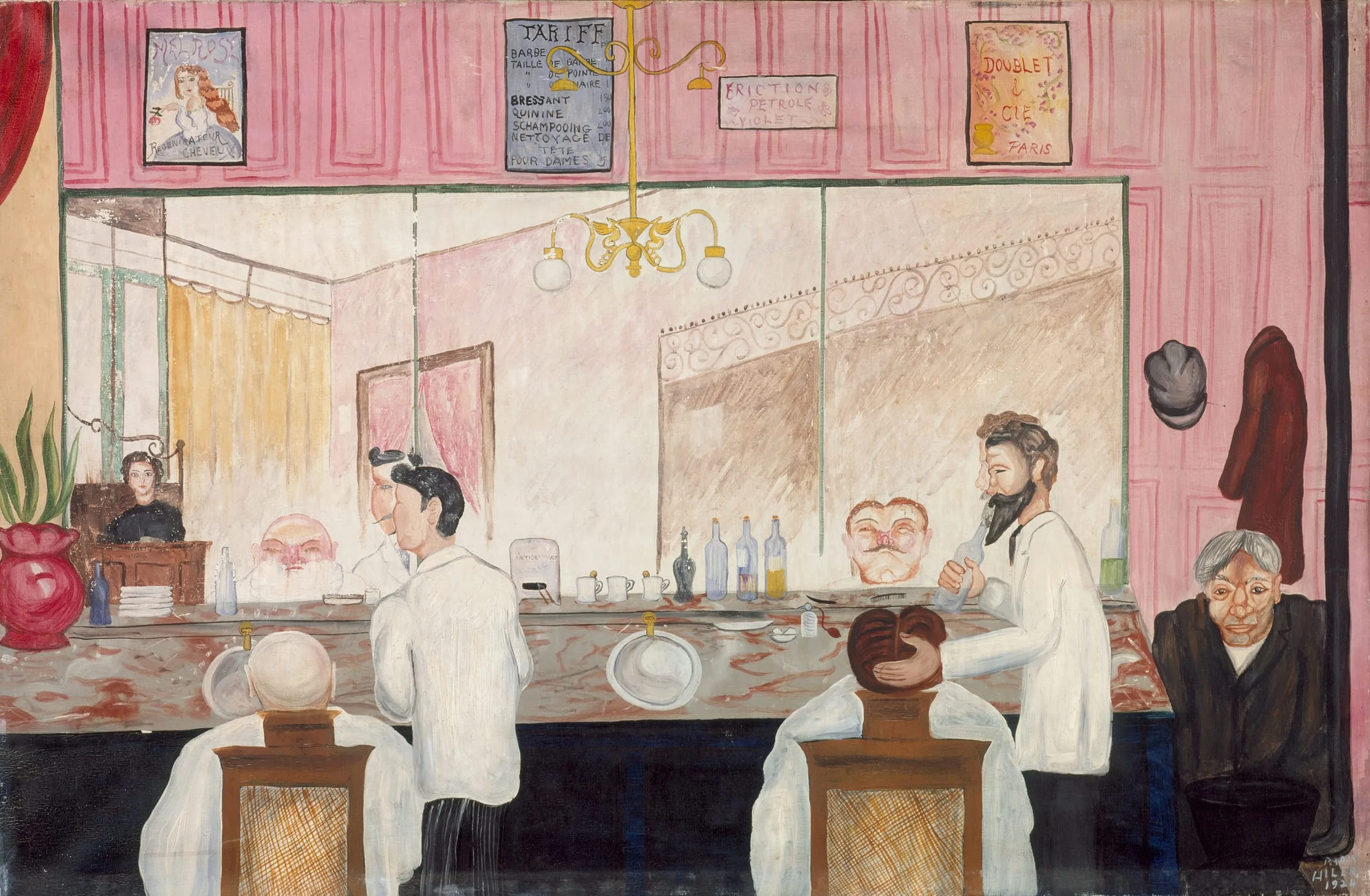
During his first years in Paris Hiler painted charmingly naive vignettes of Parisian city life: the streets, theater, and cafés. He supported himself by playing piano and managing the jockey Club and so became immersed in the artistic and literary life of the Left Bank. Barber Shop differs from many of his early paintings in being an interior scene that does not relate specifically to the artist’s avant-garde life-style. Moreover, the figures are larger than those in earlier paintings by Hiler. His early primitive style is quite apparent in the multiple perspectives, awkward anatomy, lack of modeling, and exaggerated facial expressions. The last named accentuate the humor of the scene as Hiler subtly mocks convention. Critics compared Hiler’s delicate sense of irony with that of Pieter Breughel (1525-1569), but his early scenes were also reminiscent of the great French primitive, Henri Rousseau (1844-1910), whose paintings Hiler was surely introduced to by the Parisian avant-garde.
The interior is compressed so that the major compositional lines of the scene are the horizontals and verticals of the mirror, countertop, posters, and wall decorations. Hiler used a similar handling of figures lined up in a narrow space in his Restaurant dans la rue Torte, 1930 (unlocated). Indeed, this emphasis on geometric, man-made objects reflects the artist’s underlying formalism, an aspect of his art that would become more apparent with his paintings of the late 1920s.