Image
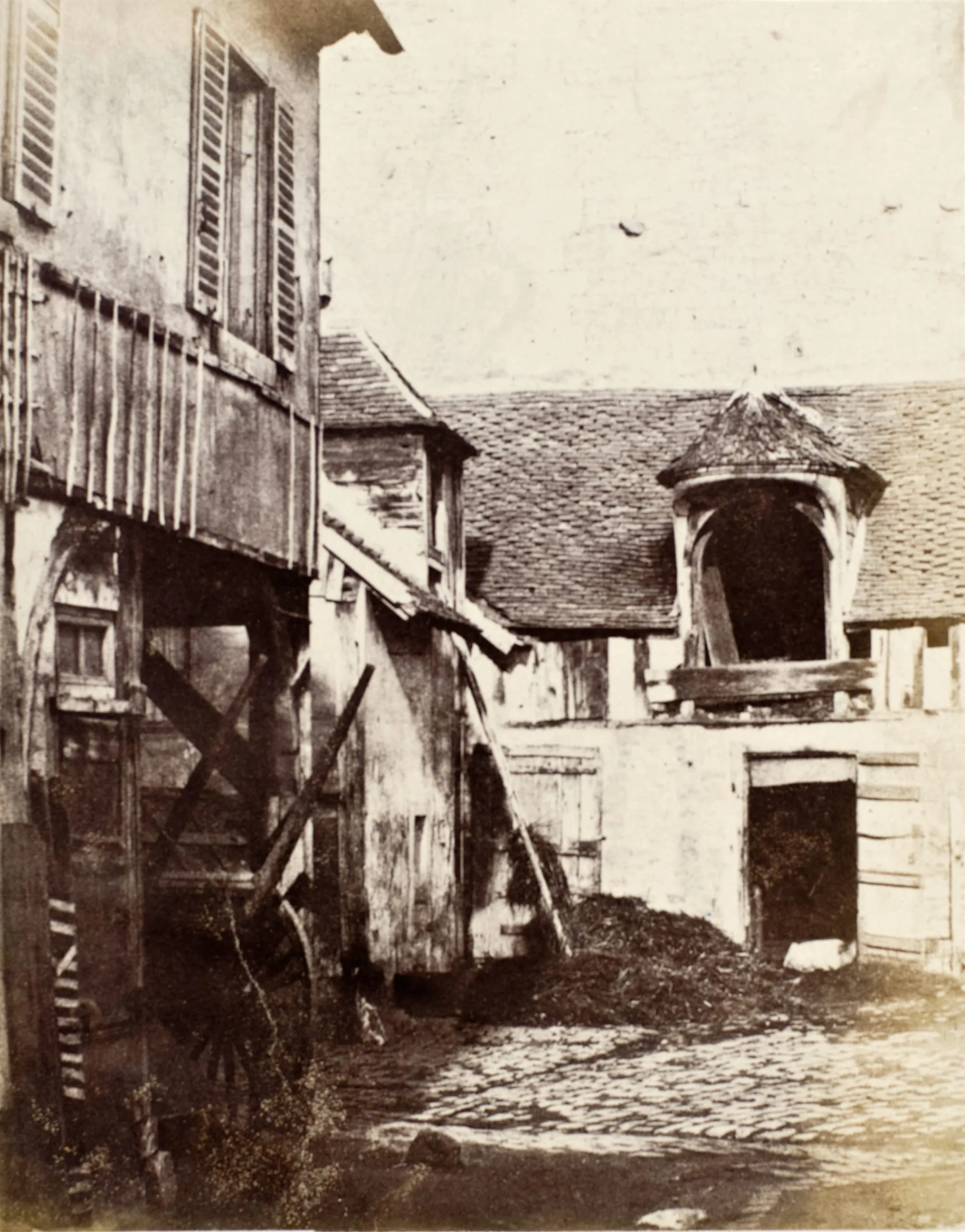
This photograph of a farmyard was published in an album titled Etudes photographiques (Photographic Studies) in 1853. The scene is tightly framed, with the receding line of the building on the left creating a dramatic perspective. All of the characteristics of a salt print are evident. There are visible paper fibers in the emulsion, the image has a sense of softness, and the areas with the most light, such as the sky, lack detail, reminding the viewer of the length of exposure. Contact-printed from a paper negative, the image lacks the clarity that printing from a glass-plate negative would have afforded. Blanquart-Evrard used a strong solution of sodium thiosulfate to fix the image, creating a slate-gray color rather than the brown tone caused by sunlight.
Technique
The two-step replicable negative-positive process of photography known today was patented in 1841 in England by William Henry Fox Talbot (1800—1877). Talbot brushed writing paper with silver salts (to create salted paper) before exposing the paper to light in the camera for seconds or minutes. He then developed it in gallo-nitrate, which brought out the latent image on the paper. He fixed the negative with chemicals and sandwiched it under glass with a sheet of unexposed salted paper, using sunlight to make a positive image, which he then fixed. He began to publicize his invention in 1839 after learning that he had competition in the daguerreotype. (For more on the daguerreotype, see the c. 1850 untitled image of a young boy.) Talbot called his invention the calotype, from the Greek word kalos, meaning beautiful. In salted paper prints, the emulsion, photosensitive chemicals, and binder were embedded in the paper and included visible paper fibers, creating a soft, romantic effect. It was a popular printing technique from 1840 to 1855.
Context
Louis Désiré Blanquart-Evrard was an accomplished French calotypist who made significant innovations. In 1847, he started soaking the paper in the emulsion instead of brushing it on, which gave a more uniform and dense effect. His process also made the paper more sensitive, obliterated streaking, and increased the tonality. In addition, he invented a method that reduced the developing time to six seconds in the sunlight, with the latent image being drawn out by chemicals.
In September 1851, Blanquart-Evrard opened the Imprimerie Photographique, a printing business that published albums of photographs. At its height, the company produced five thousand photographic prints a day. The business used an assembly-line format, and up to forty people were employed in specialized tasks in the printing and publishing process. Blanquart-Evrard is probably most famous for inventing the albumen print, which would supersede the salt print and dominate until the 1880s. (For more on albumen prints, see Alfred Capel-Cure's St. Ouen, Rouen.)