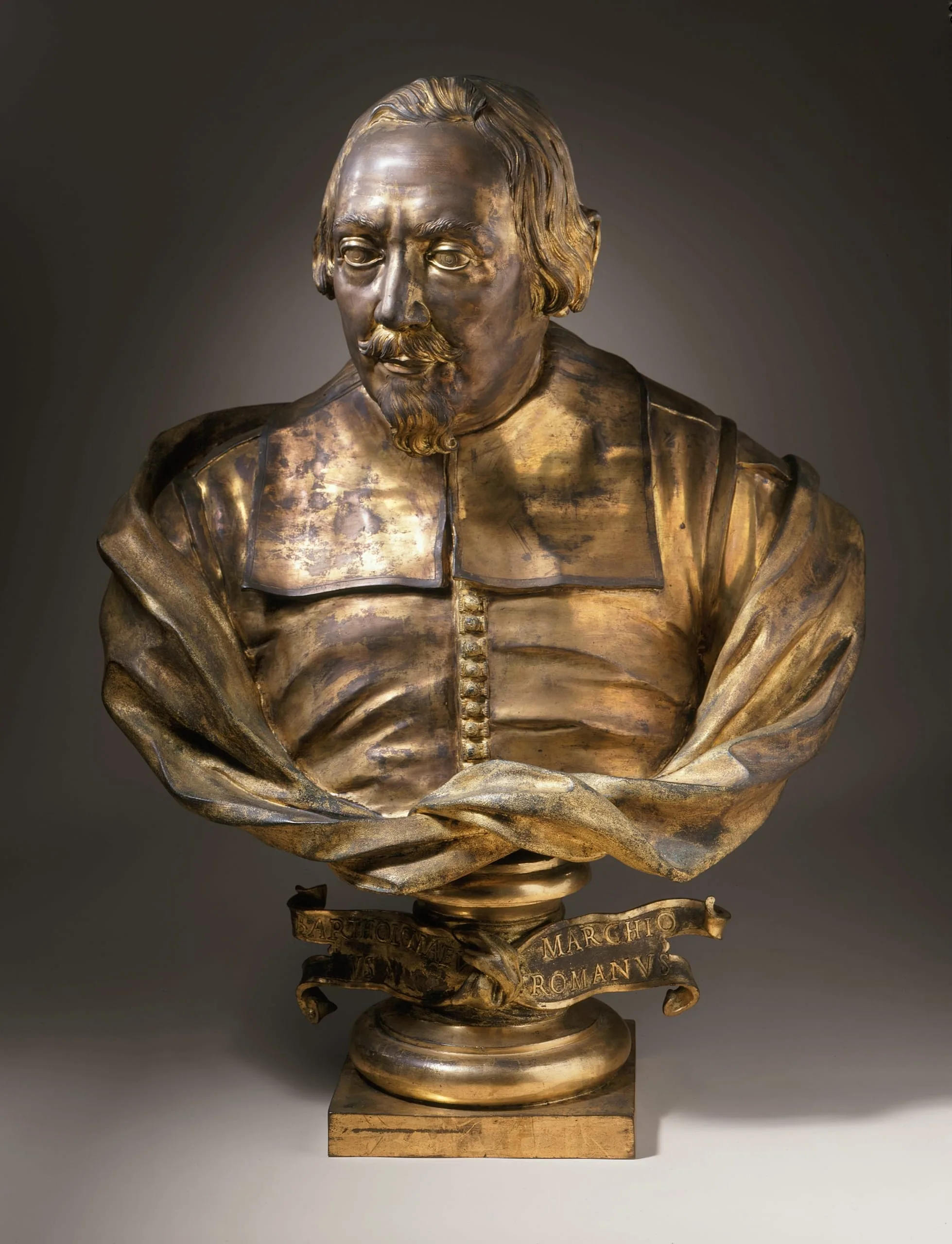
This gilt bronze bust portrays the Roman marchese Bartolomeo Ruspoli (1596−1681), head of one of Rome’s leading aristocratic families, with a composed and authoritative demeanor. His hair, mustache, and pizzetto (goatee) are neatly combed, his shirt is buttoned, and a simple drapery falls off his shoulders. Previously attributed to a number of different sculptors, including Pietro Paolo Naldini (1632–1713) and Gian Lorenzo Bernini (1598−1680), documents published by Maria Celeste Cola in The Burlington Magazine in 2011 demonstrate it to be the work of Filippo Carcani (active 1657−85). Produced just after Ruspoli’s death in 1681, the bust was originally displayed on a pedestal in the family palace at the foot of the Campidoglio, the civic and ceremonial center in the heart of Rome.
Born in Rome, Bartolomeo Ruspoli managed the family’s affairs and firmly established the Ruspoli among the city’s leading dynastic families. Of Florentine origin, the family gradually relinquished their Tuscan holdings, and by 1662—following the sale of their Florentine estates and renunciation of Florentine citizenship—they were formally recognized as citizens of Rome. Bartolomeo acquired prominent residences there, consolidating the family’s position. Following Bartolomeo’s death, his nephew Francesco inherited the estate, and the funeral prompted the commission of the sculpture bust. Archival evidence indicates that Carcani based the bust on a funeral mask and several painted likenesses of Ruspoli that were already in the family collection. The sculpture was cast in bronze by Girolamo Lucenti (c. 1620–1692), a smelter, sculptor, and engraver to the papal household; gilded by the swordsmith Antonio Benci; and mounted on a wood pedestal (now lost) carved by the woodworker Filippo Passarini.
Filippo Carcani, known as “Filippone,” was active in Rome during the latter half of the seventeenth century, though his precise birth and death dates remain unknown. He trained initially under the painter Fabio Cristofori before joining the workshop of Ercole Ferrata (1610–1686) at the age of fifteen, where he contributed to both stucco and marble projects. His notable commissions included figures for the Falconieri monument in San Giovanni dei Fiorentini, statues for the main altar of San Marcello, and the “Primavera” for a fountain in the gardens of Palazzo Borghese, and he collaborated with Bernini in the design and production of the monument to Pope Alexander VII in Saint Peter’s Basilica.