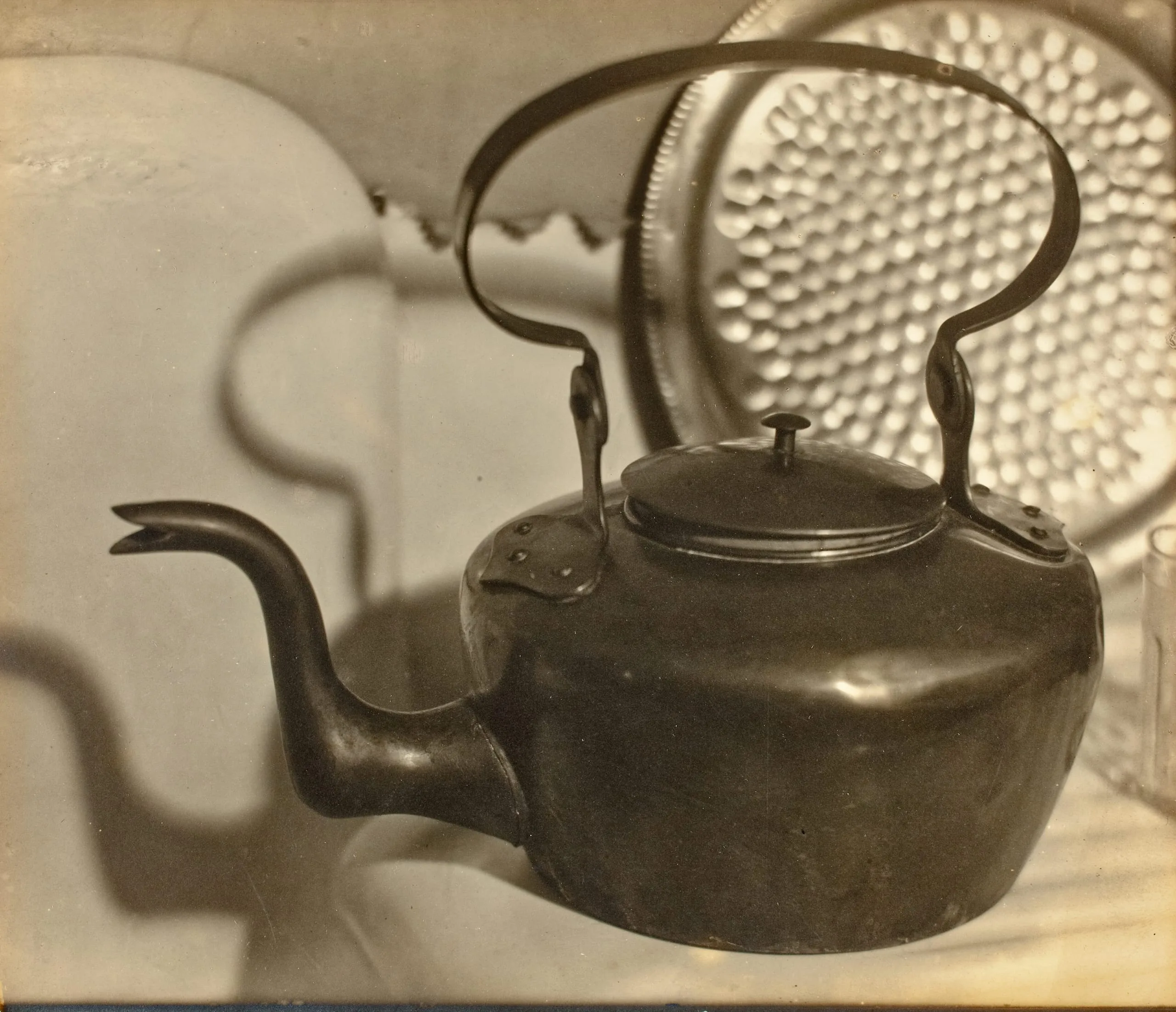
Born in Hamilton, Ontario, Margaret Watkins rejected bourgeois domestic life and moved to New York City in 1915. There she joined the vibrant community of artist-photographers Alice Broughton, Gertrude Käsebier, Alfred Stieglitz, and Clarence White. White, an influential instructor with whom Watkins studied, translated the principles of painting into the making of photographs, emphasizing the two-dimensional character of both mediums. Watkins absorbed the printmaking methods of Pictorialism alongside the compositional rigor of Cubism. In her modest Greenwich Village garden apartment, she devised a new visual language to represent domestic objects. Using modernist, Cubist strategies, she brought photography “into the kitchen,” to use Vanity Fair’s title for a one-page, four-picture grouping of her work (October 1921), which included The Teakettle.
During this period, Watkins worked at White’s school and built an impressive résumé of exhibitions and publications. This was the moment when photography was beginning to overtake illustration in advertising imagery, and Watkins’s work caught the attention of art directors. She enjoyed success in this field until 1928, when she left New York and embarked on the European chapter of her life.
Britt Salvesen
2024
Bibliography
“Photography Comes into the Kitchen: A Group of Photographs by Margaret Watkins Showing Modernist, or Cubist, Patterns in Composition.” Vanity Fair (October 1921):