Image
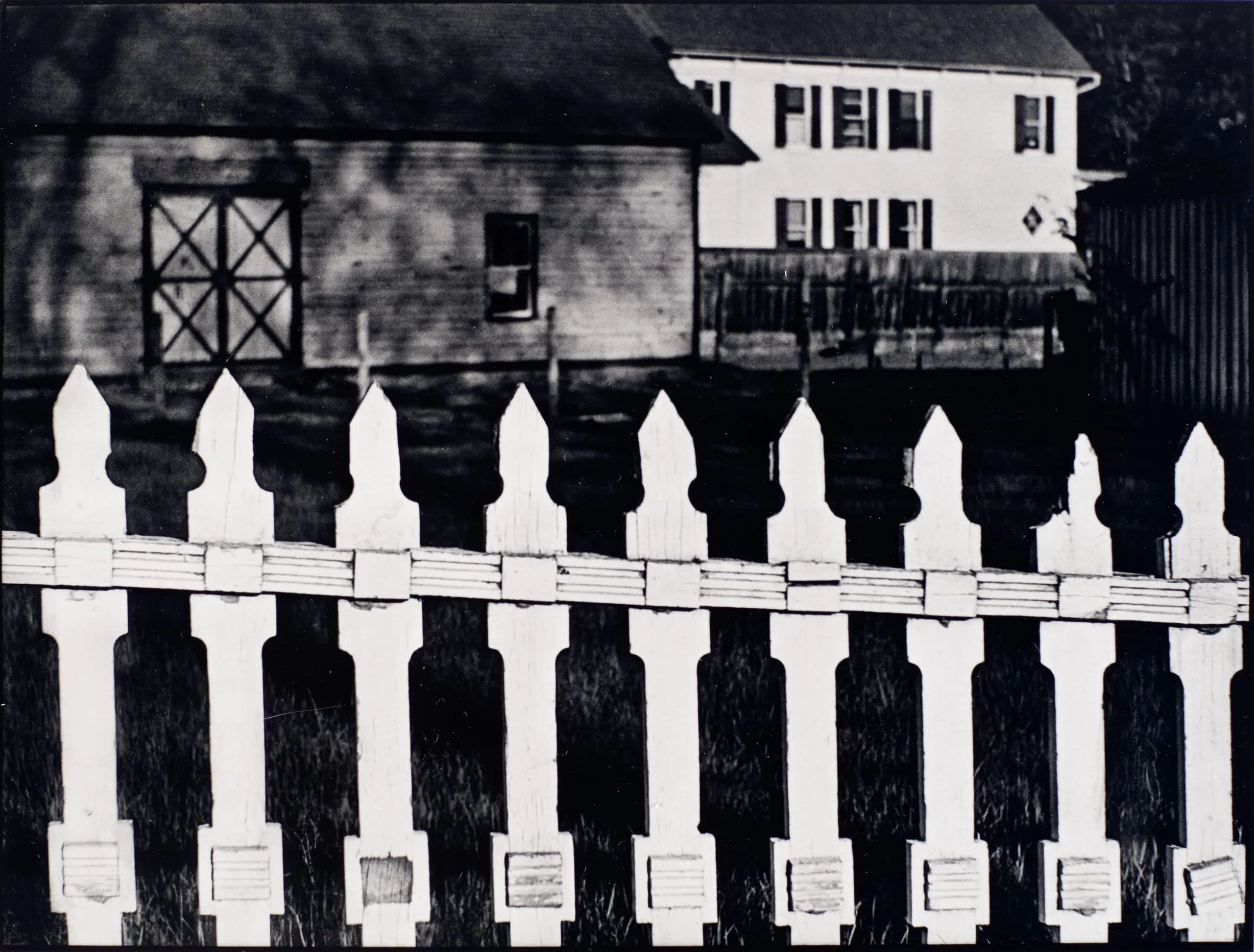
Paul Strand has framed the blindingly white fence in the foreground against a dark ground of buildings farther back. The fence is sharply in focus while the buildings are softer, singling out the fence as the most important element of the photograph. The focus on an ordinary, weathered fence and its graphic depiction from a low vantage point signaled a move away from the literary themes and painterly composition of the pictorialist movement. Strand described it as "the basis for all the work"7 that followed:
Why did I photograph that white fence up in Port Kent, New York, in 1916? Because the fence itself was fascinating to me. It was very much alive, very American, very much a part of the country....8
Technique
Paul Strand used a hand-held camera, which allowed him to access perspectives that would have been difficult with the bulkier view camera. The American Graflex and the British Soho Reflex, introduced in 1903 and 1906 respectively, were the standard hand cameras until the 1920s. Strand enlarged his negatives when printing, using gelatin silver for its sharpness and tonal range, rather than the handmade bromoil and gum prints of his earlier pictorialist days. He did not believe that enlarging the negative, rather than contact-printing, was in conflict with the newly emerging style of direct representation, called "straight photography." (For more on gelatin silver paper, see Untitled [Group].)
Context
Paul Strand is often cited as the originator of a new approach in photography in which the world was directly represented, without any manipulation. This celebrated purity was seen as both inherently photographic and artistic.
Strand captured what he saw in front of him, framing it in such a way that it was still clearly the product of a personal vision, either in the perspective or the dramatic contrast in tone. Strand studied photography under Lewis Hine at the Ethical Culture School in New York. He was also encouraged by Alfred Stieglitz, who gave him a solo show at Gallery 291 and highlighted his photographs in Camera Work in 1916. In 1917, Strand had the entire final issue of Camera Work dedicated to his work, of which Stieglitz wrote that it was "brutally direct, pure, and devoid of trickery."