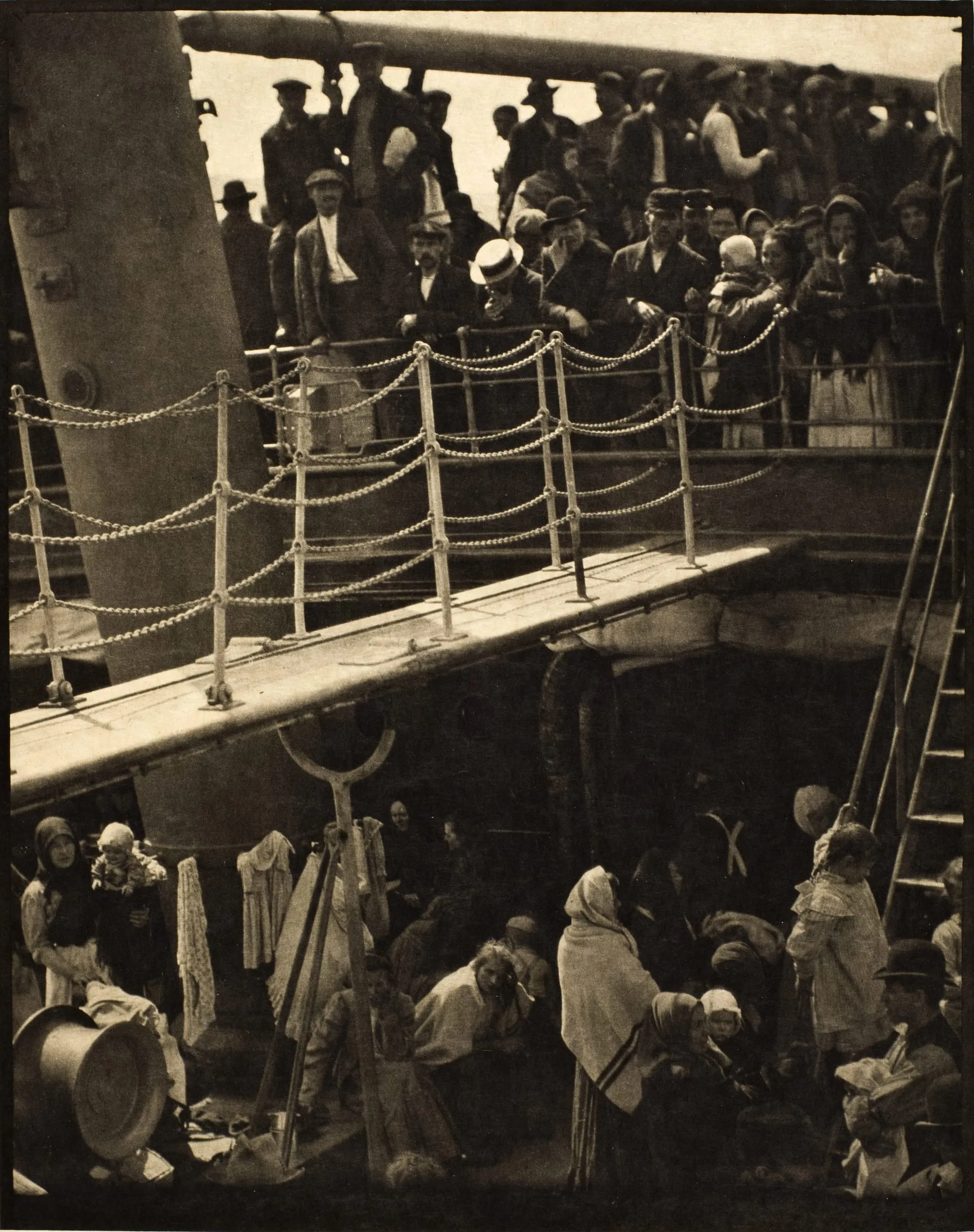
Late in his life, Alfred Stieglitz confessed that “if all my photographs were lost and I’d be represented by just one, The Steerage, I’d be satisfied.” The Steerage is perhaps the most iconic turn-of-the-century American photograph, heralding the assimilation of modernism within fine-art photography. Taken during Stieglitz’s trip to Europe in June 1907 aboard the S.S. Kaiser Wilhelm II, the photograph is a view of looking down, quite literally, on the ship’s lower-class passengers. The sixty people crammed into two levels of steerage almost meld into the vessel’s infrastructure of stairway, funnel, mast beam, iron machinery, and a plank with chain railings that bisects the image. The strong counterpoint of natural oceanic light and cavernous shadow exemplifies Stieglitz’s aesthetic ambitions for photography.
In his telling, the scene presented itself to him as a collection of shapes and textures. Irritated by the luxury of the upper promenade, he wandered down to steerage and experienced an epiphany: “I stood spellbound for a while . . . I saw a picture of shapes and underlying that, the feeling I had about life. . . . the common people, the feeling of ship and ocean and sky and the feeling of release that I was away from the mob called the rich,—Rembrandt came into my mind and I wondered would he have felt as I was feeling.”
The subject of The Steerage is migration, yet Stieglitz’s approach places aesthetics above didacticism. It is often described as an archetypal image of the European masses who sailed, in often hazardous conditions, to destinations such as Ellis Island. In fact, the ship was traveling from New York to Europe, and the passengers in steerage likely fell into two categories: the infirm or disabled who had been turned away by immigration officials, and craftspeople whose working visas had expired and were returning to professions on the European continent. Although not devoid of an ethical or social message, The Steerage is firmly modernist in its formal opacity, as the ship is discernible only as fragmentary, abstracted metal forms, while the most distinct characteristics of the passengers are their shadows and often indirect gaze.
2024