- Title
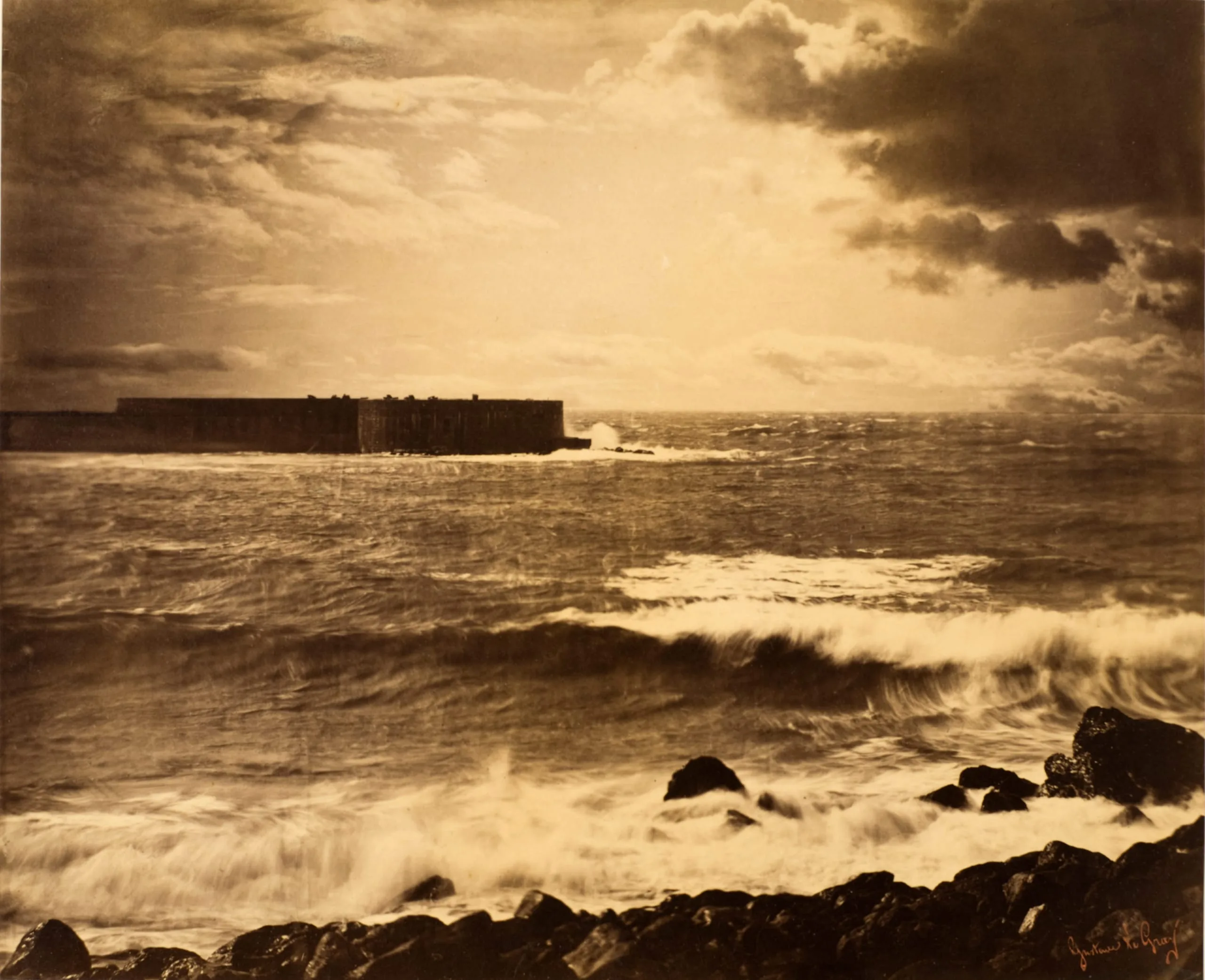
- The Great Wave, Sète
- Date Made
- 1857
- Medium
- Albumen silver print
- Dimensions
- Image: 13 3/8 × 16 7/16 in. (34 × 41.8 cm)
Primary support: 13 3/8 × 16 7/16 in. (34 × 41.8 cm)
Secondary support: 20 15/16 × 26 15/16 in. (53.2 × 68.5 cm)
Mat: 24 × 28 in. (60.96 × 71.12 cm)
- Accession Number
- M.2008.40.1284
- Curatorial Notes
Gustave Le Gray studied painting before taking up photography in the late 1840s, shortly after its invention. A master technician, he was influential as both a teacher and an artist, and much of his renown was based on the seascapes he began producing and exhibiting in 1855. At the time, photographic emulsions were not equally sensitive to all colors of the spectrum, and it was therefore impossible to record both landscape and sky in a single negative. Le Gray solved this problem by making two exposures and printing them on a single sheet of paper. Critics—unaware of Le Gray’s dexterous combination printing method—were captivated by The Great Wave’s impression of instantaneity. With the new and still limited medium of photography, Le Gray had achieved an effect also sought by contemporaneous Realist painters such as Gustave Courbet.
Britt Salvesen
2024
- Selected Bibliography
- Salvesen, Britt. See the Light: Photography, Perception, Cognition: the Marjorie and Leonard Vernon Collection. Los Angeles: Los Angeles County Museum of Art; New York: DelMonico Books/Prestel, 2013.