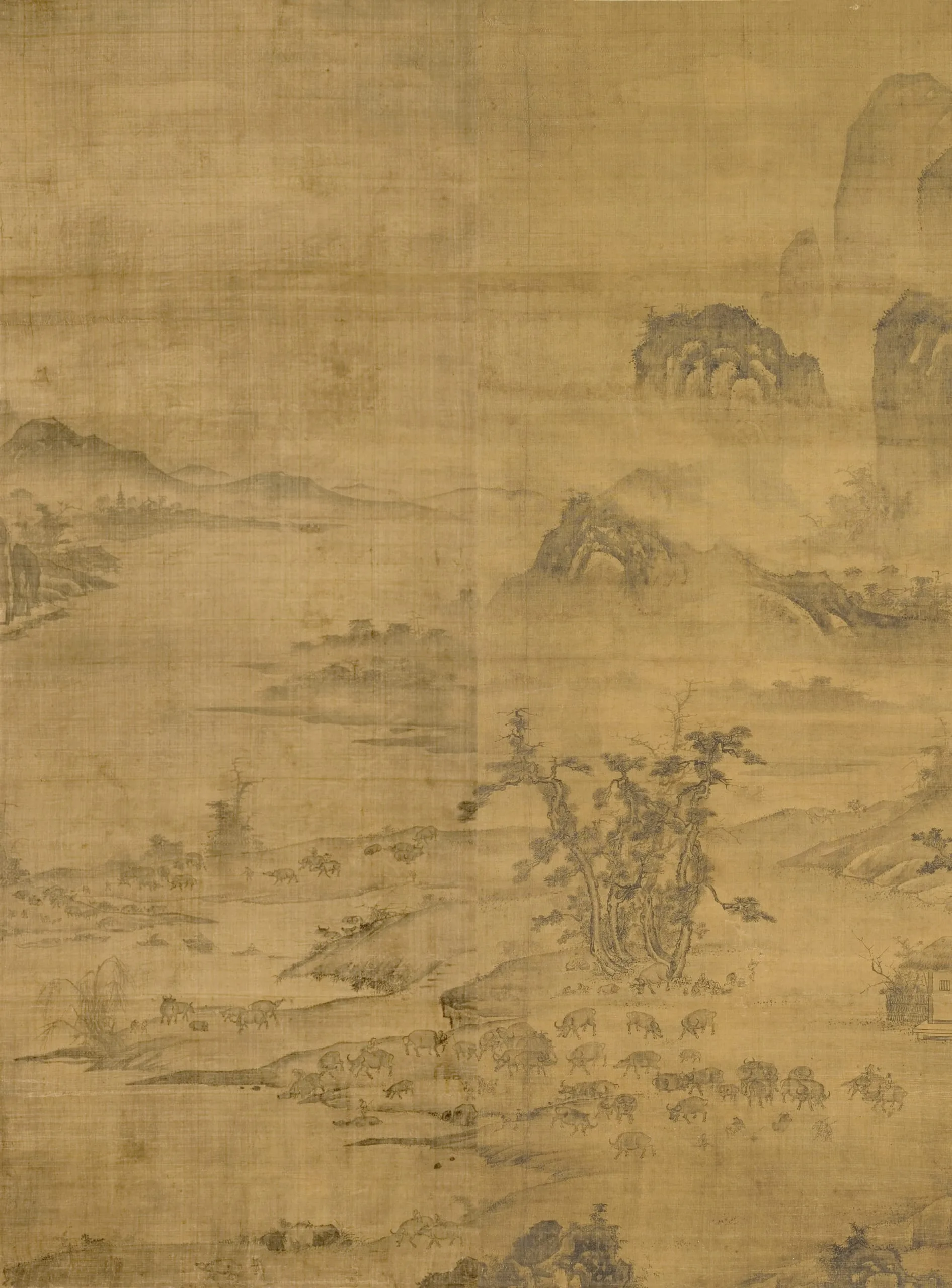
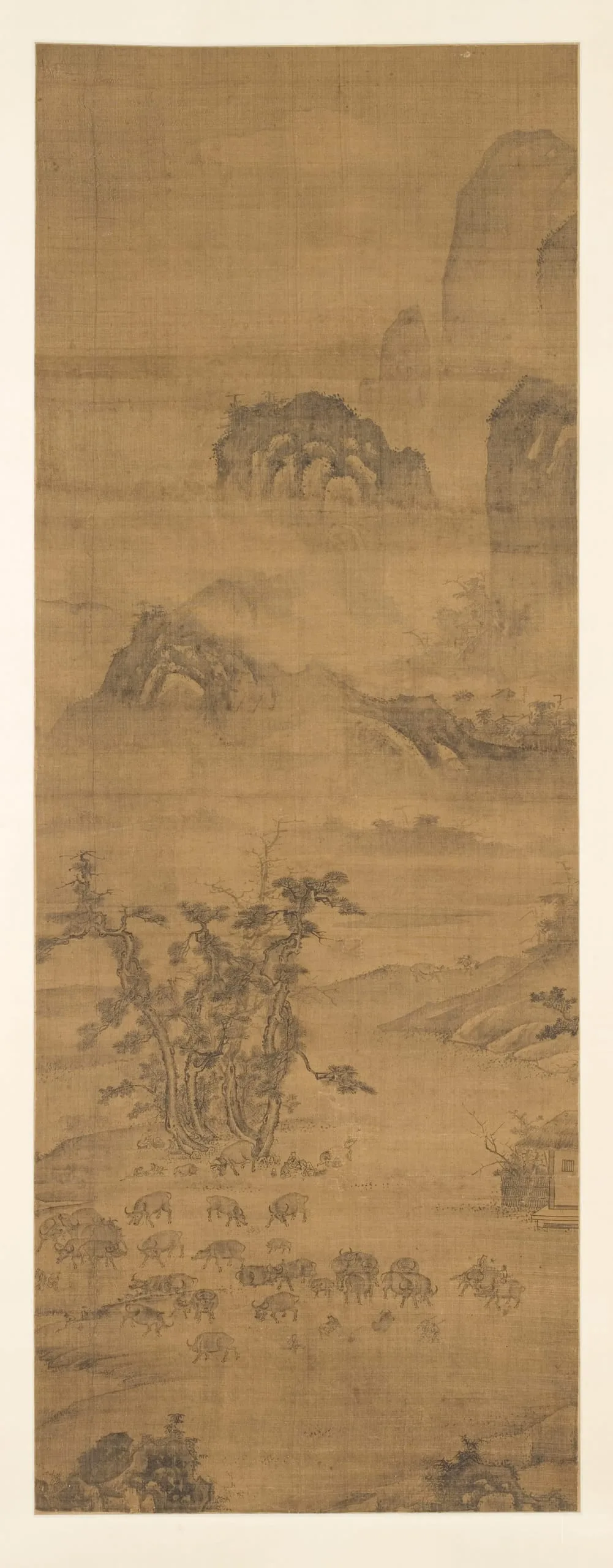
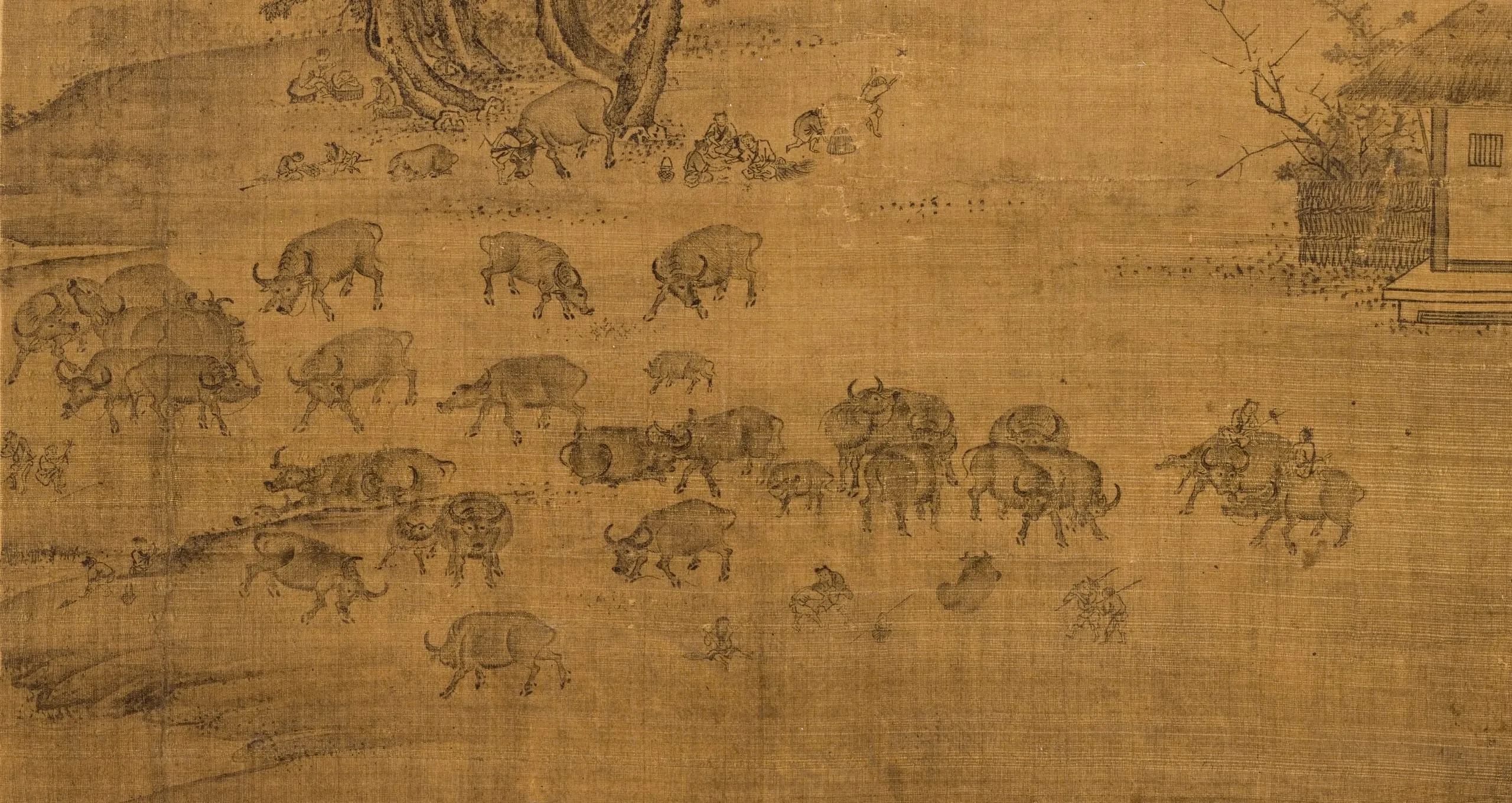
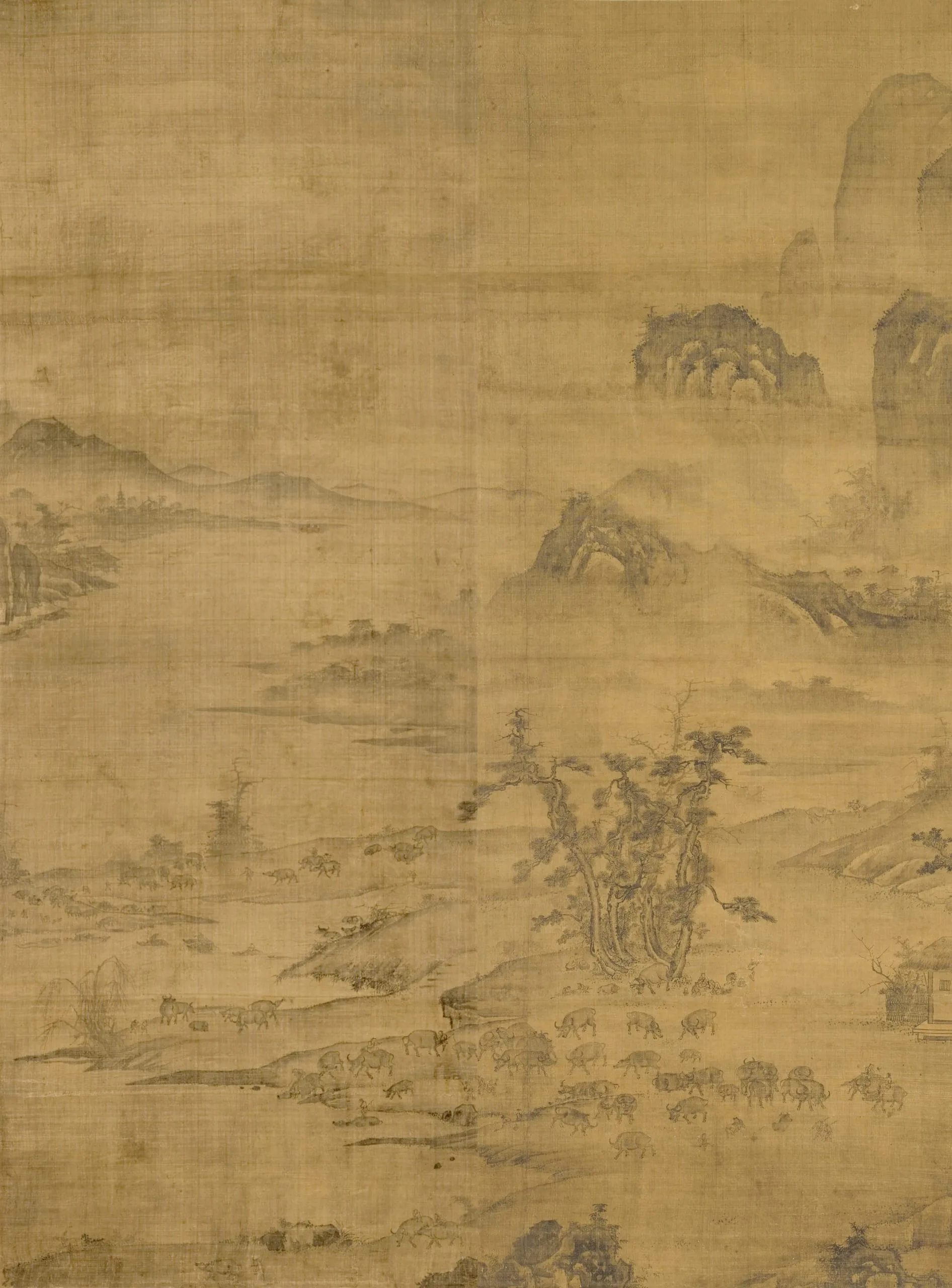
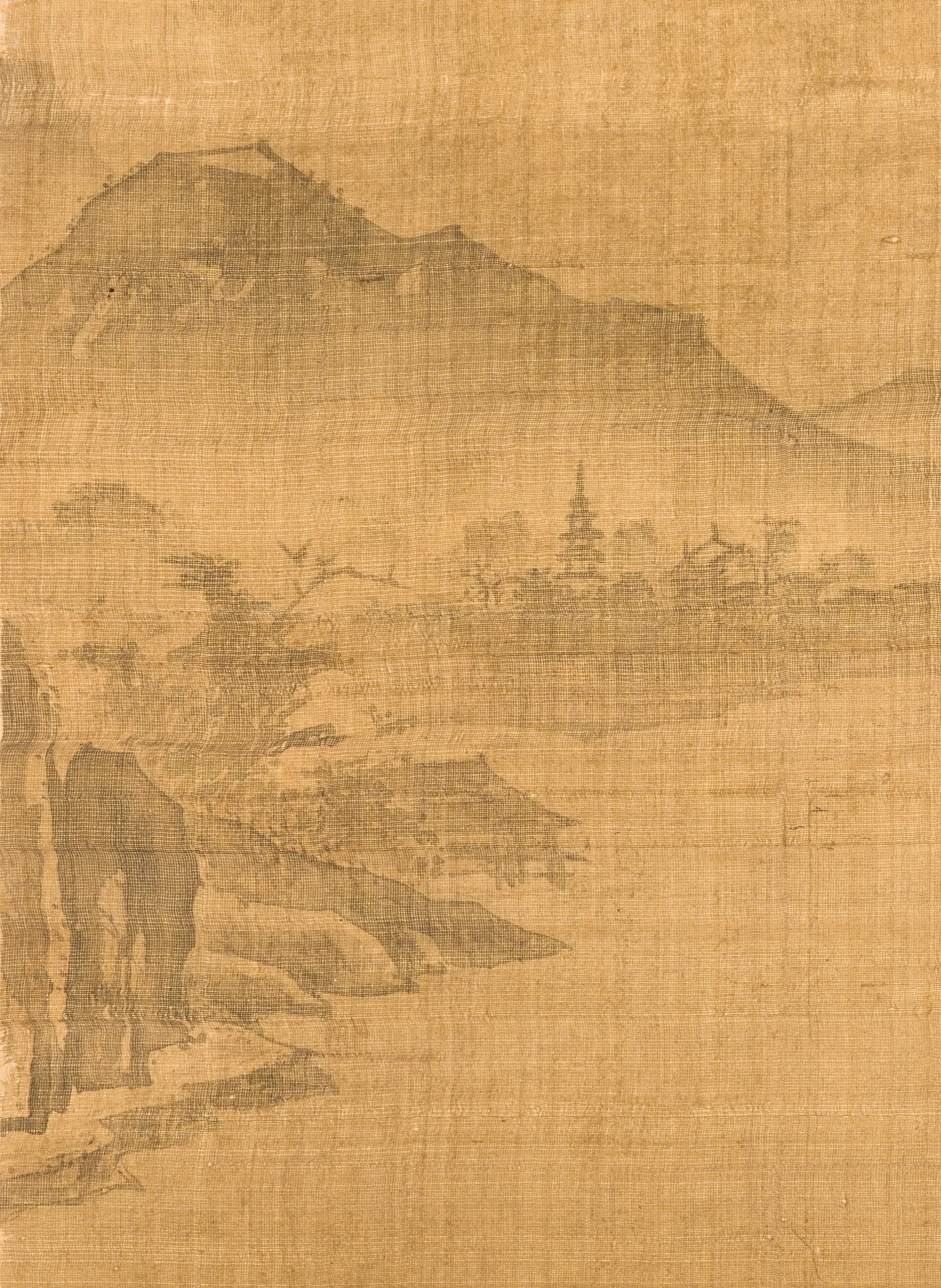
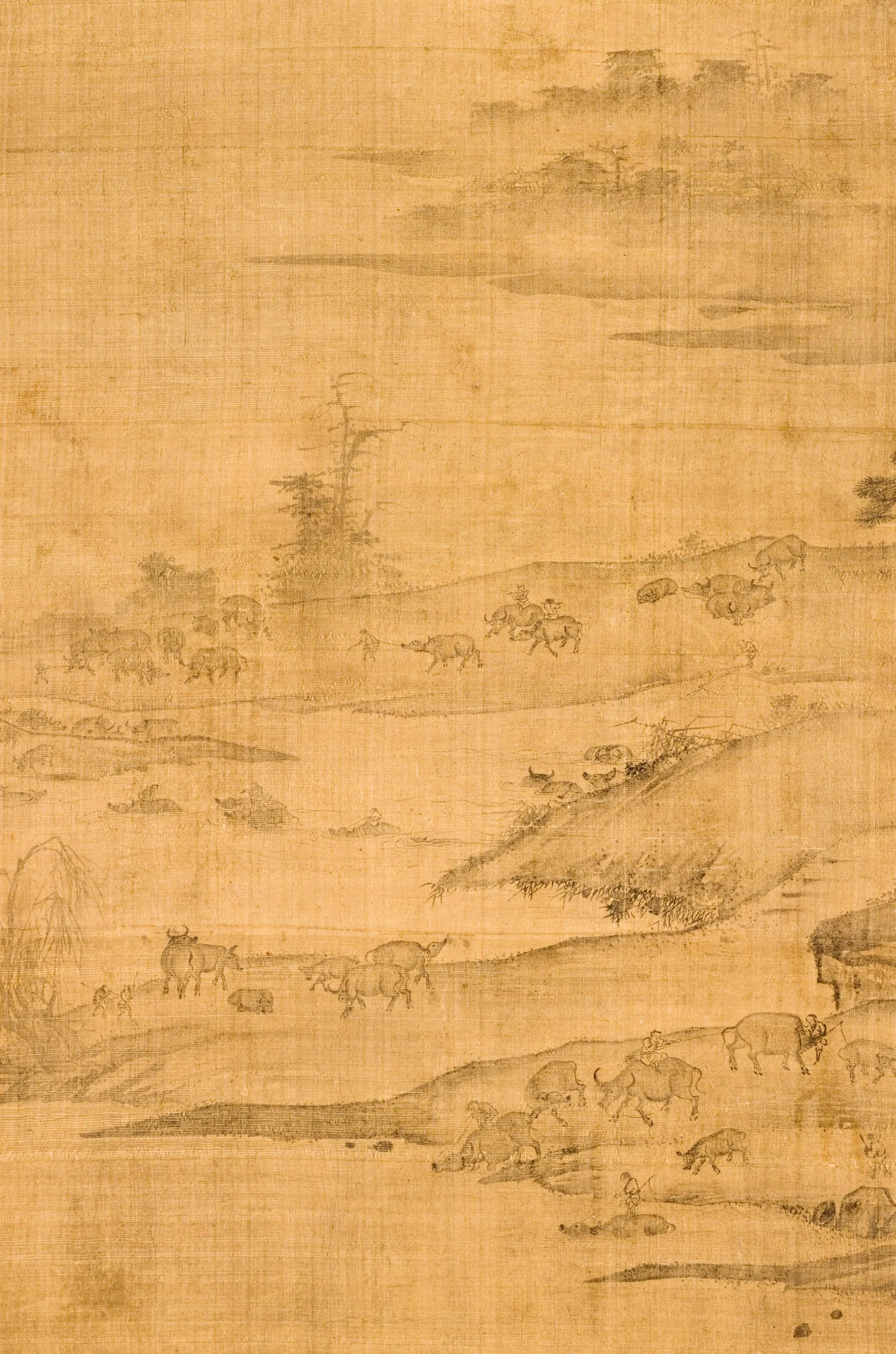
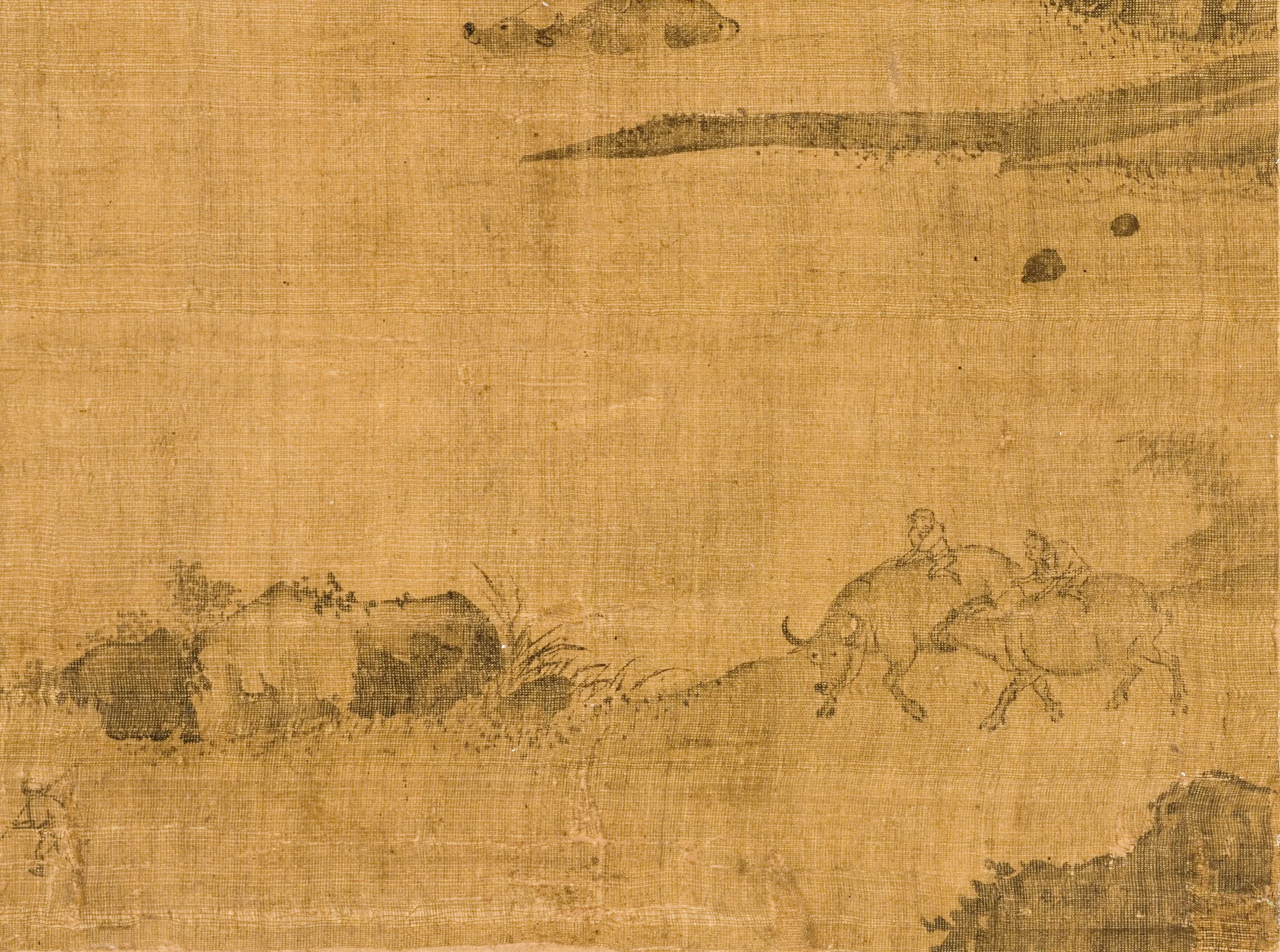
These two scrolls – which were originally from a single painting – have an interesting story because each was acquired by LACMA at a different time. The museum purchased the right half of the painting (det. 1) in 2000 from a local collector, and – after learning of the existence of the additional section – the museum purchased the left half from a Japanese dealer in 2005 (det. 2).[1]
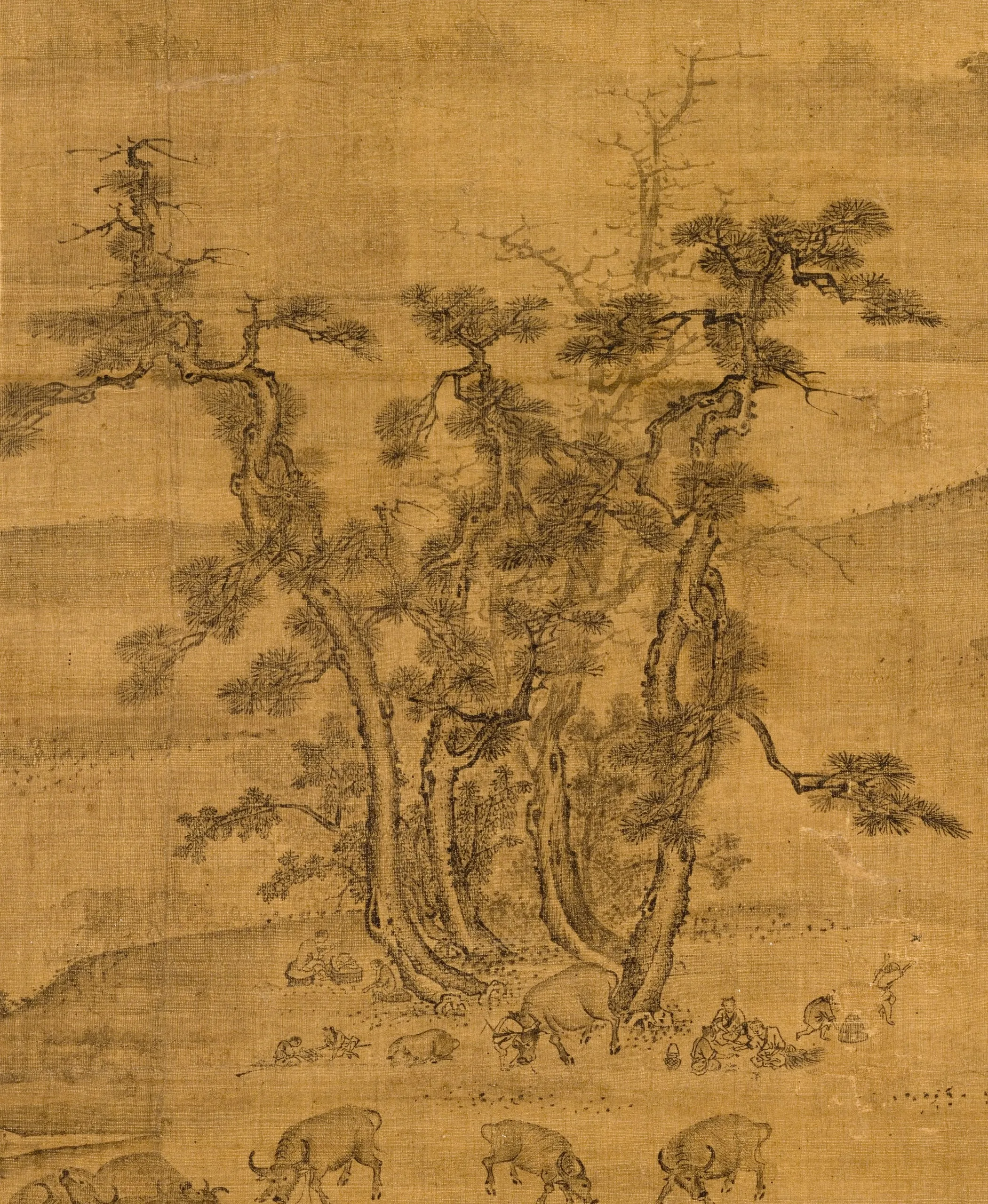
When viewed together (det. 3), these bucolic scenes feature almost one hundred water buffaloes and forty-six herd boys.[2] Some youths play flutes while they ride on the backs of water buffaloes; others neglect their duties and play games; still others busily try to herd the animals using their whips (det. 4-6). Some of the buffaloes are bathing, while others are idle or rest beneath the pines. Despite all the activity, the boys and animals are at ease in a peaceful and lush river valley surrounded by a majestic mountain landscape.
Water buffaloes are not indigenous to Korea and China. In China, the subject began to appear during the Tang dynasty (618-906); by the Southern Song dynasty (1127-1279), water buffaloes with herdsmen had become an enormously popular subject, in part because of a connection with Seon (Chan) Buddhism.[3] In Korea, the subject was often treated individually, and it was mastered by two early Joseon dynasty artists. A water buffalo painted by Kim Si (1524-1593) is especially distinctive because it shows the animal’s backside as it turns away from the viewer (fig. 1). In another example, Kim Sik (1579-1662), Kim Si’s grandson, produced a very amusing scene of a mother buffalo with her calves (fig. 2). Although both painters had an unconventional approach, they each captured the animals in peaceful and rustic scenes. During later centuries, the subject of water buffalo continued to be popular among many artists; however, the depiction of water buffaloes on the grand scale seen in the LACMA paintings is uncommon.
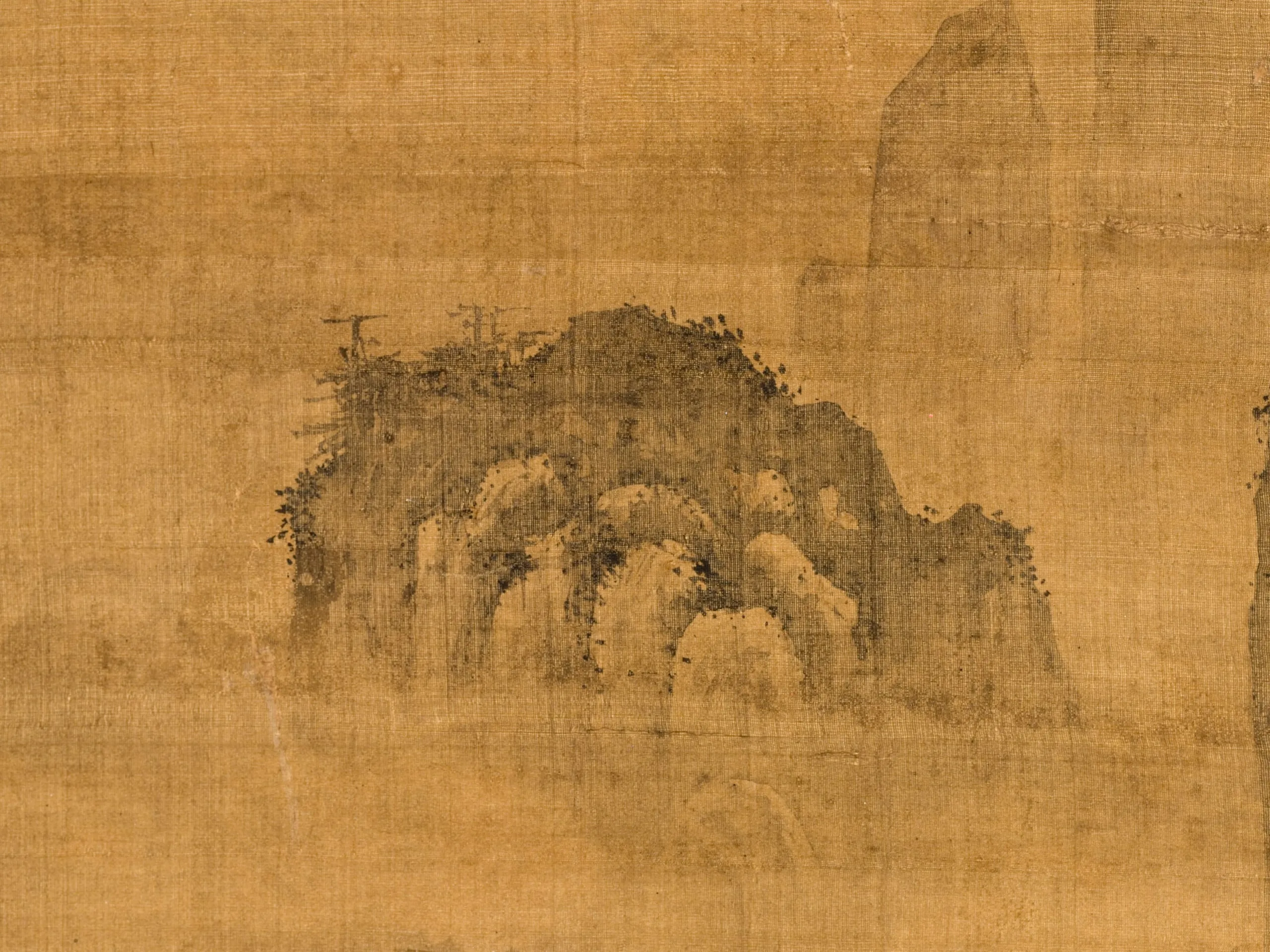
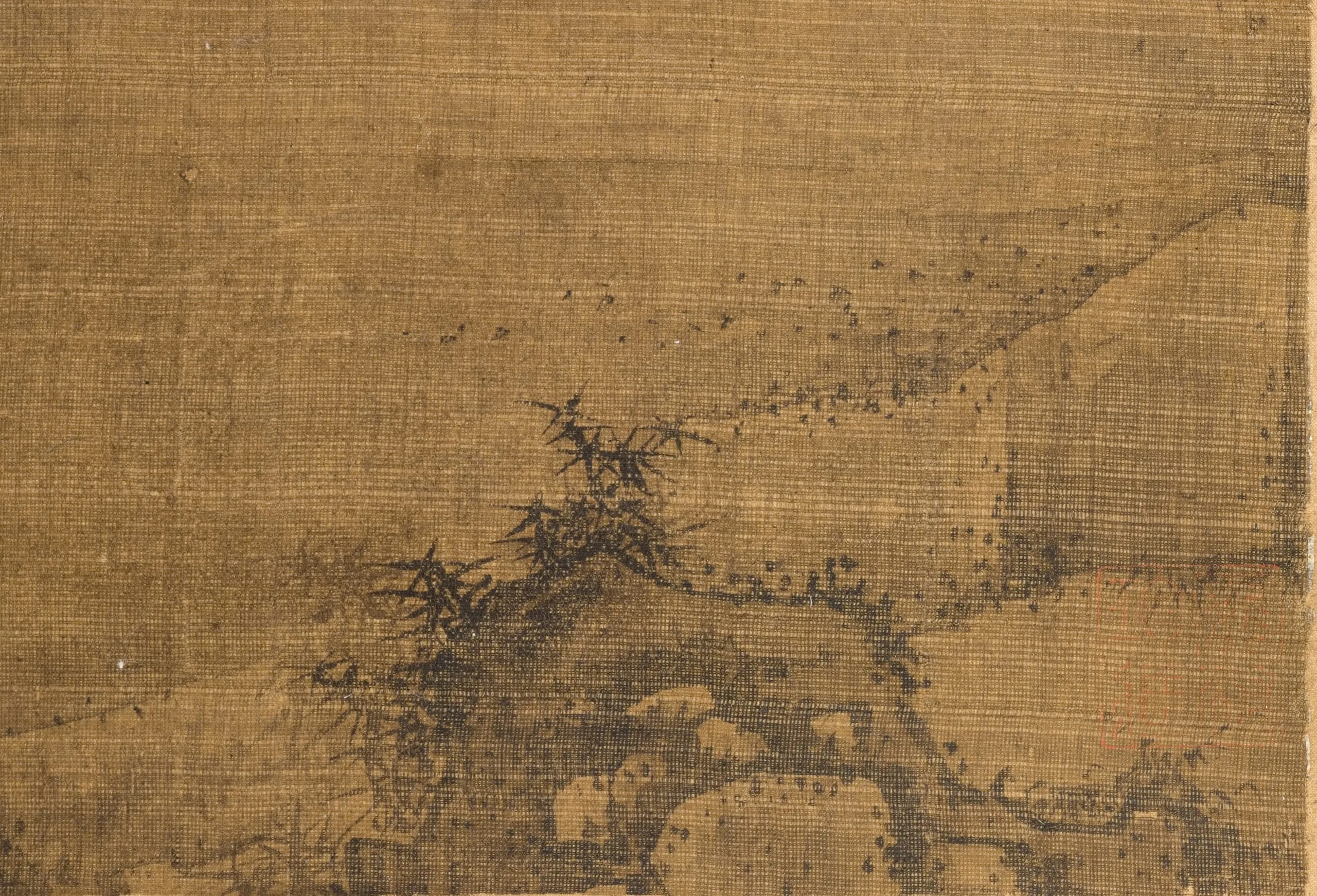
The landscape style in LACMA’s paintings is closely related to the style of An Gyon (active fifteenth century) and An’s follower, Yi Jing (born 1581), who was active in the seventeenth century. In particular, the treatment of mountains on the right half (det. 7) is very close to Yi Jing’s painting of Hwagaehyun (fig. 3). The pine trees in the lower foreground are depicted in fine detail (det. 8), and the style here can be compared with the trees in the anonymous painting Eight Views of the Xiao and Xiang Rivers (fig. 4), long considered typical of sixteenth-century style. Stylistically, LACMA’s paintings clearly display early Joseon painting elements and can be dated to this period.
The scenes in the two paintings connect naturally. However, elements of the composition suggest that additional portions may still be missing. The thatched hut in the lower right corner of the right half of the painting is cut through the middle (det. 4), a visual effect unknown in any complete landscape paintings. The vast mountains in the distance appear interrupted. Also, the two paintings together are too wide to fit the conventions of a typical Korean hanging scroll. Assuming there are additional missing sections, further research is required to determine the original format of the painting. Nonetheless, these rare, early paintings are valuable examples of the early Joseon style and this unique subject matter.
Footnotes
[1] Whether or not to unite the paintings is a complex decision still under discussion. Current opinion at the museum is to wait until more information is available. There are many missing threads where they join and the current mounts are stable. Another important factor influencing this decision is that the original format of the paintings is still not clear.
[2] Jenny Lee, a graduate student at UCLA, wrote a seminar paper on these two paintings: “Landscape with One Hundred Water Buffaloes of the Early Choson at LACMA” (spring 2004).
[3] For more on Chinese ox-herding paintings, see Scarlett Ju-yu Jang, “Ox-herd Painting in the Sung Dynasty,” Artibus Asiae 52, no. 1/2 (1992), 54-93.