- Title
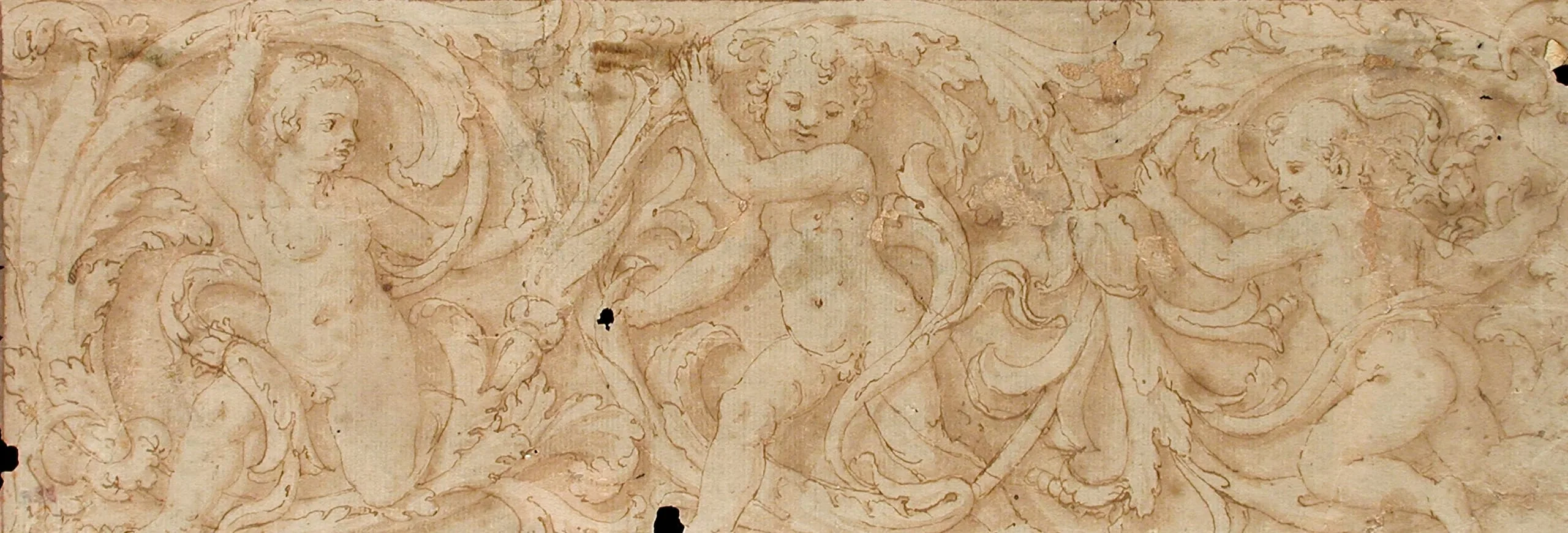
- Part of a Decorative Frieze with Putti and Rinceau, probably for the Sala dei Cavalli, Palazzo Te, Mantua
- Date Made
- c. 1526-1528
- Medium
- Pen and brown ink and wash
- Dimensions
- Sheet: 2 1/8 x 11 3/4 in. (5.4 x 29.84 cm)
- Accession Number
- M.39.3.2
- Curatorial Notes
The three lively putti that twist and turn in playful poses add lighthearted visual interest to this design for a frieze intended to decorate the walls of a room in the Palazzo Te, a luxurious sixteenth-century leisure residence for the Mantuan court designed by Giulio Romano between 1524 and 1534. This drawing, done in brown ink and wash, almost certainly relates to the decorative scheme for the Sala dei Cavalli, a room frescoed with portraits of prized horses belonging to the Gonzaga family and enhanced with ornamental motifs that evoke antique sculptural decoration. Throughout this decorative conceit, the illusion of three-dimensionality is suggested by the careful application of wash meant to resemble shadow; when translated to the wall, this drawing’s design is intended to appear like painted stucco.
Elements of the composition likely originated with Giulio’s instructor Raphael, who took inspiration from the patterns of adornment on ancient villas and grottoes being unearthed in early sixteenth-century Rome. The sharing of drawings, a common practice in Raphael’s studio, allowed labor to be divided and ideas to be transmitted beyond the practice of the master. This drawing stands as an important example of the productive environment of the sixteenth-century workshop, showing how Raphael’s innovations were furthered by his followers.
Claire Spadafora Baes
2024