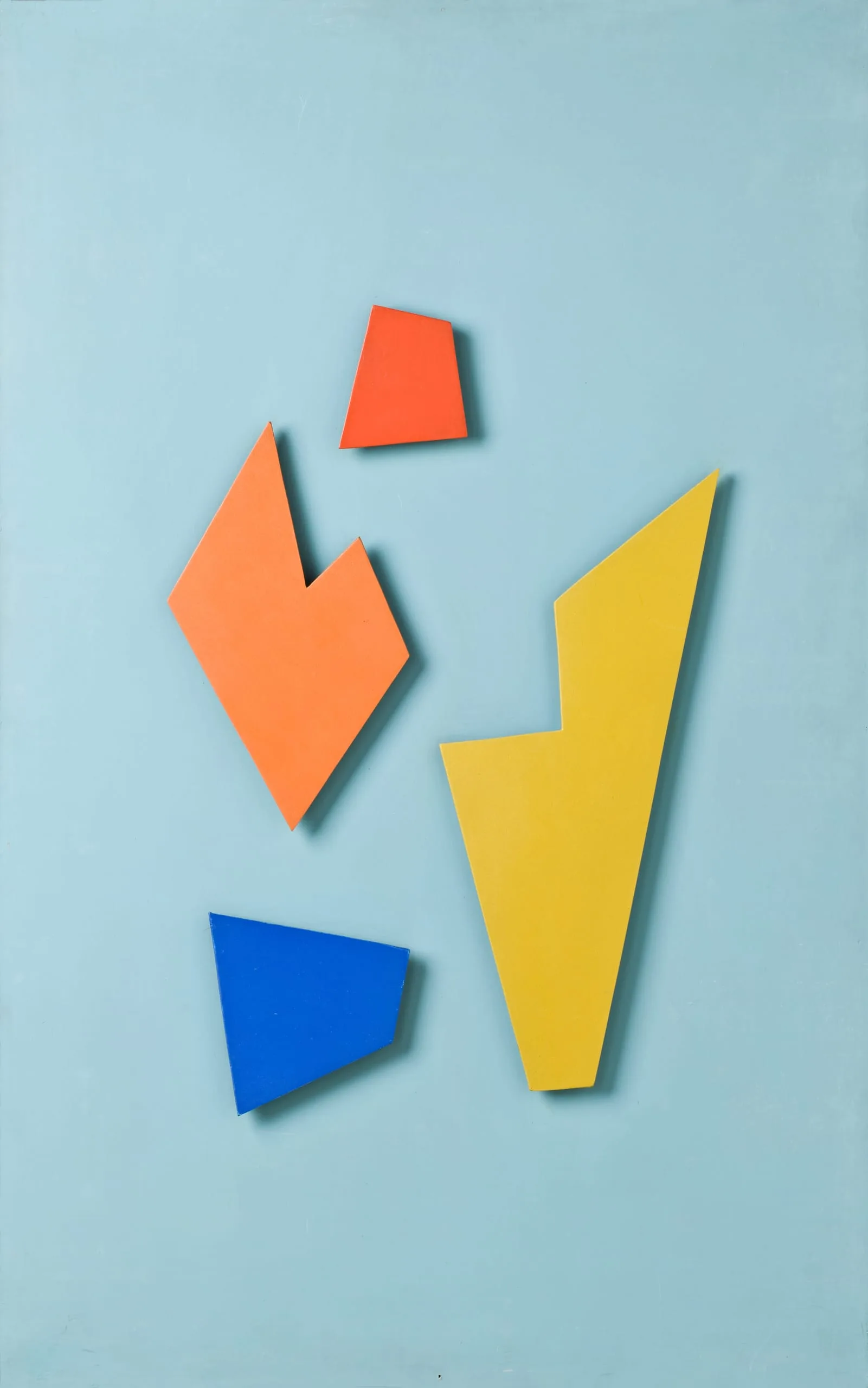
Beginning in the mid-1940s, a number of artists in Buenos Aires sought to create artworks that bore no references to anything outside of the work itself. Raúl Lozza emerged as a major innovator, founding Perceptismo (Perceptivism), a movement based on three primary principles—open structure, the notion of the field, and Lozza’s new theory of color—that are evident in this 1953 work. Untitled (No. 315) consists of four individual monochromatic polygons mounted on a larger painted monochromatic board. The four polygons emerged from Lozza’s experiments with coplanals, open compositions of geometric forms that had no limiting frame and were instead presented on a wall as connected relief elements. Here, Lozza fixed these elements on a support that functioned as a portable wall or colored field. He first created a sketch, where he carefully mapped out the colors and forms according to mathematical principles and his color theory, which he called cualimetría. The artist considered a form’s color in relation to its size, shape, and dimensions to create an overall composition that lacks visual perspective and is perceived on a single plane.
Lozza developed his theories of Perceptismo after splitting from the group Asociación Arte Concreto-Invención (Concrete-Invention Art Association). He was joined in his new movement by his brothers as well as the philosopher and art critic Abraham Haber (1924–1986). Lozza gave Untitled (No. 315) to Haber as a wedding gift, a testament to their friendship and Haber’s championing of the artist and his ideas.
Rachel Kaplan
2024