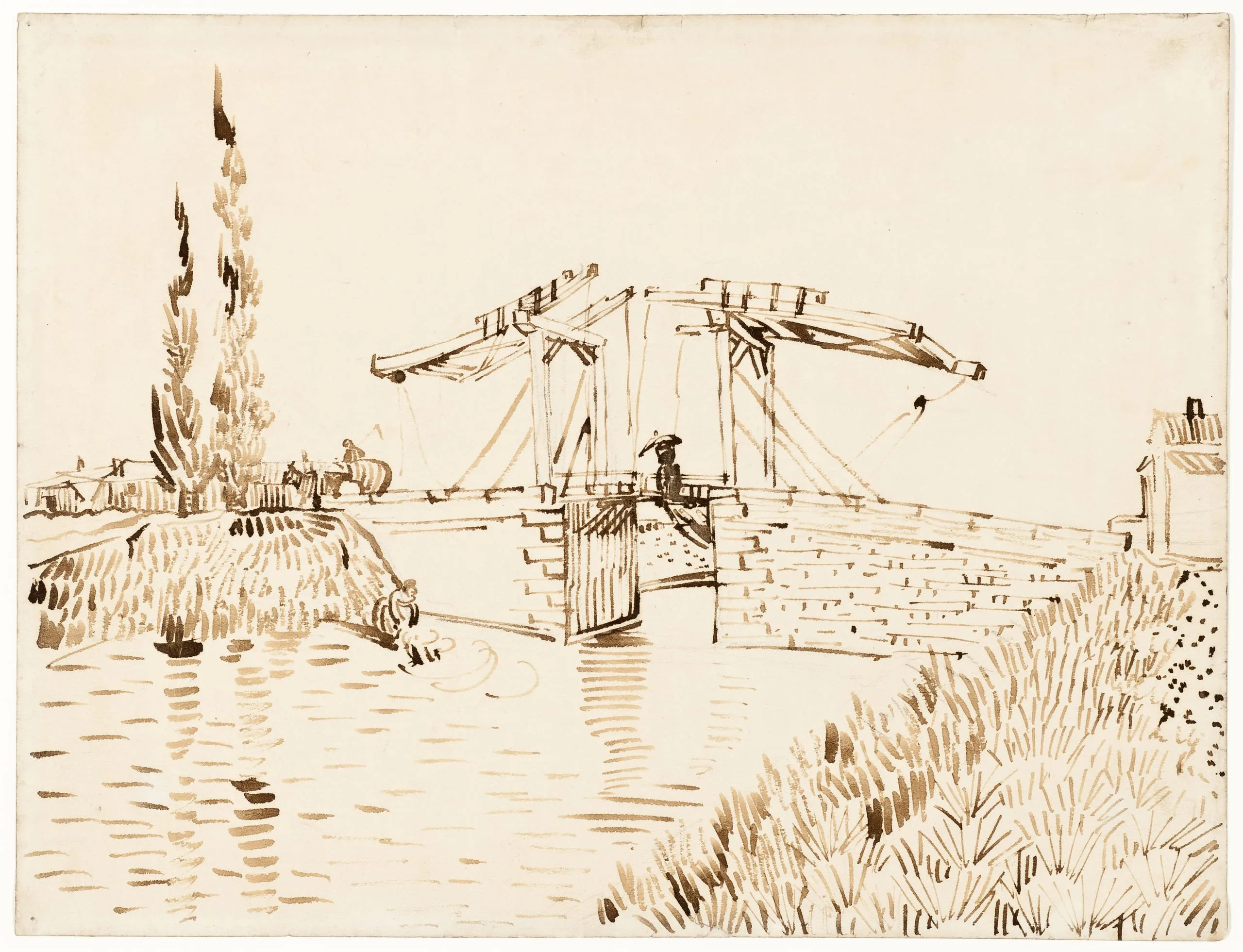
When Vincent van Gogh arrived in the south of France in 1888, he was immediately captivated by the bright sunlight, vibrant colors, and varied landscape, which was so different from the flat terrain and monochrome tonality of the Dutch province of North Brabant where he lived during his formative years. He discovered a canal drawbridge in the countryside of Arles that reminded him of a similar structure from his youth and became one of his favorite motifs. Van Gogh depicted the bridge in five paintings, three finished drawings, one watercolor, and fifteen studies, including this one.
Here, he used a reed pen and brown ink, with minor traces of graphite or black chalk. The rippling water, the grassy knoll in the right foreground, and the foliage of the cypress trees bending in the wind are described with short hatched lines and dots of ink. The figures are captured with a similar economy of means: two people have just crossed the bridge; a washerwoman does her laundry in the canal below; and a woman holding a parasol, rendered in the heaviest application of ink, takes in the scene from the center of the drawbridge. Van Gogh’s technique here is reminiscent of Hokusai’s woodcuts, and he wrote that he had achieved “a certain Japanese look” in these studies (Jansen et al. 2021). But the monochromatic brown tones also suggest a French landscape interpreted through Dutch eyes. This drawing served as a study for one of Van Gogh’s paintings of the Langlois Bridge, now in the collection of the Wallraf-Richartz-Museum in Cologne.
Claudine Dixon
2024
Bibliography
Jansen et al. 2021. Leo Jansen et al., eds. Vincent van Gogh: The Letters, Van Gogh Museum, Letter #652 to Theo van Gogh, July 31, 1888, https://vangoghletters.org/vg/letters/let652/letter.html.