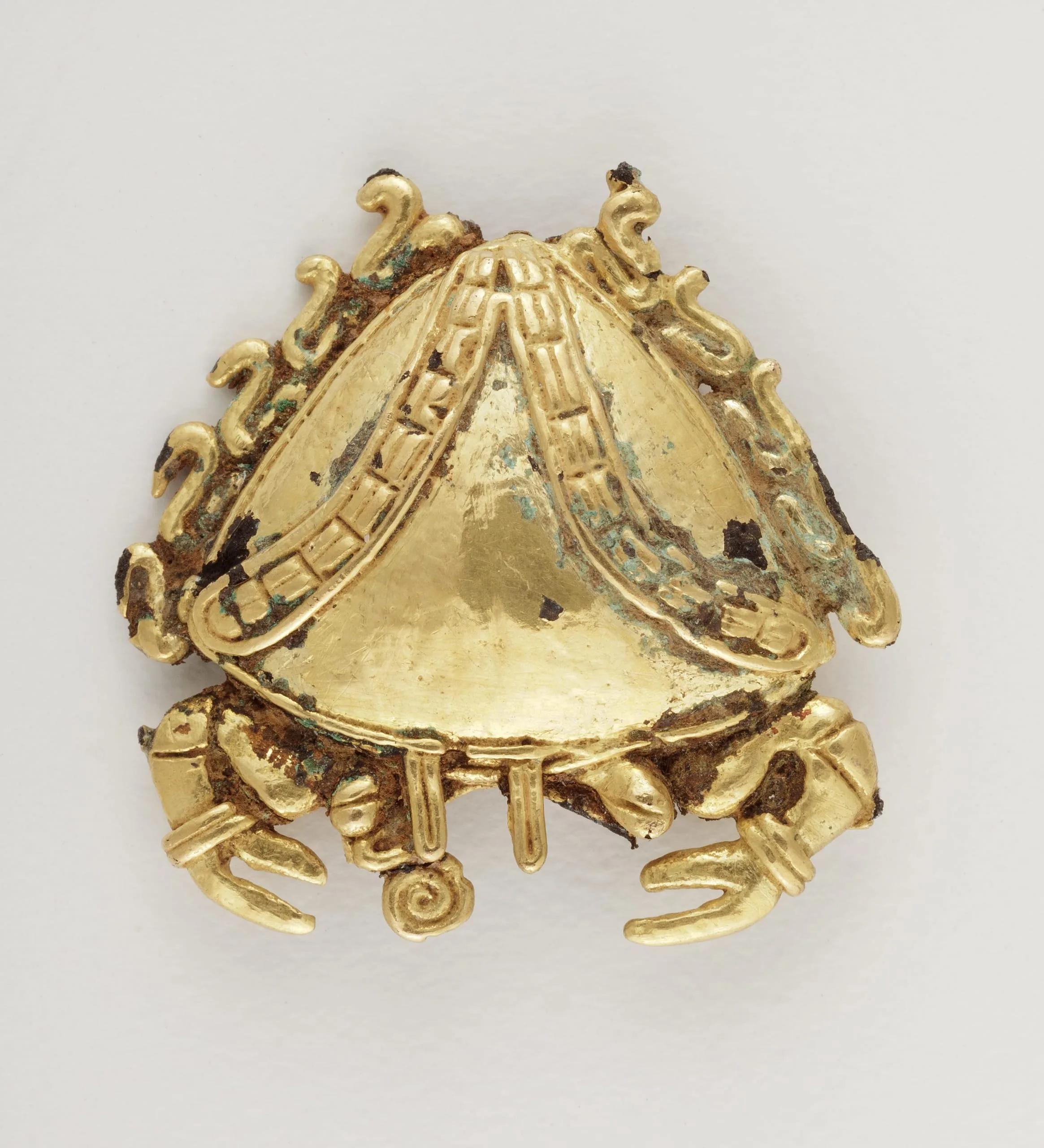
This tiny crab pendant is a fairly modest example of the numerous large-scale golden objects created by metalsmiths in ancient Panama, but it is nonetheless the result of the same highly sophisticated technology. It was cast using the lost-wax method, wherein a wax model would have been created in the shape of a crab. The model was encased in clay, then fired to melt the wax and harden the mold. Molten metal could then be poured into the void in the ceramic mold and, after cooling, the mold was broken open to reveal the metal crab.
Although appearing golden, it is made of tumbaga, a gold-copper alloy widely used in ancient Panama and Colombia that played a significant role in Pre-Columbian metallurgy due to its versatility and symbolic importance (see M.2007.146.663a-g). The alloy composition could range from 97% gold to 97% copper, often also containing silver impurities. The surface of this crab appears golden because an additional technique was employed by the maker: depletion gilding. The surface was treated with an acidic solution to dissolve copper, leaving a gold-rich outer layer.