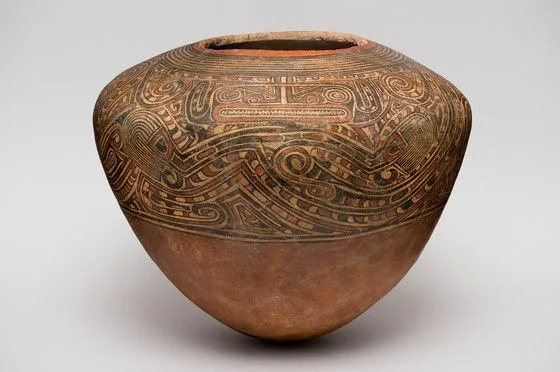
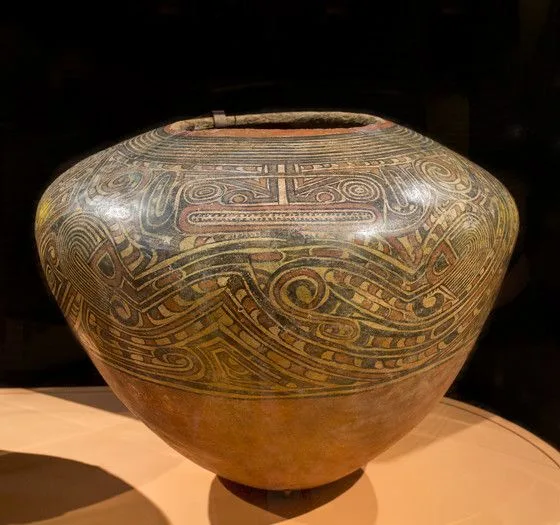
Among the densely packed polychrome designs and motifs that fill every available space on this enormous vessel, it is possible to discern two front-facing anthropomorphic beings. The wide-set eyes consist of several concentric circles of black paint, giving the effect of a being in trance or experiencing hallucinatory or supernatural visions. The nose is colored in purple with red nostrils; above, a wide red-lipped mouth filled with numerous sharp teeth seems to grin at the viewer. With arms extended wide, the figures seem to float or fly into view while their slender torsos disappear into the swirling patterns that engulf them. This type of design, common to Macaracas-style ceramics, has been interpreted as representing shamans in transformation or ritual flight (see also M.2016.348.2 and M.2001.168.2).
Ritual specialists in South America consider it their obligation to guide their communities in the principles that sustain the equilibrium of the universe, balancing life and death, fertility and scarcity, sickness and health, male and female energies, taking and giving back. Only the most powerful ritual specialists know how to transform into or communicate with other beings. They preserve this knowledge—in part acquired through the consumption of sacred plants that open one’s mind—through laws, organizational principles, rituals, songs, dances, myths, offerings, and objects. Transformation between beings is possible because everything shares a conscious spirit. As explained by Brazilian anthropologist Eduardo Viveiros de Castro, “The universe is populated with extra-human intentions, endowed with their own perspectives, which you have to take into account. Shamanism is what understands it, and translates it.”
This extraordinarily large vessel has been restored from a few fragments. The neck is missing, having seemingly been removed in antiquity, which is common in most of these supposed burial urns. Their true function is uncertain. The graves excavated at cemeteries like Sitio Conte and El Caño did not include urn burials. The prevailing assumption is that large polychrome ollas such as this piece were used for secondary burials (the deposition of bones after the rest of the body had decayed elsewhere), even though there is no concrete evidence to support this.
Selected Bibliography
Grinnell, Alan, 2025. Painting the Cosmos: Art and Iconography of the Ceramics of Ancient Panama. University of New Mexico Press, 2025.
Mayo Torné, Julia, and Juan Carles, eds. Guerreros de Oro / Golden Warriors: Los señores de Río Grande en Panamá / The Lords of Río Grande in Panama. Fundación el Caño, 2015.