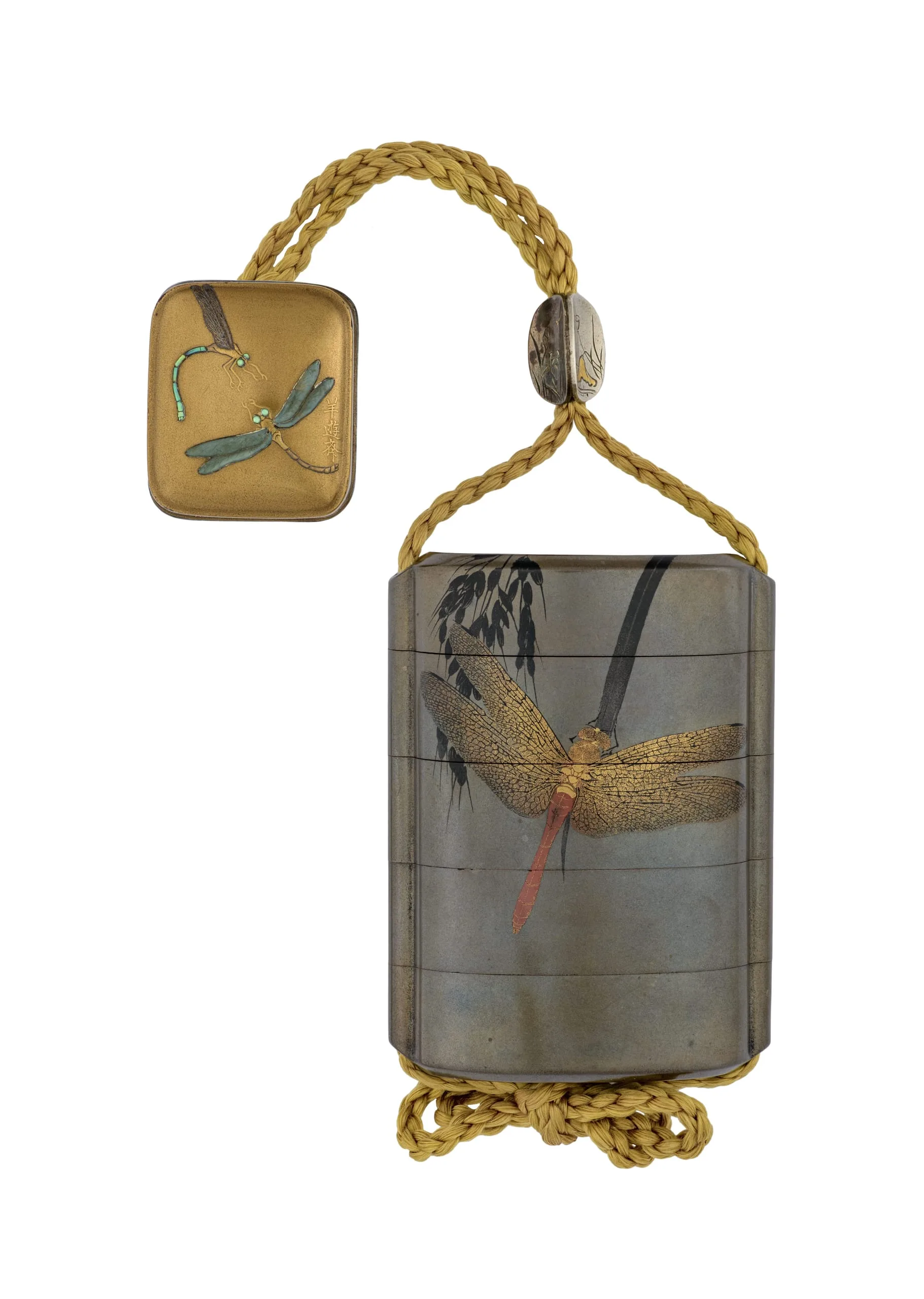
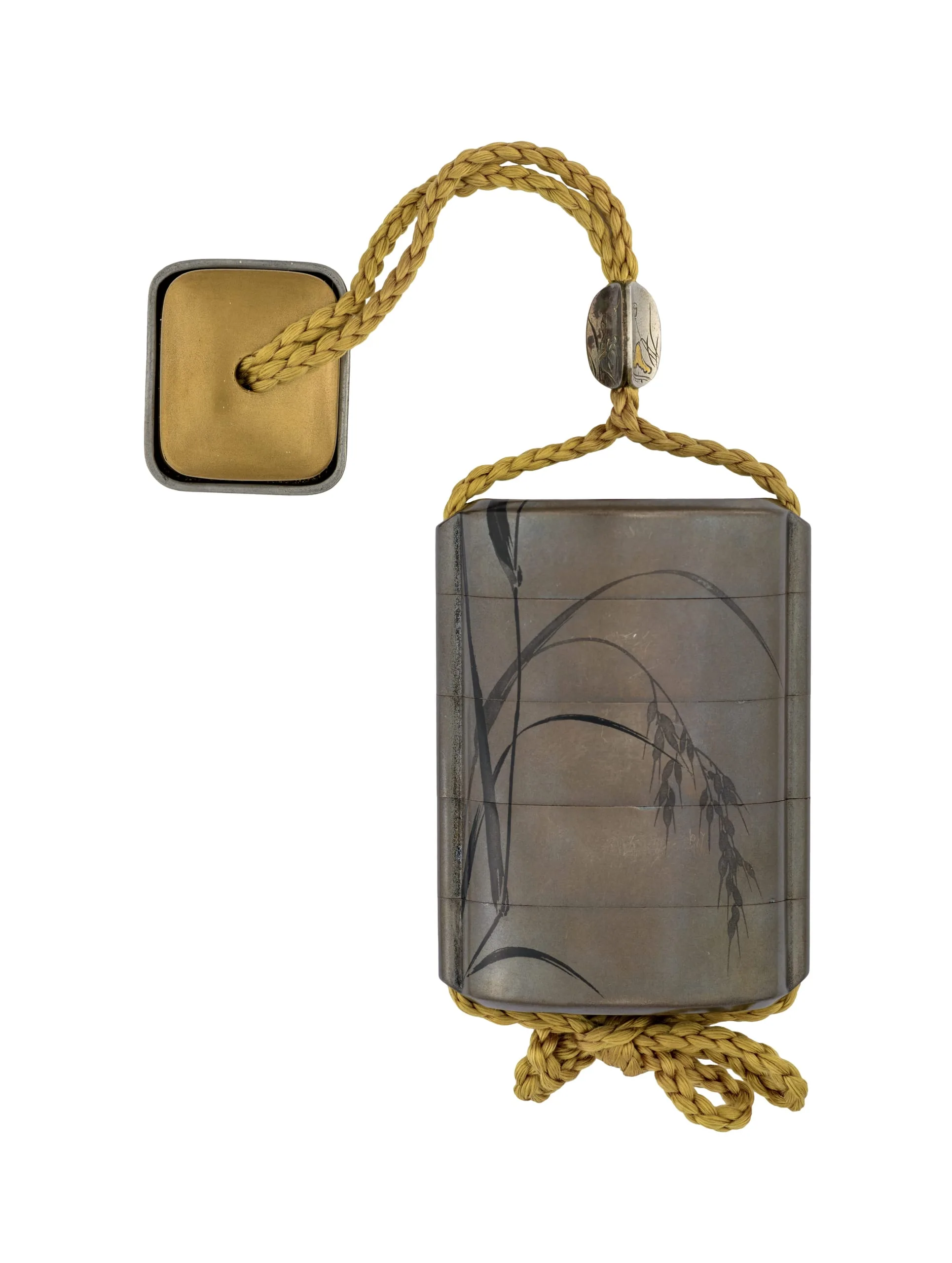
This highly significant inro raises the entire tenor of LACMAs collection of this wearable art. The inro was crafted by Iizuka Toyosai, an attendant to the Hachisuka fief lord from Shikoku, the smallest of the four main islands of Japan. Toyosai was among the rare craftsmen who through his high level of talent achieved samurai status. His designs were based on paintings by the Kano school, artists to the shogunate, and by the sinophile literati school of artists. This design seems closest to the delicate manner of Kano Eisenin Furunobu (1696-1731), head of the Kobikicho branch of the Kano school that served the shogun.
This ethereal image represents a scene in the summer months, and therefore would have been donned during that season. Toyosai applied the lacquer design using togidashi technique, in which after 30 layers of lacquer have been applied and polished, a design is sprinkled on in gold, silver, and colored powders of varying fineness and density, adhered with wet lacquer, then this design is covered over with a few layers of lacquer the same color as the background. Once polymerized in a warm, humid chamber, these overlayers are polished down to reveal the design. This technique was often used to approximate a design scheme from a painting or woodblock print, and allows for a feeling of depth and atmosphere.
The artist of the netsukeused as a fob to suspend the inro from the sashHara Yoyusai was an attendant to the Maeda fief lords of Kaga Province (now Kanazawa Prefecture), the wealthiest and most powerful lords next to the shogun during the Edo period (1615-1868). Yoyusais stunning work in lacquer often followed the Rimpa style of painting and design, and he worked personally with Sakai Hoitsu (1761-1828), a painter whose work is well represented in the Etsuko and Joe Price collection, displayed seasonally at the Pavilion for Japanese Art.
Inro evolved as part of a mans dress in the 17th century, fulfilling a need to carry seals or medicines on ones person in the absence of clothing with pockets. By the mid-18th century, their use as carriers for pharmacopeia was established, due to their airtight construction, though by the 19th century, men tended to wear them empty, like jewelry. None of the inro in LACMAs collection show any sign of having been used to hold contents, and so were probably only employed to reveal the taste of the wearer. During these centuries, dress of the samurai was regulated by the government, whose proclamations stated that samurai of any economic level still needed to wear silk kimono, and that their sword accoutrement and dress should be dignified in manner. One finds that many of these details of dress for samurai were created in a palette of black and gold.