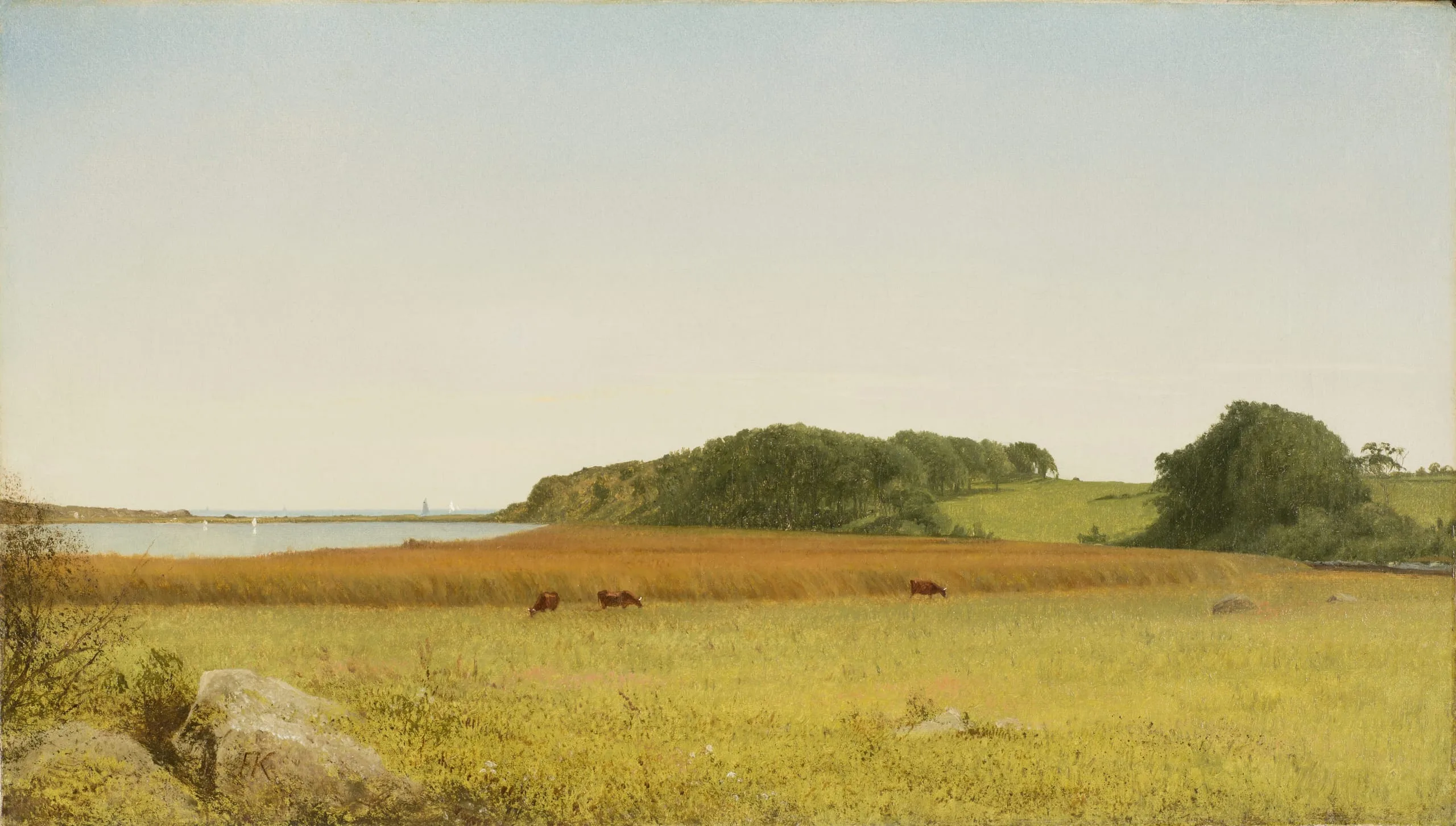
This landscape came into the collection with the title An Inlet of Long Island Sound. The setting has recently been identified as Almy’s Pond, near Newport, Rhode Island. This low-lying area of the Rhode Island coast, with its rolling hills and salt marshes, was a popular site with American artists at mid-century and was painted by Martin Johnson Heade (1819-1904) and William Trost Richards (1833-1905) as well as Kensett. The numerous landscapes of the Newport vicinity listed in the sales catalogue of his estate indicate that Kensett often worked in the area. The museum’s painting may be one of the three Almy’s Pond scenes of similar size sold at auction in 1873 (New York, Association Hall, The Collection of Over Five Hundred Paintings and Studies by the Late John E. Kensett, nos. 366, 454, 559; another painting of the same subject and similar size believed to be one of these three is in the Terra Museum of American Art, Chicago). A very similar landscape painted around 1860 from the same vantage point that recently appeared on the art market (see Related Work) suggests that the museum’s canvas was painted about the same time.
In the museum’s painting Kensett viewed the pond, which once was an inlet of the Rhode Island Sound, looking toward the nearby sound, indicated by the large sailboats in the distance. The topography well suited Kensett’s temperament for serene, open landscapes. The museum’s painting typifies the artist’s mature luminist images of the 1860s. It is a tranquil view of nature on a sunny day with a clear, almost cloudless sky dominating the horizontal composition. Little activity occurs. The cattle grazing do not disturb the harmony of the composition, allowing the viewer to attain a transcendental unity with nature; even Kensett’s thin, smooth brushwork keeps from intruding upon the illusion of contact with nature.