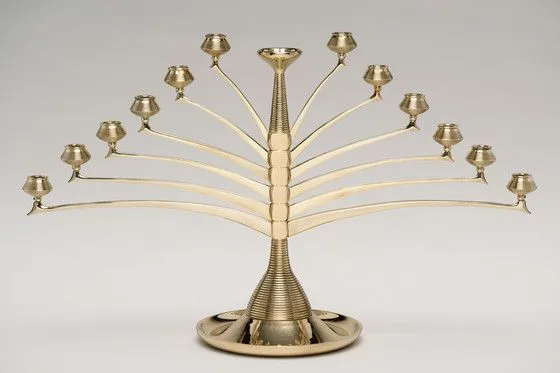
With its gently arched arms undecorated save for symmetrical ribbing on the candleholders, this candelabrum represents Bruno Paul’s movement away from the sinuous curves and ornamentation of Art Nouveau to a more functionalist aesthetic. An architect and designer, Paul cofounded Munich’s Vereinigte Werkstätten für Kunst im Handwerk (United Workshops for Art in Handicraft). These cooperative workshops were intended to bring modern decorative arts to the public and involve artists more directly in the process from first conception to execution, display, and final sale. The intent was to produce not only high-quality work but also entire rooms as complete design ensembles (two of the major goals of the Arts and Crafts movement). First displayed with other candleholders at the Exhibition of Art in Handcraft in 1901 (held at the Bavarian National Museum), the candelabrum was then shown in the context of a complete interior, for example at the Munich Secession (1904) and in the dining room Paul designed for the Third German Applied Exhibition in Dresden (1906).
While few examples have survived (mostly in museum collections), the Paul candelabrum was well known at the time. It was often illustrated in periodicals during the first decade of the twentieth century, and its design was copied by companies in Germany and the United States. The reason for the design’s popularity is clear: it is both monumental and practical. Its many arms revolve, so when displayed flat against a wall, they suggest the tail of a preening peacock, and when swiveled, the branches of a tree.
Wendy Kaplan Department Head and Curator, Decorative Arts and Design
Adapted from the 2008 text