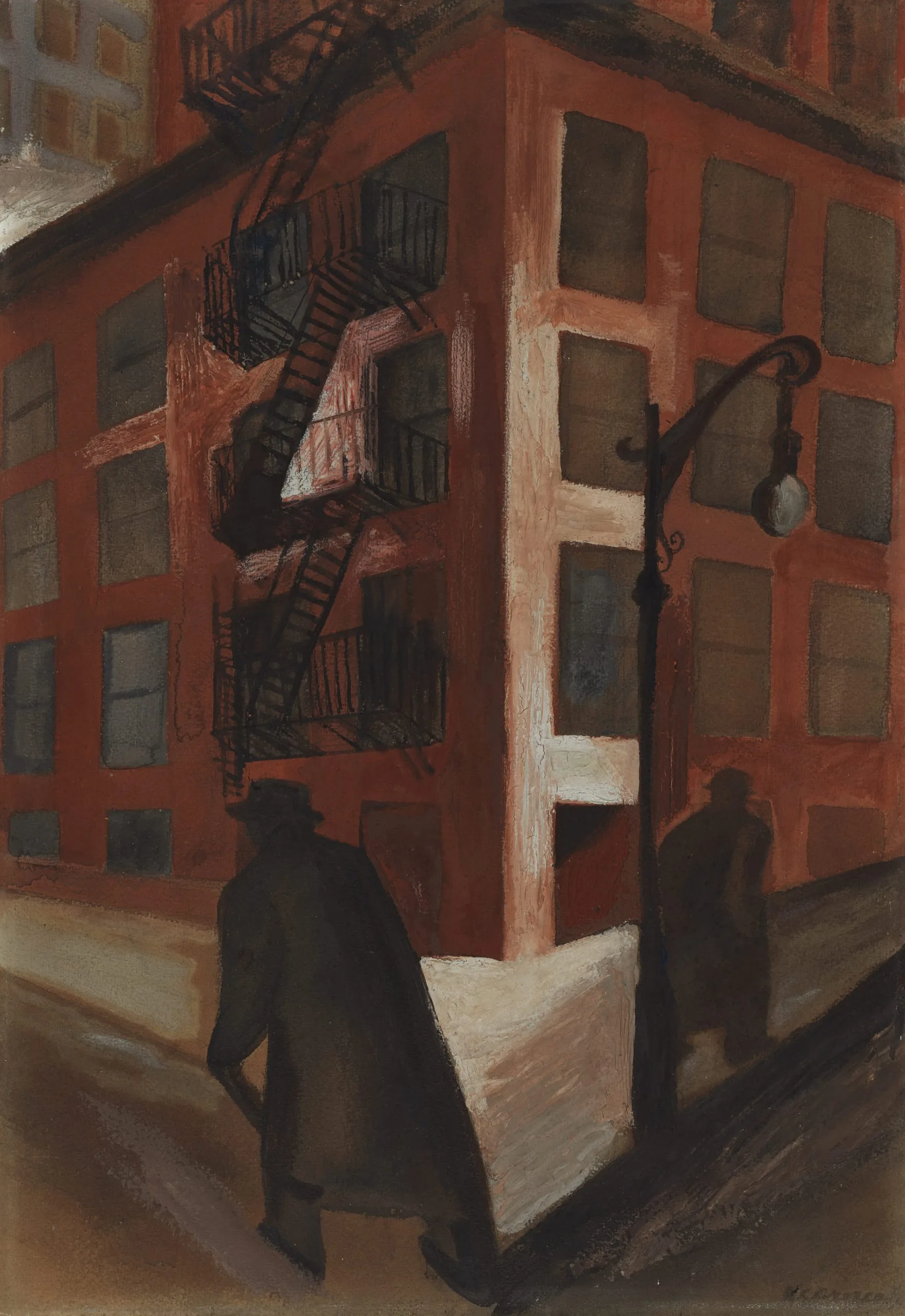
- Title
- Street Corner, Brick Building (Esquina, edificio de ladrillo)
- Date Made
- 1929
- Medium
- Tempera, oil on board
- Dimensions
- Frame: 27 1/2 × 21 1/4 × 2 in. (69.85 × 53.98 × 5.08 cm); canvas: 18 13/16 × 13 5/8 in. (47.78 × 34.61 cm)
- Accession Number
- M.2008.16
- Curatorial Notes
José Clemente Orozco was, with Diego Rivera (1886–1957) and David Alfaro Siqueiros (1896–1974), one of "Los Tres Grandes" (the Big Three) of Mexican muralists. Orozco, however, was opposed to the political and propagandistic quality of the work of Rivera and Siqueiros. "A painting should not be a commentary, but the fact itself," the artist said. During his stay in New York City from 1927 to 1934, Orozco created a number of works depicting Manhattan. The city, a symbol of modernity, is often presented as an alienating place filled with estranged people downtrodden by massive architecture. Orozco advocated the creation of a new art that would be uniquely American, one not tied to European or Mesoamerican traditions "If new races have appeared in the New World", said Orozco, "such races have the unavoidable duty to produce New Art." Here, Manhattan becomes a symbol of continental renewal.
Ilona Katzew, 2008
- Selected Bibliography
- Affron, Matthew, Mark A. Castro, Dafne Cruz Porchini, and Renato González Mello, eds. Paint the Revolution: Mexican Modernism, 1910-1950. Philadelphia: Philadelphia Museum of Art; Mexico City: Museo del Palacio de Bellas Artes, 2016.
- Copyright
- © José Clemente Orozco / Artists Rights Society (ARS) New York / SOMAAP, Mexico