LACMA

ShopMembershipMyLACMATickets
LACMA
Los Angeles County Museum of Art
5905 Wilshire Blvd.
Los Angeles, CA 90036
info@lacma.org
(323) 857-6000
Sign up to receive emails
Subscribe
© Museum Associates 2026
  • About LACMA
  • Jobs
  • Building LACMA
  • Host An Event
  • Unframed
  • Press
  • FAQs
  • Log in to MyLACMA
  • Privacy Policy
© Museum Associates 2026
Collections

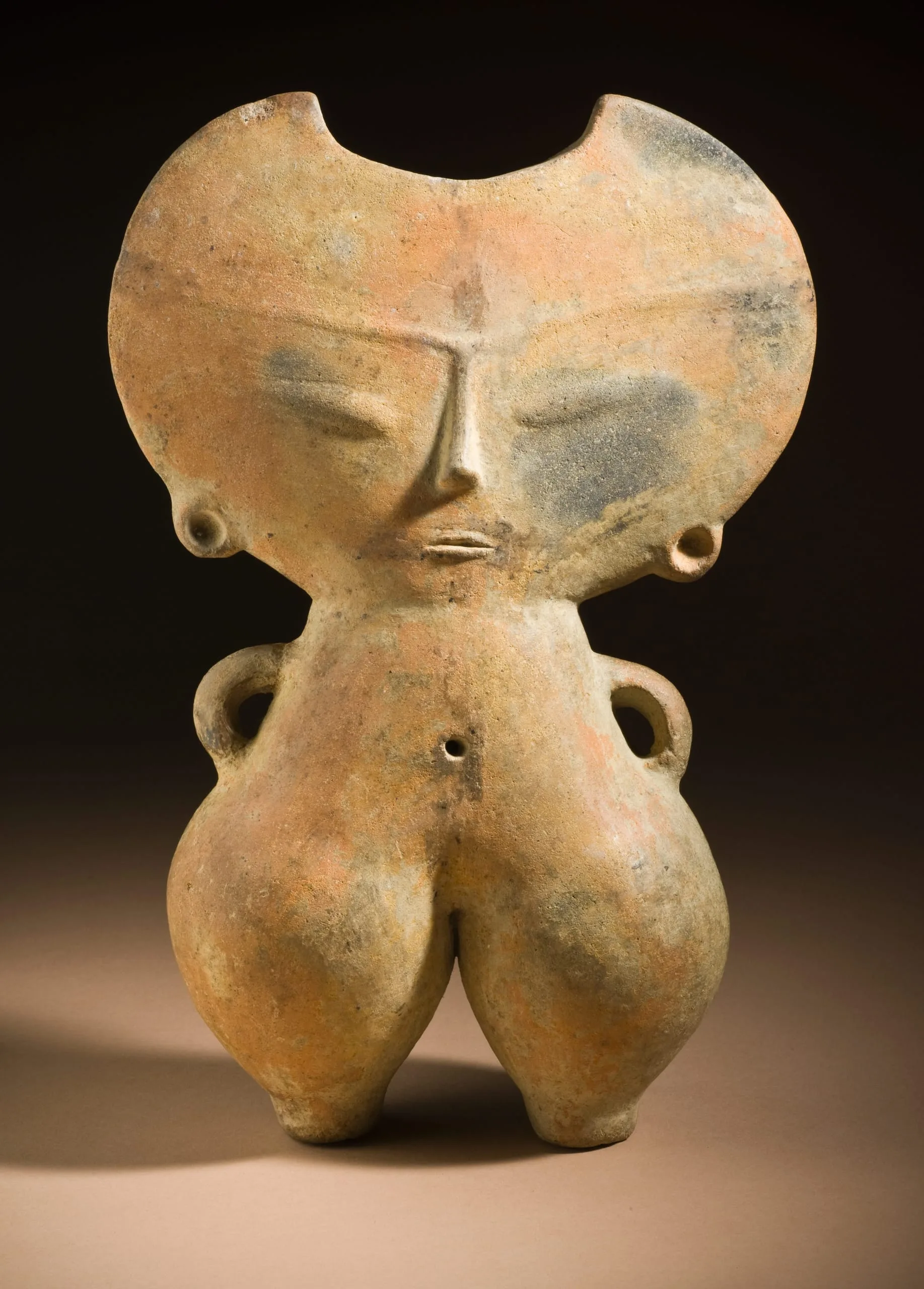
Standing Woman with Crescent-shaped Headunknown date

On view:
Geffen Galleries
Unglazed ceramic figurine with wide disk-like head lobes, simplified facial features, and rounded double-lobed lower body, in mottled tan and gray tones
Ceramic figurine with a stylized human form, featuring a wide, flat head with modeled facial features and dark painted areas around the eyes, small loop ears, stubby arm projections at the shoulders, and a rounded lower body divided into two bulbous lobes, in earthen tones of tan and gray.
Title
Standing Woman with Crescent-shaped Head
Culture
Zenú
Place Made
Colombia, Caribbean Lowlands, Sinú
Date Made
unknown date
Medium
Earthenware
Dimensions
10 1/2 × 7 × 3 1/4 in. (26.7 × 17.8 × 8.3 cm)
Credit Line
The Muñoz Kramer Collection, gift of Stephen and Claudia Muñoz-Kramer and Camilla Chandler Frost
Accession Number
M.2007.146.622
Classification
Ceramics
Collecting Area
Art of the Ancient Americas
Curatorial Notes

Ceramic sculptures from the Zenú culture are almost always of women, although the way in which they are depicted varies enormously over the vast time period and region in which the Zenú flourished (see also M.2007.146.13 and .621). The crescent-moon shape of the figure’s head signals an association between the lunar cycle and female fertility. However, even though a number of effigies of this exact shape have been found, their exact meaning is unknown.

Over a number of years of close collaboration between LACMA and the Arhuaco community (see Burtenshaw et al. 2022), we learned that deciphering the narrative encoded in ancestral objects and motifs is not the only way to expand our understanding of them. As well as their iconography or function, their essence matters. According to Arhuaco elders, pieces like this were created as reciprocal offerings to the earth, to maintain balance in the network of life; in other words, to help manage the universe. They contain the essence of ancestral beings and create bridges between different times and places, us and them, past and present. This beautiful, enigmatic sculpture invites us to connect with a different culture, perspective, and worldview.

Selected Bibliography

Burtenshaw, Julia, Diana Magaloni, Maria Alicia Uribe, and Hector Garcia Botero, eds. The Portable Universe/El Universo en tus Manos: Thought and Splendor of Indigenous Colombia. LACMA/DelMonico Prestel, 2022.
Selected Bibliography
  • Fields, Virginia M., and Victoria Lyall. "New Galleries for the Ancient Americas at LACMA." Tribal Art no.50 (2008): 74-79.
  • Gifts on the Occasion of LACMA's 50th Anniversary. Los Angeles: Los Angeles County Museum of Art, 2015.
  • Burtenshaw, Julia, Héctor García Botero, Diana Magaloni, and María Alicia Uribe Villegas. The Portable Universe = El Universo en tus Manos: Thought and Splendor of Indigenous Colombia. Los Angeles: Los Angeles County Museum of Art, 2022.