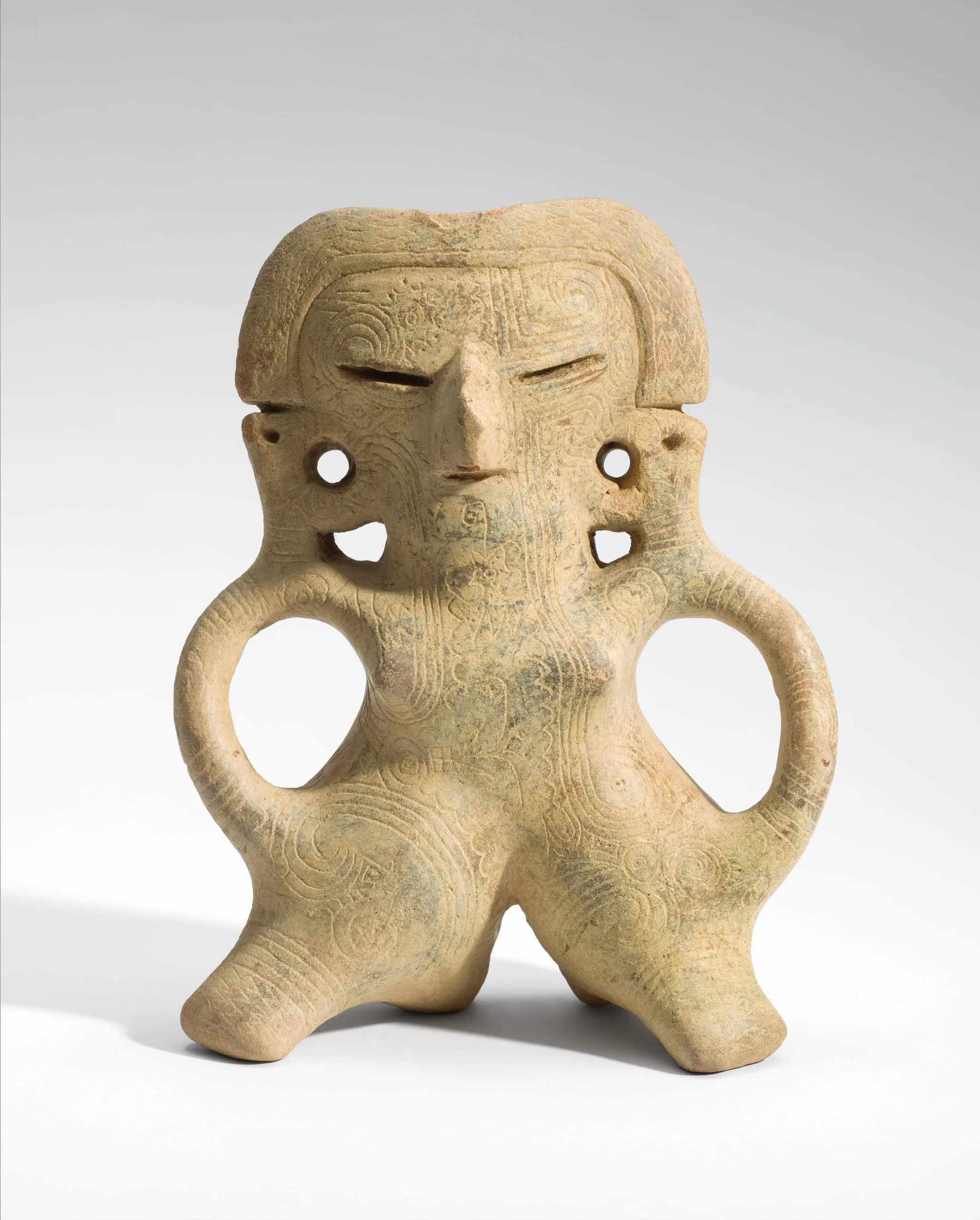
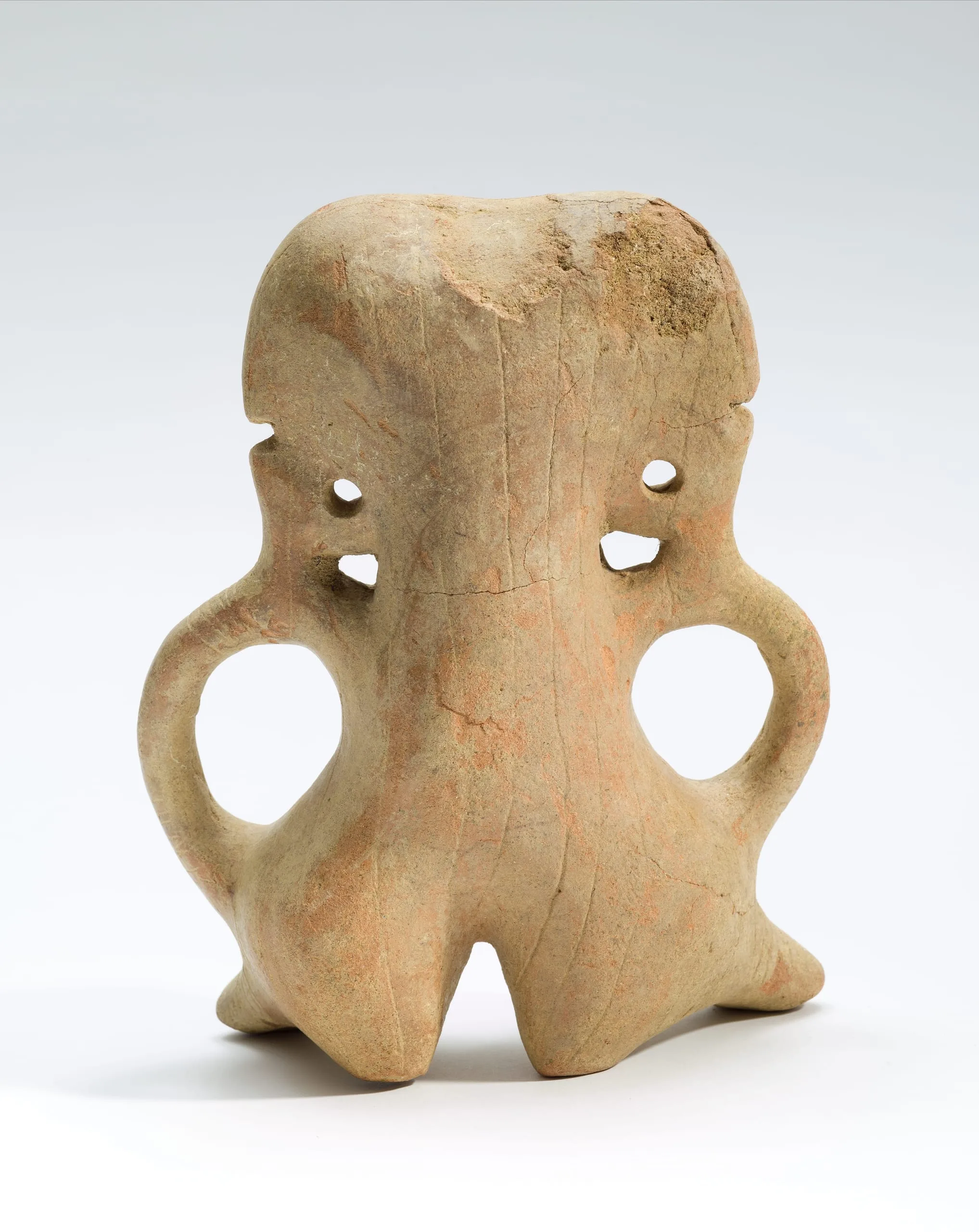
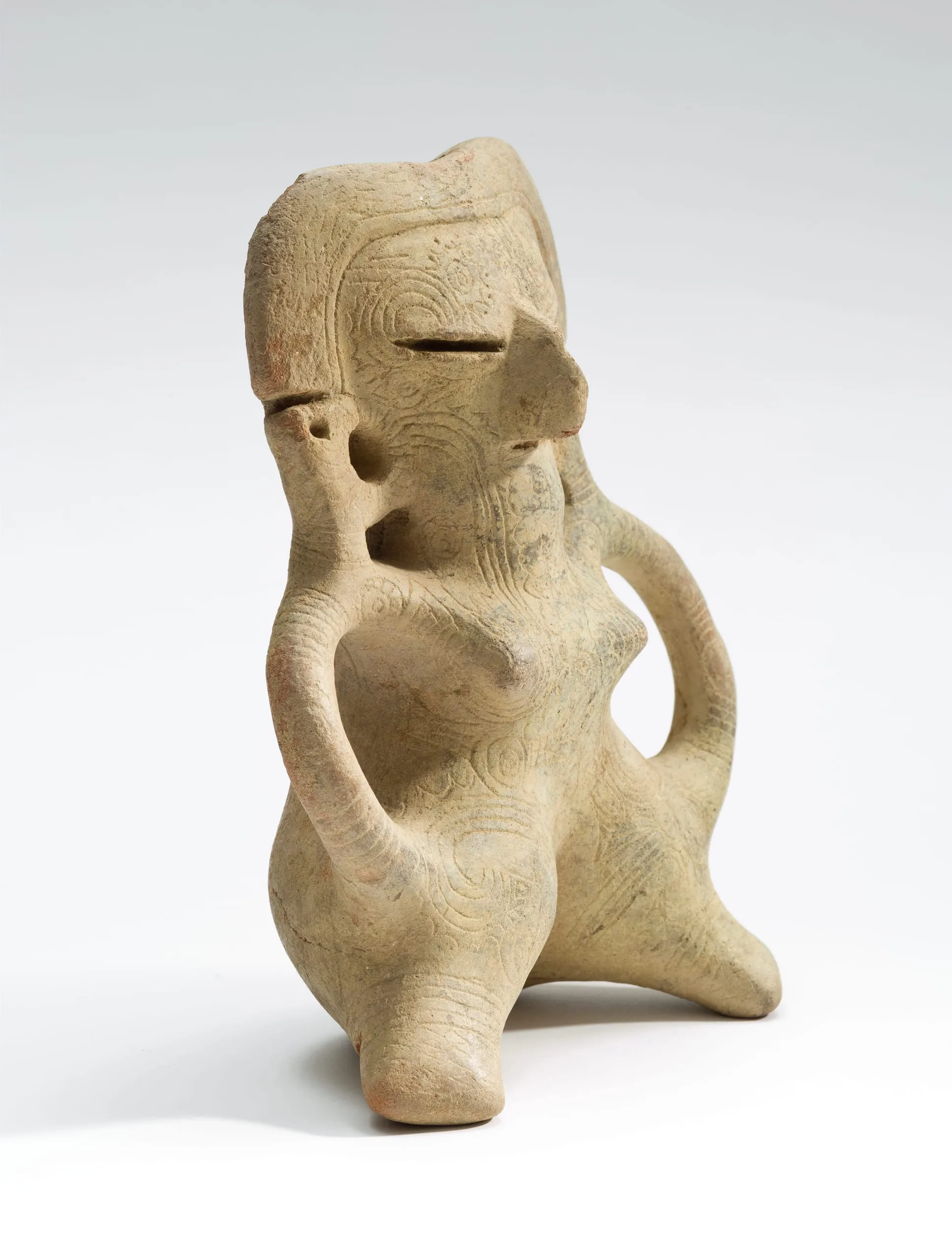
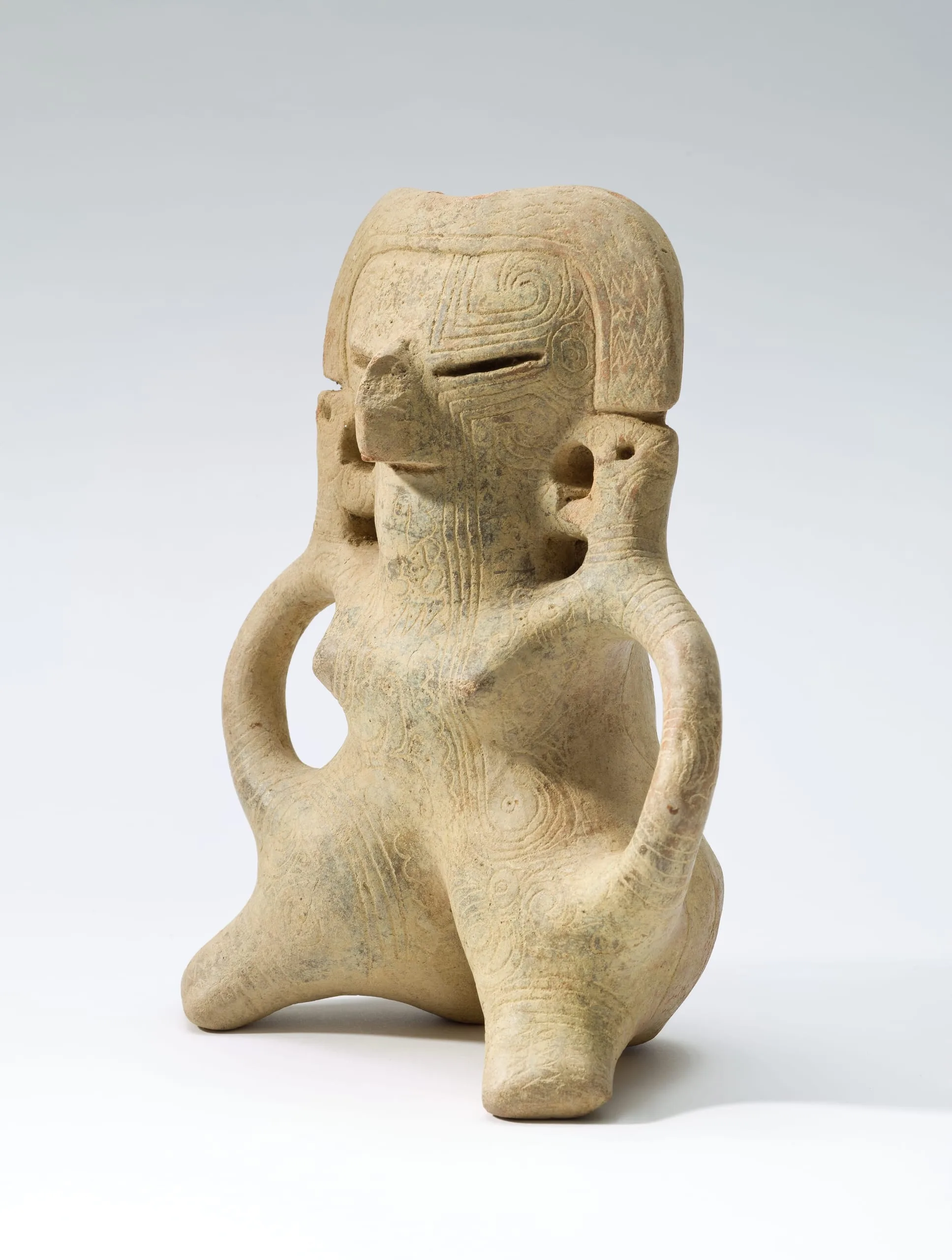
Ceramic sculptures from the Zenú culture are almost always of women, although the way in which they are depicted varies enormously over the vast time and region in which the Zenú flourished. This stylized sculpture is covered with details that emerge only on close observation. She is decorated all over with intricate, asymmetrical patterns of parallel lines, zigzags, spirals, and possible floral motifs. On the back, the decoration is limited to a few vertical lines. Her ears, shoulders, and arms similtaneously form the heads, bodies, and long tails of small animals, perhaps monkeys. We interpret these as helper animals or as alter egos, a common concept in shamanic practices, where ritual specialists harness the powers of other beings, often merging with or transforming into them.
Very little is known about how these ceramic female effigies were used or who they represent (see also M.2007.146.13 and .622). However, the symbolism encoded in sculptures like this one indicate that women held high positions of both political and religious authority in Zenú society. This is supported by sixteenth- and seventeenth-century reports of Spanish chroniclers about a female ruler called Toto/Tota who presided over Finzenú, a large town and cemetery where elites were laid to rest. Leadership roles were not exclusively female as other provinces were governed by male chiefs, but we know of no ceramic sculptures of explicitly male characters.
Over a number of years of close collaboration between LACMA and the Arhuaco community of northern Colombia (see Burtenshaw et al. 2022), we learned that deciphering the narrative encoded in ancestral objects and motifs is not the only way to expand our understanding of them. As well as their iconography or function, their essence matters. According to Arhuaco elders, pieces like this were created as reciprocal offerings to the earth, to maintain balance in the network of life; in other words, to help manage the universe. They contain the essence of ancestral beings and create bridges between different times and places, us and them, past and present. This beautiful, enigmatic sculpture invites us to connect with and respect a different culture, perspective, and worldview, and thus continues to impact the patterns that govern our world.
Selected Bibliography
Burtenshaw, Julia, Diana Magaloni, Maria Alicia Uribe, and Hector Garcia Botero, eds. The Portable Universe/El Universo en tus Manos: Thought and Splendor of Indigenous Colombia. LACMA/DelMonico Prestel, 2022.