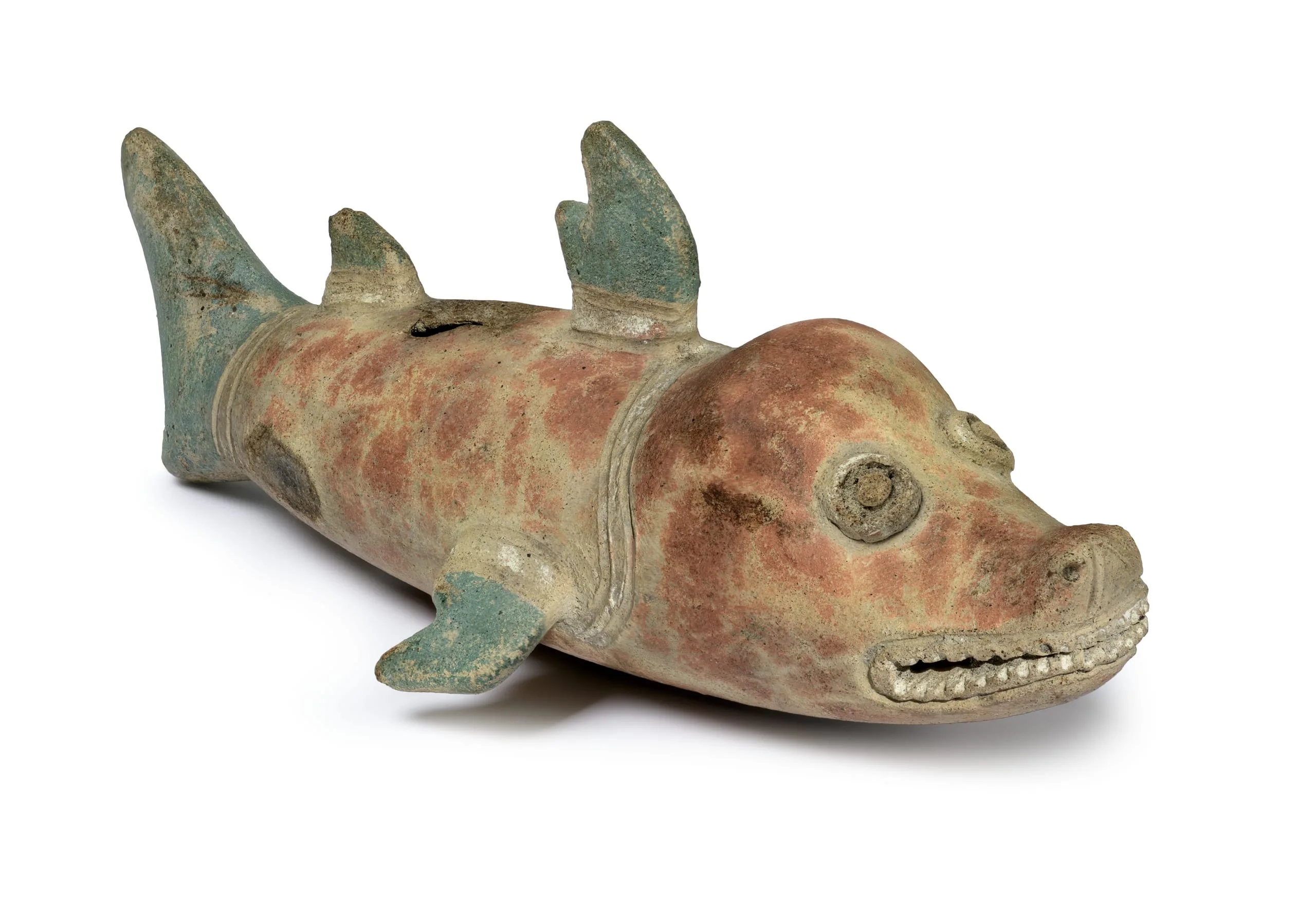
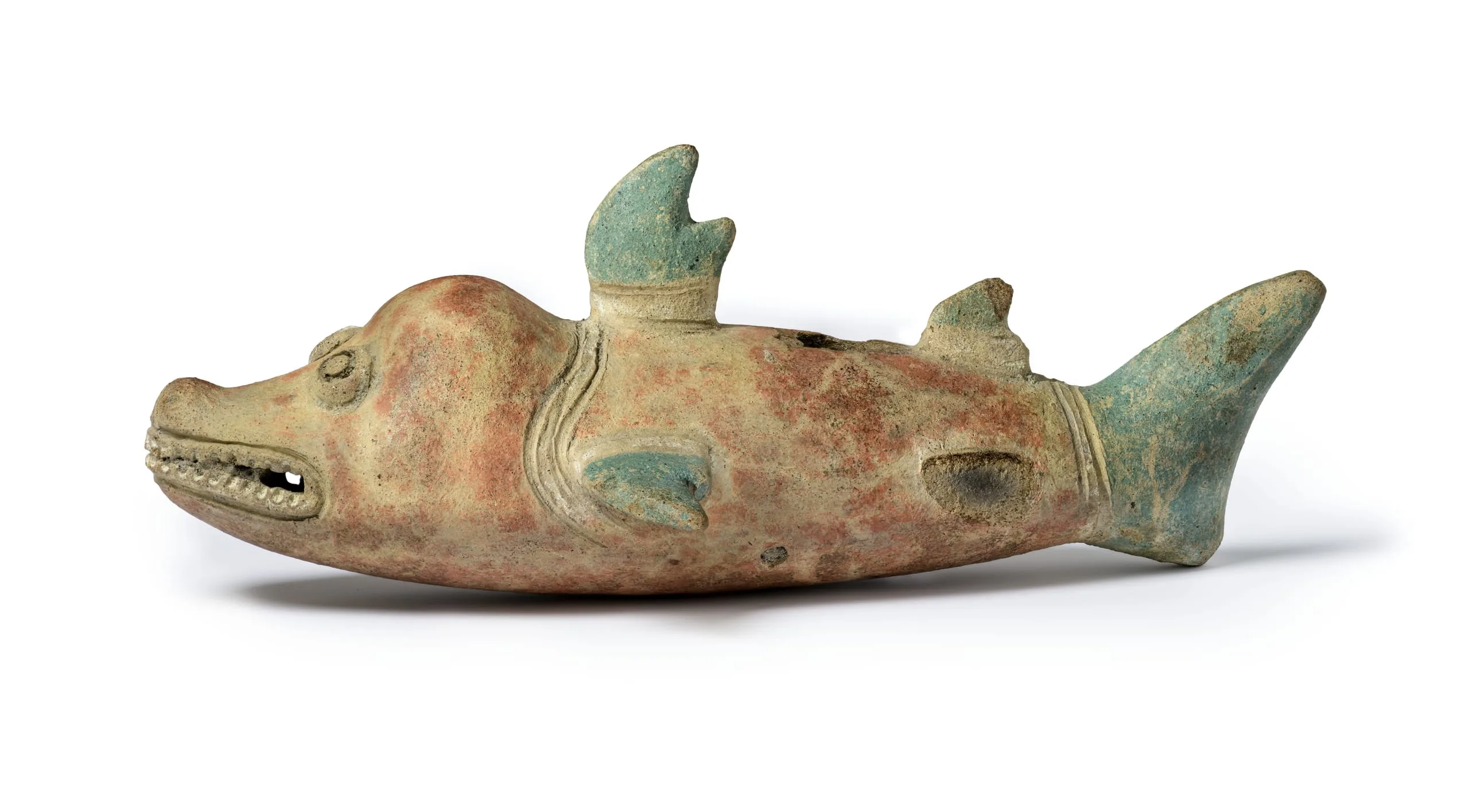
Living on the Pacific coast and undoubtedly reliant on marine resources as a staple food source, Tumaco-La Tolita people were intimately familiar with and respectful of the beings and forces of the ocean. Sharks feature prominently in their mythology and artworks, some examples of which show them wearing headdresses or adornments (see M.2007.146.538). More naturalistic depictions, such as here, were also not mere animal portraits but symbolic expressions of natural forces and spirits. They reveal a culture deeply connected to its environment, with art serving as a medium to navigate human experiences, hierarchies within the environment, and the cosmic order.
The people who lived in what we now call the Tumaco-La Tolita area are among the few ancient Indigenous groups in Colombia to create figurative ceramic sculptures that do not have a dual function, such as simultaneously serving as a vessel or ocarina. Many figurine fragments have been recovered from domestic as well as ceremonial and burial contexts. According to Arhuaco elders from northern Colombia, sculptures like this contain the essence of living creatures and ancestral beings, and can be used to communicate with them. They were created as reciprocal gifts to the ocean or earth to maintain balance in the network of life; in other words, to help manage the universe.
Ceramics from this region and time period are typically a light, mottled gray, but many were once polychrome, as exemplified by the bright orange and blue colors remaining on this shark. The technology or pigments used await further study, but there may be a connection with the vibrant colored ceramics of the Jama Coaque region in Ecuador further south that feature similar tones of blue-green, orange, and yellow.
Julia Burtenshaw
2025