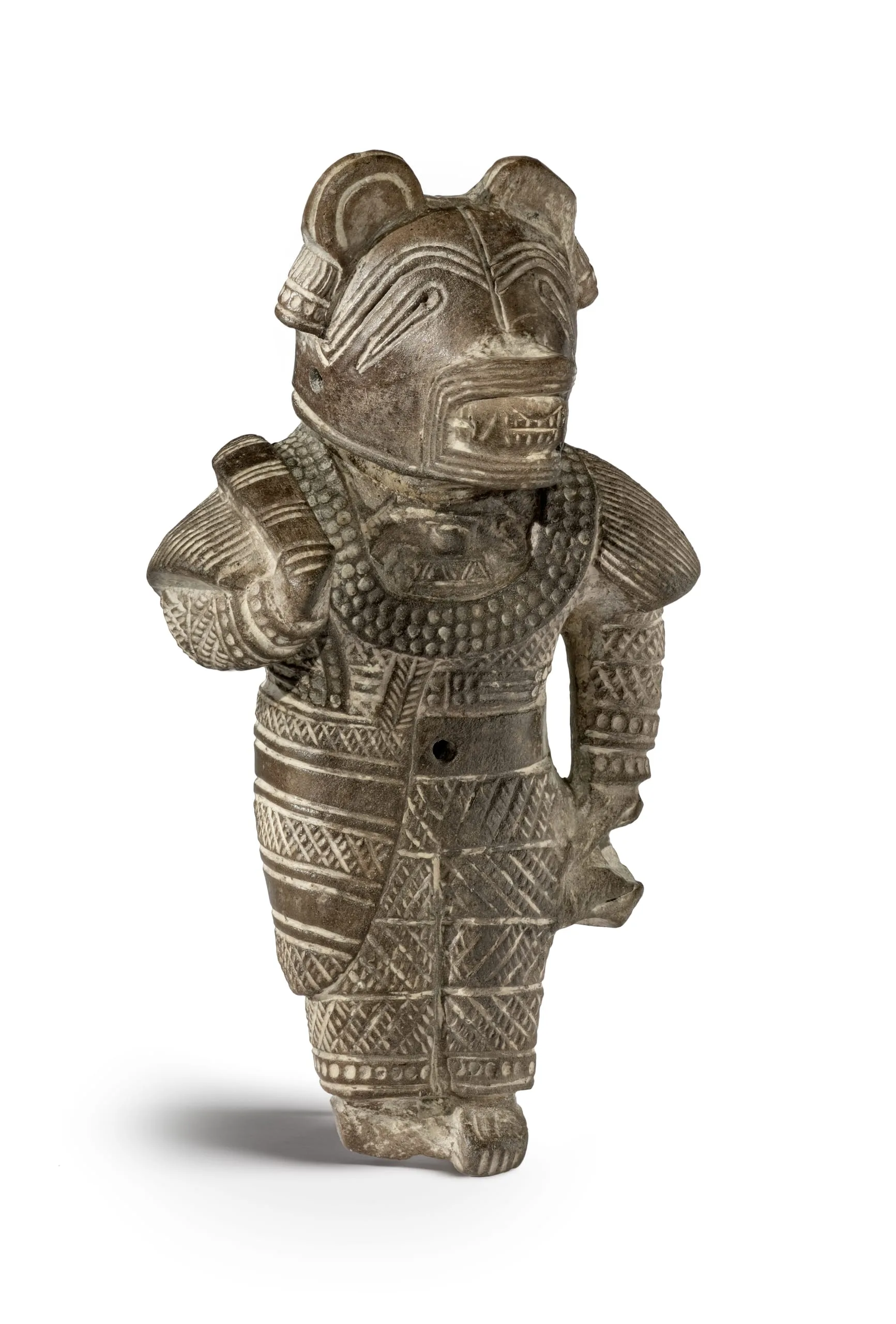
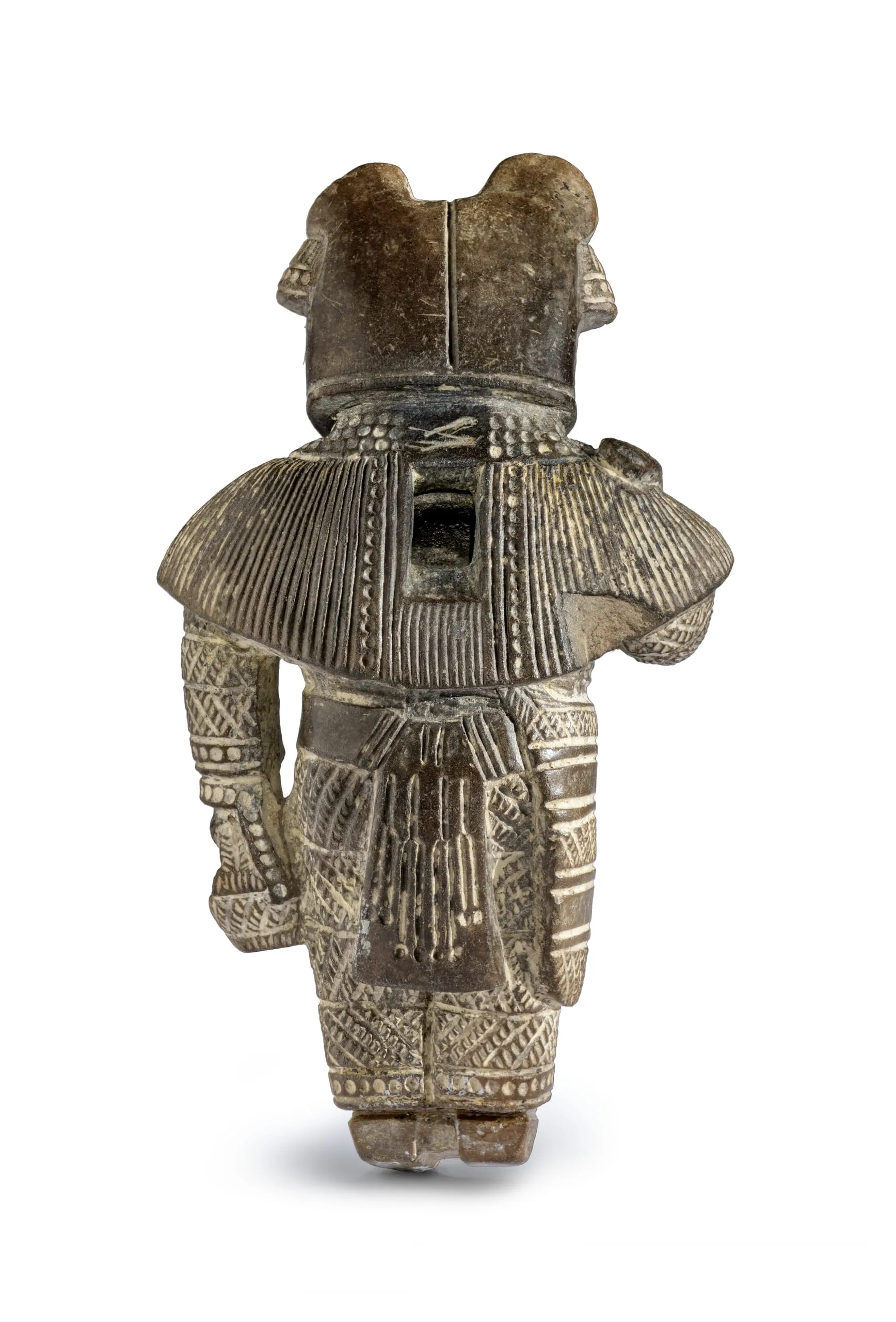
This tiny clay whistle is one of the masterpieces of the ancient Colombia collection currently stewarded at LACMA. It depicts a standing person, probably male, in an elaborate costume. The details are extraordinary. The face is hidden under a helmet or mask that wraps around the head; the rounded ears and long snout suggest a bear or feline. The figure wears a short cape over the shoulders, a long, patterned skirt, and a necklace and belt, both of which are fastened at the back. One hand holds a club or staff that rests against his shoulder, the other an item that is damaged and thus not identifiable. A bag rests on his right hip, the strap slung diagonally across his body. Both bag and strap bear an uncanny resemblance to the mochilas used by Indigenous peoples of the Sierra Nevada de Santa Marta today.
Made of cotton, wool, or fique (a plant fiber), mochilas are used to carry coca leaves, coca-chewing paraphernalia, and other items (see photograph below). They are made by women for their husbands and nowadays also for sale to tourists—an important source of cash income for many Indigenous communities. The crocheting technique used to produce mochilas is filled with meaning. Each stitch represents a thought, so as a woman weaves a mochila, she is also weaving her thoughts. The designs convey ancestral knowledge, history, and the Arhuaco people’s connection to nature and the cosmos. Like other items conscientiously made and used by Amerindian peoples in the past or present, mochilas are not just objects; they are a way of transmitting knowledge and culture from one generation to the next.
This whistle figurine, containing the essence of ancestral beings—and perhaps, with its sound, a way to communicate with them—may have played, and can continue to play, a similar role. (See also M.2007.146.10 and M.2007.146.462.)
Julia Burtenshaw
2025
Arhuaco elders with their mochilas. Photo courtesy of Jota Arango, 2018
Selected Bibliography
Burtenshaw, Julia, Diana Magaloni, Maria Alicia Uribe, and Hector Garcia Botero, eds. The Portable Universe/El Universo en tus Manos: Thought and Splendor of Indigenous Colombia. LACMA/DelMonico Prestel, 2022.
Unpacking the Universe: The Making of an Exhibition, Los Angeles County Museum of Art, 2022, https://www.youtube.com/playlist?list=PLJy-HLfC3xxCue9_kM1GRNcnPEaNvi_aW.