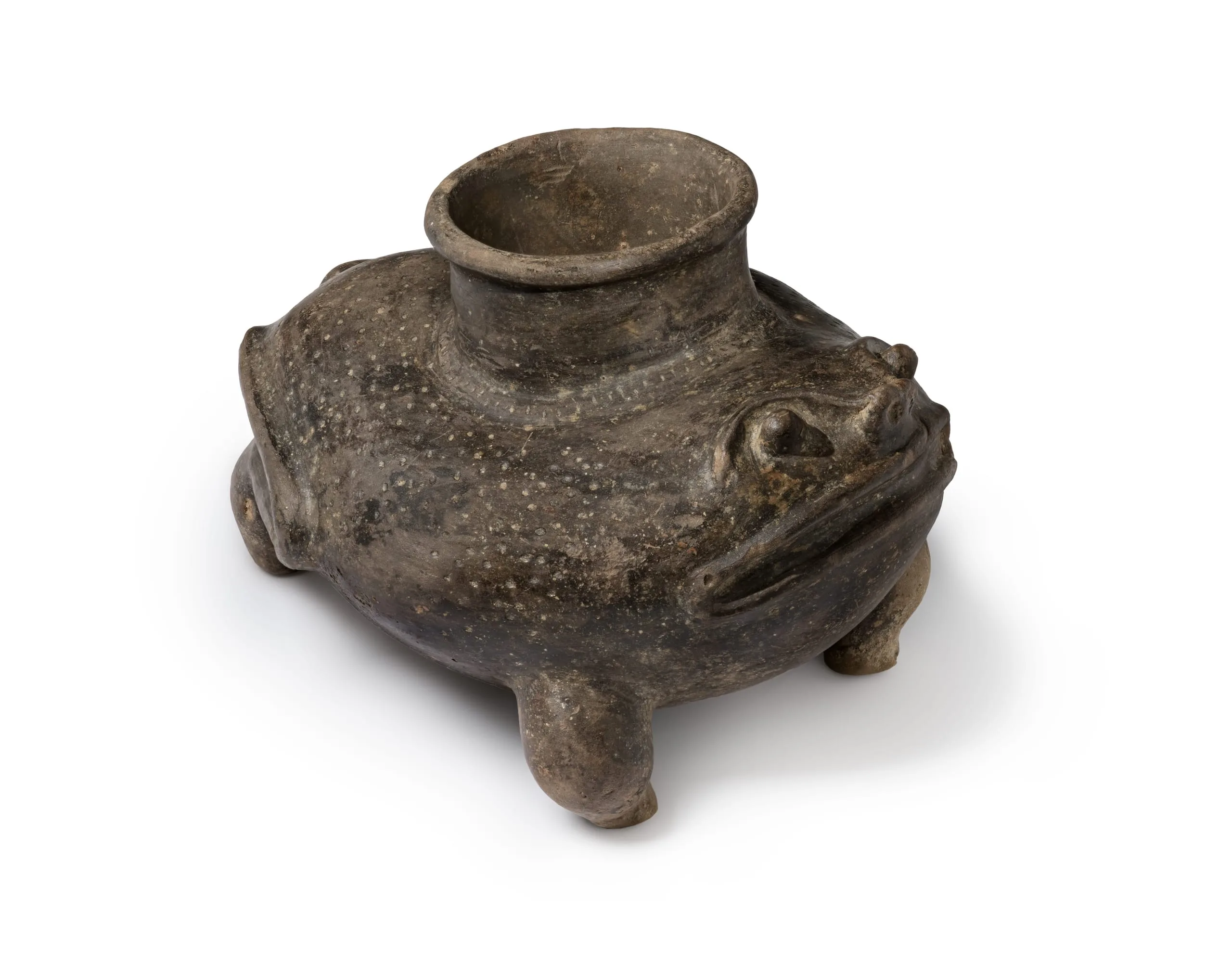
With its warty skin, pointy nose, and considerable size, this vessel is an almost perfect to-scale rendering of a cane toad (Rhinella marina) in a defensive posture, puffed up and lifting its body off the ground to appear taller and larger. The person who made this vessel was almost certainly well aware of the animal’s behaviors, practical uses, and ritual meanings.
The varied and complex meanings of frogs or toads encompass both transformation and fertility. Many species emit toxic secretions that Indigenous people of the Americas have skillfully wielded as hallucinogens and dart poison for millennia. Cane toads have glands that secrete a milky white fluid known as bufotoxin, the effects of which are similar to those of mild poisoning. The symptoms can include hallucinations, and many ritual specialists, past and present, make use of hallucinogenic substances harnessed from plants or animals for vision-questing and ritual transformation. However, as the cane toad excretes bufotenin in small amounts alongside other toxins in relatively large quantities, uninformed or careless attempts to harness its power can result in serious illness or death. Today, the Embera-Wounaan of Panama “milk” cane toads primarily for their toxin to use as an arrow poison.
As is the case for many frogs, cane toads are prolific breeders, with females laying long strands of spawn with thousands of eggs at once. This habit, coupled with the fact that some species hide underground during the dry season and emerge suddenly when the first rains come, has also made them symbols or harbingers of fertility and abundance in the mythology of many cultural groups.
Although this vessel’s function is not known, it is tempting to assume it was made to hold some hallucinogenic brew. However, according to elders of the Arhuaco culture (descendants of the Tairona who made this toad centuries ago), these are the least important questions to ask about a piece such as this. In Arhuaco ontology, everything has a reason for being. By rendering an animal so faithfully in ceramic or other materials, the maker contributes to the richness of the world in reciprocity for what we consume from it in order to live here.