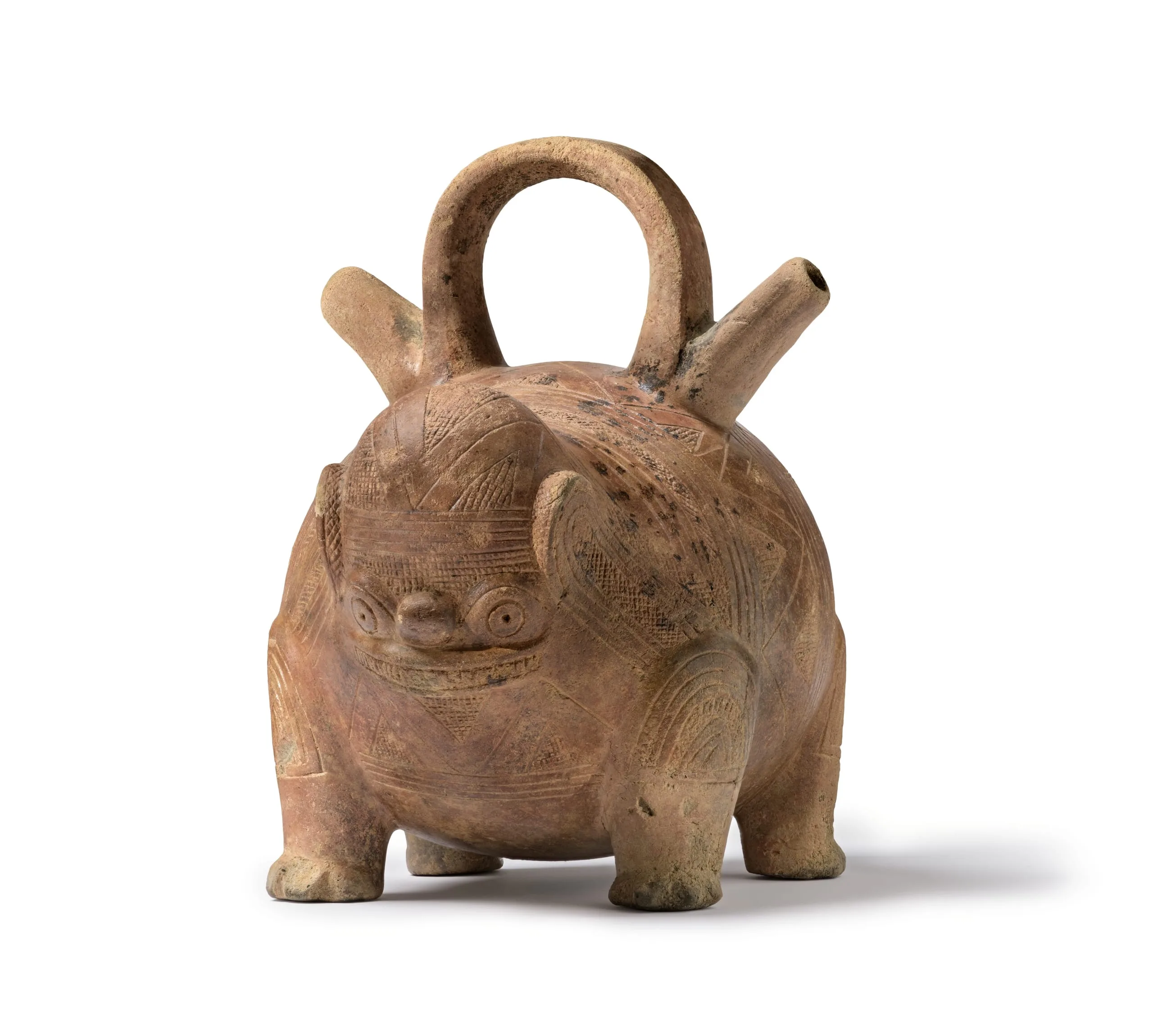
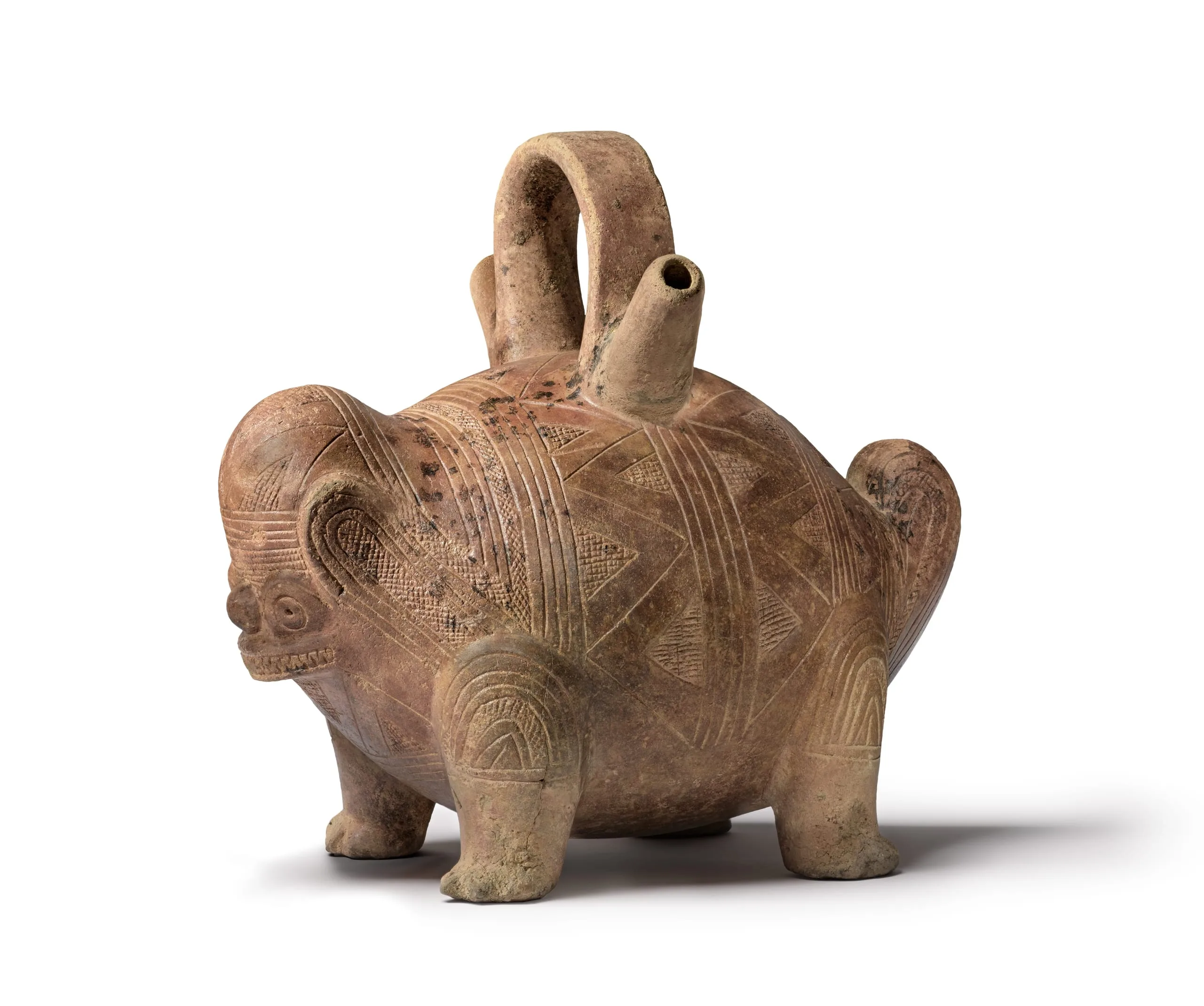
Standing on four sturdy legs, this animal-shaped vessel has incised patterns all over its body. The form, with a loop handle flanked by two spouts, is called an alcarraza (a modern Spanish term), and dates back to the Ilama period, probably sometime in the first millennium BCE. Although our vessel bears a resemblance to other Calima Ilama alcarrazas that depict animals such as armadillos or turtles (see M.2007.146.336), its features are indecipherable, so scholars refer to the type simply as the “Fabulous Beast.” It probably ended up as a burial offering, but its prior use—if any—is not known.
According to elders of the Arhuaco culture in northern Colombia, however, the typical questions that we ask about pieces such as our “Fabulous Beast”—provenance, dating, function, decorative subject matter—may not actually be what is important about them. Over a number of years of close collaboration between LACMA and the Arhuaco community (see Burtenshaw et al. 2022), we learned that treating this piece merely as a source of data about the past misses the point, because it was not made for the purpose of recording historical data. Compiling a lot of information about it will not reveal its true significance—past or present. That larger meaning resides in the item’s purpose as a reciprocal offering. Pieces like this were created to sustain healthy relationships in the network of life; that is, to help manage the universe. Indigenous people in the Americas understand that the balance of life is delicate. Maintaining respectful relationships with the rest of the world and the beings that inhabit it requires reciprocity. A conversation with Arhuaco elder Jaison Pérez Villafaña clarifies this point:
Jaison Pérez: There are various activities needed to hunt, and to transform meat into food. You pay before going hunting. I nourish with my offering. If I stop doing this practice, my son, my family, becomes their food. When we take too much, without permission, we get sick.
Diana Magaloni: This is also related to the objects that we are displaying here, because they are offerings?
Jaison Pérez: That’s right, they are food for the parents [los padres, encompassing the creators, ancestors, and mother earth].
In other words, vessels such this one are human contributions to the richness of the world, reciprocal offerings for what we consume. This is why, in the Indigenous worldview, the extraction of ancestral works from tombs or other offering contexts damages, even breaks, the reciprocal relationship that was established with the powers of the universe.
Under the right circumstances, however, such pieces, which contain the essences of living creatures and ancestral beings, can continue to fulfill a balancing role today. For example, they brought LACMA staff to Colombia to seek out Indigenous knowledge and leadership, prompting a dialogue that resulted in an Indigenous-led interpretation and exhibition of ancient Colombian works at LACMA and other North American and European museums in 2022−24. By creating bridges between different cultures and respect for different perspectives or worldviews, pieces like this one continue to contribute to a more harmonious world and a better balanced universe.
Julia Burtenshaw
2025
Selected Bibliography
Burtenshaw, Julia. “What Happened Next? A Sacred Ceremony After ‘Unpacking the Universe: The Making of an Exhibition.’” LACMA Unframed, December 11, 2022, https://unframed.lacma.org/2022/12/11/what-happened-next-sacred-ceremony-after-unpacking-universe-making-exhibition.
Burtenshaw, Julia, Diana Magaloni, Maria Alicia Uribe, and Hector Garcia Botero, eds. The Portable Universe/El Universo en tus Manos: Thought and Splendor of Indigenous Colombia. LACMA/DelMonico Prestel, 2022.
Unpacking the Universe: The Making of an Exhibition, Los Angeles County Museum of Art, 2022, https://www.youtube.com/playlist?list=PLJy-HLfC3xxCue9_kM1GRNcnPEaNvi_aW.