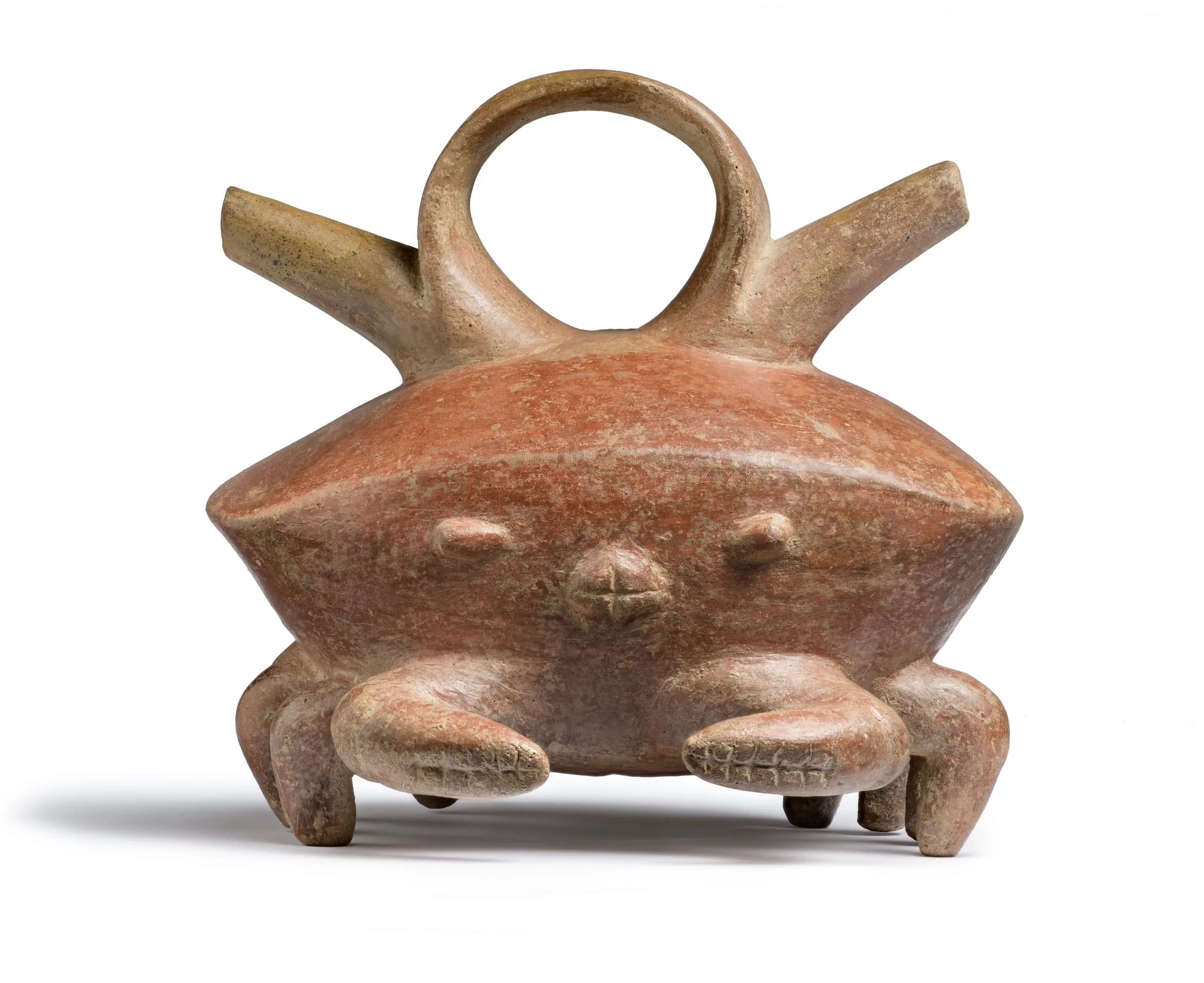
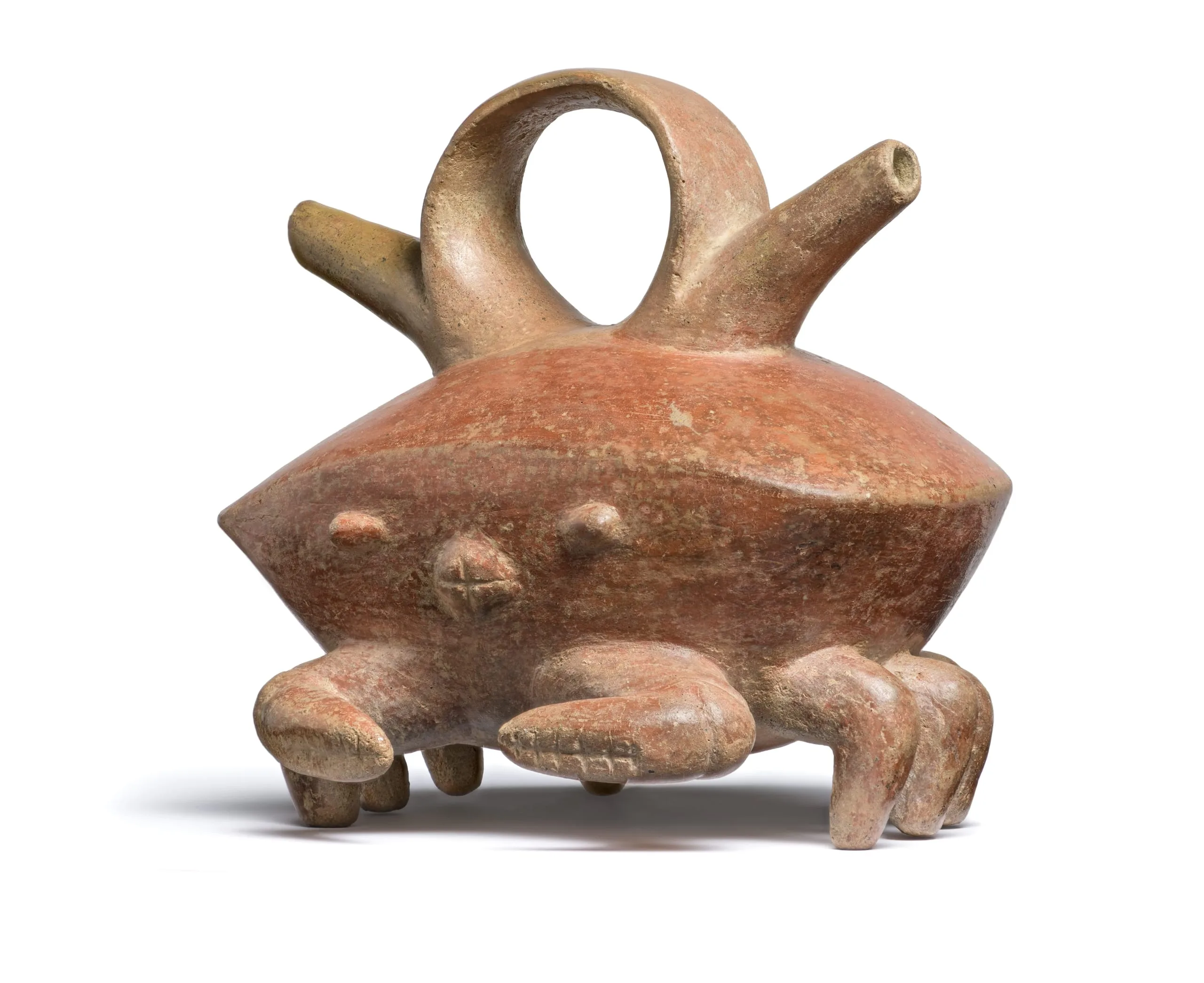
Made more than 2,000 years ago, this crab-shaped vessel charms today as it no doubt did in the past. Free-standing on six pointy legs (almost like its real-life brothers and sisters, which have eight legs), this lively sculpture is a testament to the skill of its maker. Ceramists of the Ilama period in what is now eastern Colombia both reflected and contributed to the natural world by creating animals of both naturalistic and imagined forms. Their medium of choice was a ceramic vessel with two spouts flanking a loop handle, a form now known as an alcarraza. Whether these delightful creations ever contained drink or liquid for a ceremony is unknown, but many were interred in burials or other offerings, which is how they survived through millennia to the present day.
A story of deceit, dance, and gifts surrounds the crab in a myth told by the Uitoto of Colombia and Peru and sheds light on the significance that sculptures like these may have had for the people who made and used them. At one point in a long narrative involving revenge, a character known as Jirayauma is being pursued and, after crossing a river, is caught in a tangle of vines. Desperate, he sees a crab walking along the shore and shouts to it: “Uncle Crab, help me free myself from these vines!” The animal uses its pincers to cut the vines that hold Jirayauma. Free, he thanks the crab but cannot help but notice the animal’s fractured legs and asks what happened. The crab tells him that the fish had asked for help in recovering the chontaduro palm, which had been stolen by men. With its tweezers, the crab cut the roots of the palm to return it to the fish. But the fish, ungrateful, did not pay the crab for its work. A human saw that the chontaduro had been stolen and unleashed his fury on the crab, breaking its legs. Pleading for peace, the crab offered the man a chontaduro root as a gift. From that root, the palm now grows freely among men. Jirayauma hears this story but has no way to repay the crab for its help. In gratitude, he teaches the crab some dance steps. Since then, when you see a crab move, it seems like it is dancing.
This crab vessel is remarkably similar to another in LACMA’s collection (M.86.296.163), made thousands of miles away in western Mexico. Indeed, the visual similarities of human, plant, and animal figures sculpted in ceramic between these regions align with other sources of evidence for long-distance maritime contact along the Pacific coast from Peru and Ecuador to West Mexico, such as the tradition of shaft-tomb burials, the presence of hairless dogs, and the iconic stirrup-spout bottle form.
Julia Burtenshaw
2024