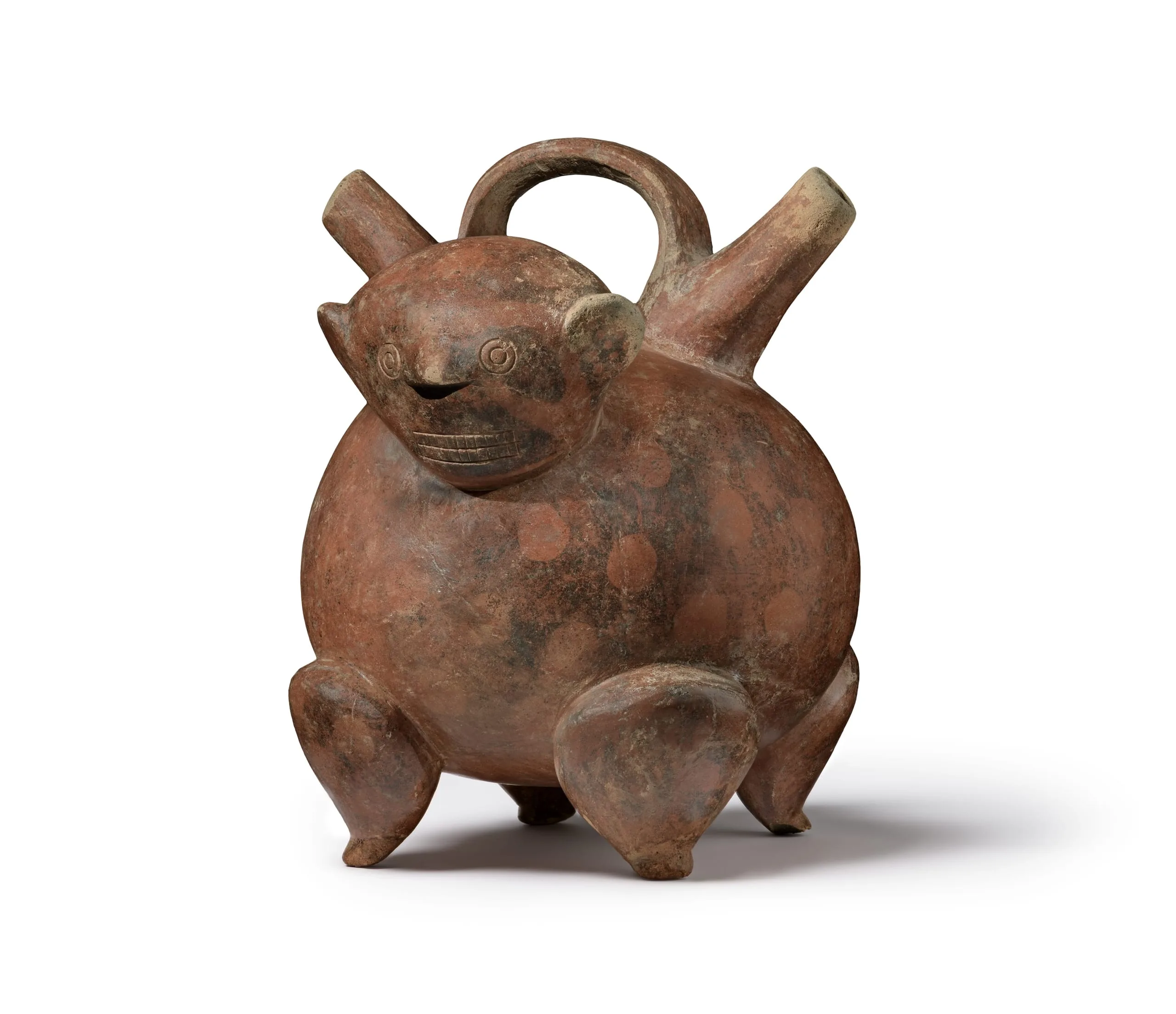
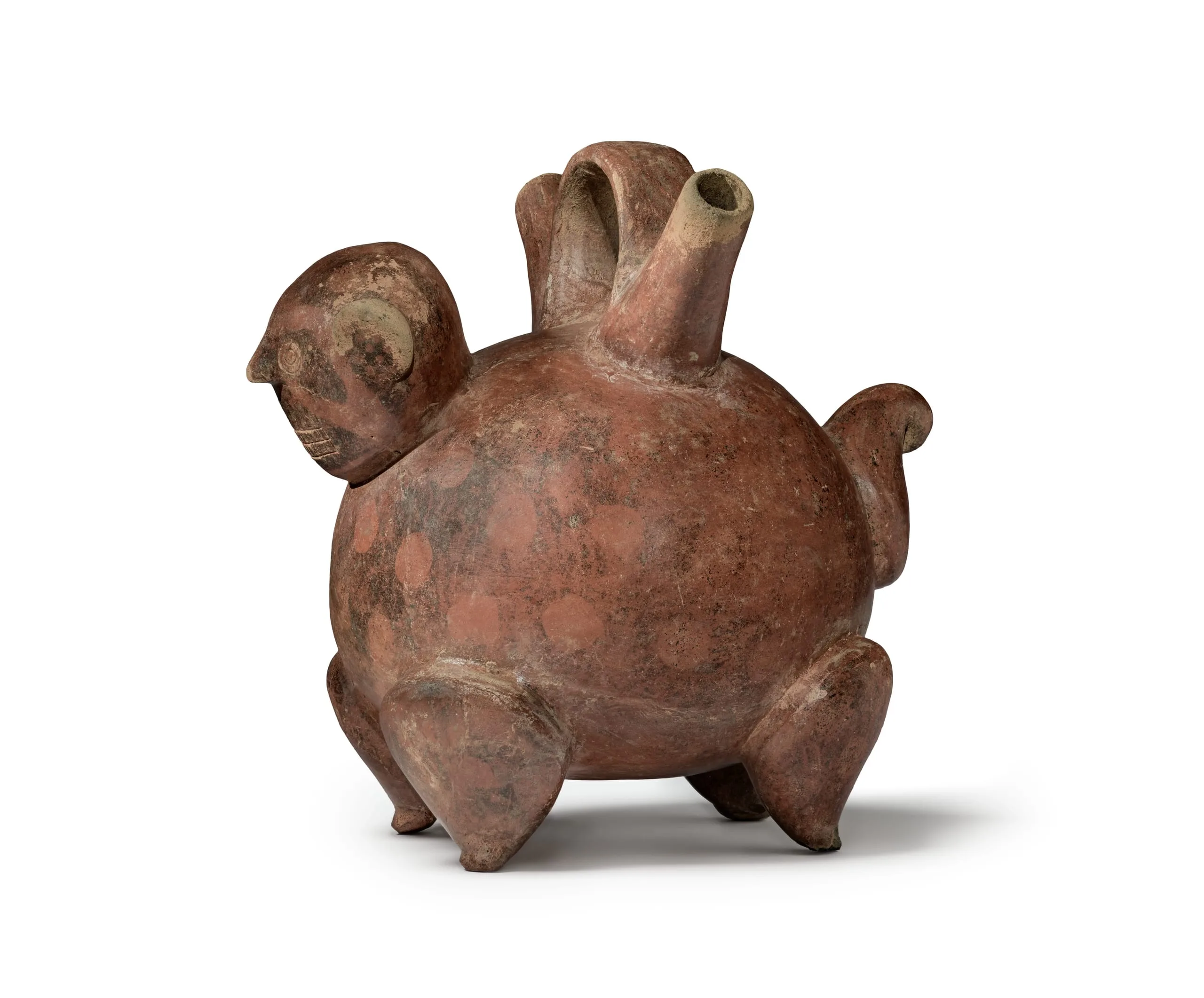
Archaeological research indicates that this style of vessel was made in the Calima region during the Yotoco period, sometime between 100 BCE and 800 CE. The specific form with a loop handle flanked by two spouts is called an alcarraza, a modern Spanish term. Its face is humanlike but, standing on four legs and with a curled-up tail, it more likely depicts a monkey; meanwhile, the spotted pattern on the body, created using a resist painting technique, could indicate the pelt of a jaguar. Perhaps this being is meant to represent them all. Drawing from and contributing to their diverse ecological surroundings as well as their rich mythology and spiritual practices, Calima artists represented and invented a range of mammalian, reptilian, and avian beings, in both metalwork and ceramic (see also M.2007.146.283 and .335). Like many others, this vessel probably ended up as a burial offering, but its prior use—if any—is not known.
Over a number of years of close collaboration between LACMA and the Arhuaco community (see Burtenshaw et al. 2022), we learned that treating pieces like this as merely sources of data about the past misses the point, because they were not made for the purpose of recording historical data. We may gather a lot of information about them, but we do not understand them. According to Arhuaco elders, such pieces are the human contribution to the richness of the world. They were created as reciprocal offerings to maintain balance in the network of life; in other words, they help manage the universe. Today, they still contain the essence of living creatures and ancestral beings and can create bridges between different cultures, us and them, past and present. By inviting us to consider a different perspective or worldview, they foster tolerance and can continue to fulfill a balancing role today.
Selected Bibliography
Burtenshaw, Julia. “What Happened Next? A Sacred Ceremony After ‘Unpacking the Universe: The Making of an Exhibition.’” LACMA Unframed, December 11, 2022, https://unframed.lacma.org/2022/12/11/what-happened-next-sacred-ceremony-after-unpacking-universe-making-exhibition.
Burtenshaw, Julia, Diana Magaloni, Maria Alicia Uribe, and Hector Garcia Botero, eds. The Portable Universe/El Universo en tus Manos: Thought and Splendor of Indigenous Colombia. LACMA/DelMonico Prestel, 2022.
Unpacking the Universe: The Making of an Exhibition, Los Angeles County Museum of Art, 2022, https://www.youtube.com/playlist?list=PLJy-HLfC3xxCue9_kM1GRNcnPEaNvi_aW.