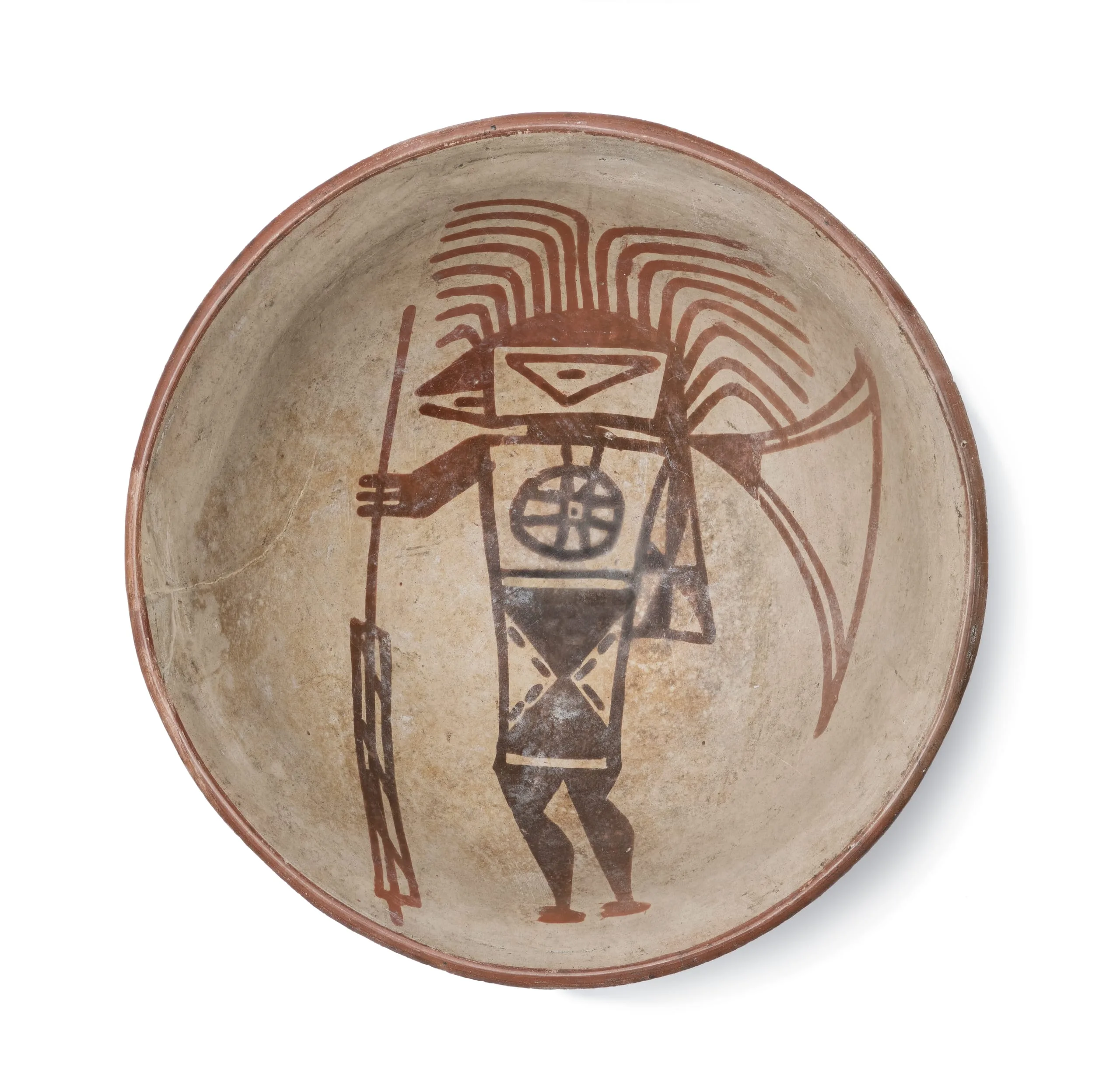
The elaborately adorned individual painted onto this bowl is either wearing a bird-mask and headdress or is partially transformed into a bird, judging by the beak. Other depictions of the same character are known, and it is likely that they represent a particular being from a myth. Holding a staff or paddle, they might be engaged in some kind of ritual dance. Our footed bowl is a stunning example of the so-called Tuza style, a type of slip-painted ceramic made in the highlands of southern Colombia and northern Ecuador around 800−1500.
Of particular note is the eight-pointed motif resembling a star that decorates the figure’s breastplate. This shape is commonly depicted at the center of Nariño bowls (see M.2007.146.161, .170, .171, .176, .181, .187, .205, and .211), gold jewelry, and occasionally in rock art of the region. According to the most common interpretation, the motif embodies the cardinal directions and solstice points, signaling its wearer as a keeper of calendrical and cosmic order. In that sense, it is reminiscent of the chakana or Andean cross and its meanings in the central Andes (see M.74.151.14).
Today, the so-called Sol de Pasto (Sun of Pasto) remains a powerful symbol in the Nariño region, strongly associated with the Pasto and Quillacinga Indigenous communities, but serving as a marker of regional identity in general. It decorates the floor of the central plaza of Pasto city and features prominently in festivals and local contemporary art. The star’s eight rays are said to represent the foundations of human life: family, health, pleasure, friendship, community, children, knowledge, and wealth—modern projections onto or reinterpretations of an ancient motif that people identify with and take pride in.
Julia Burtenshaw
2025