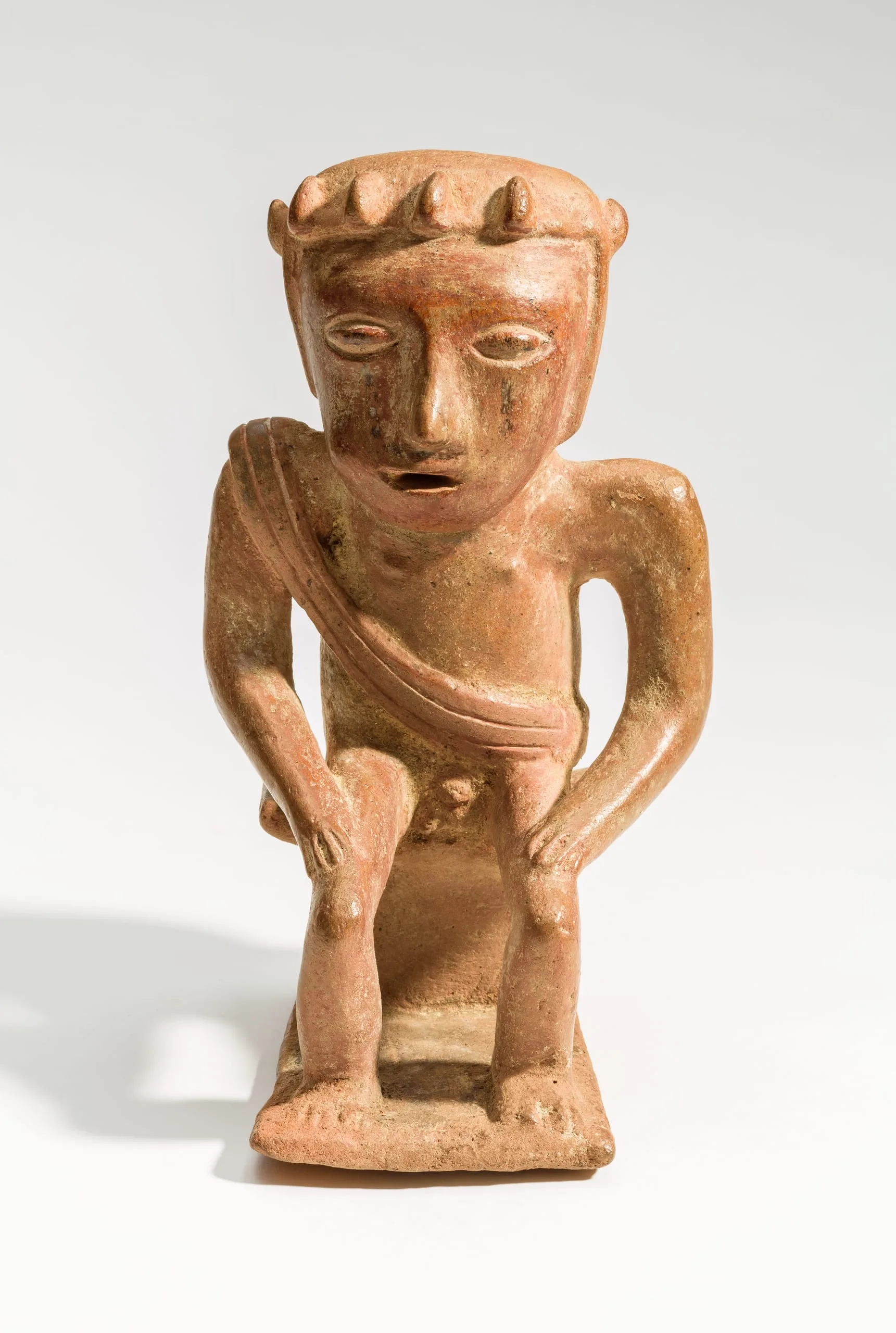
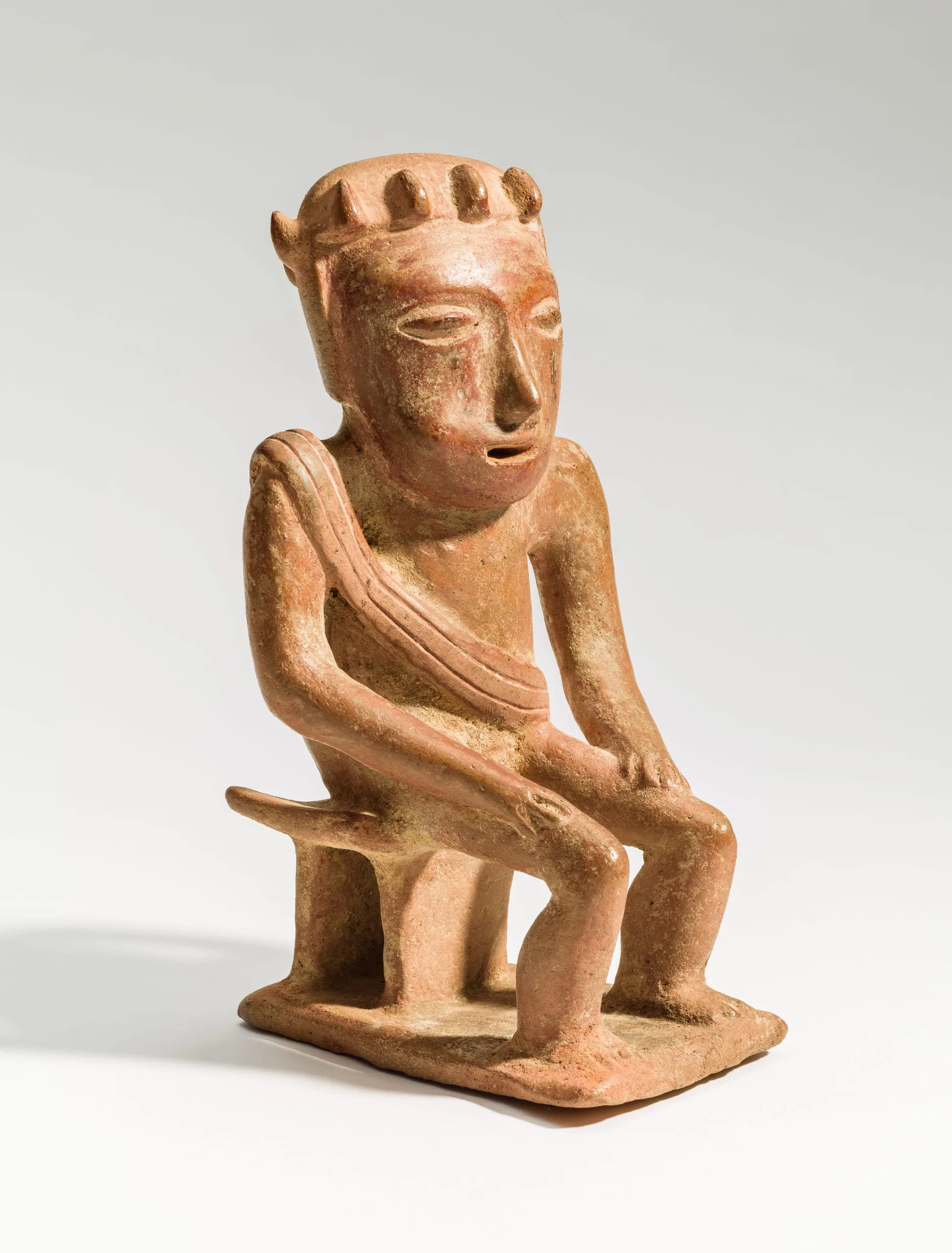
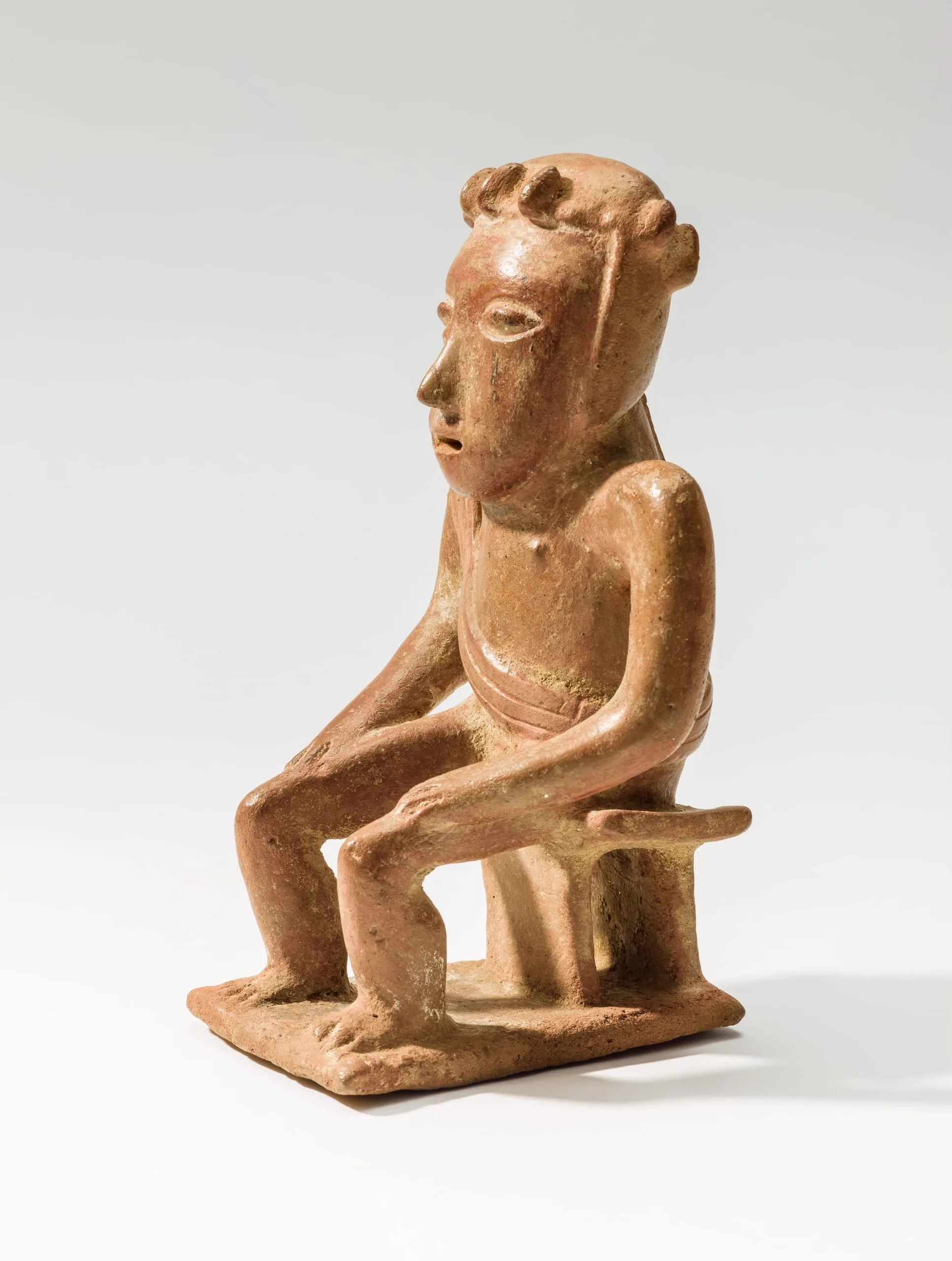
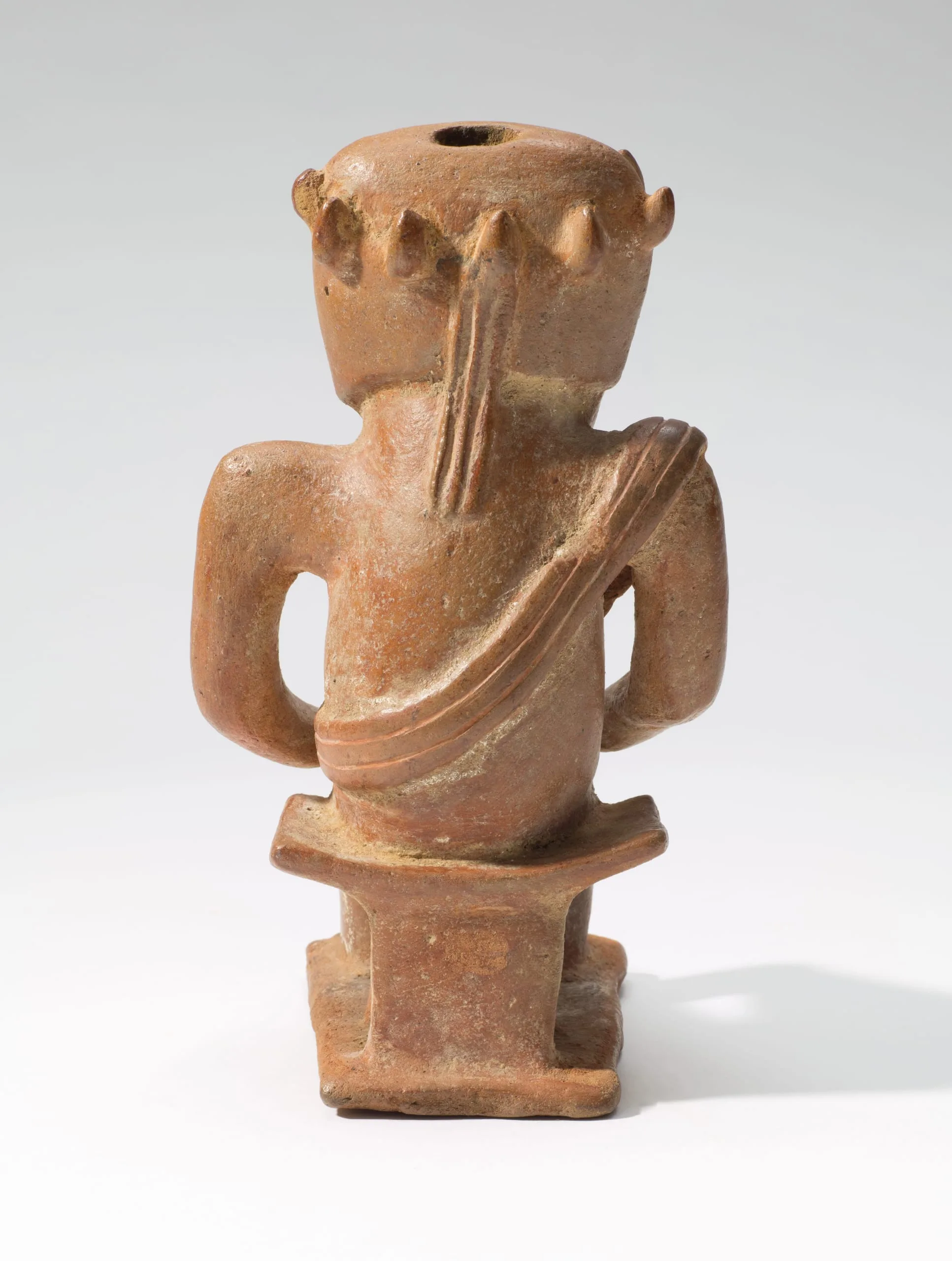
This small sculpture most likely depicts a chief or ritual specialist, deep in thought as he chews a wad of coca leaves (coquero means “coca-chewer” in Spanish). His high status is inferred from the fact that he is seated on a raised bench, a clear indicator of rank in the ancient Americas. The figure and bench, and the platform to which both are attached, were modeled and fired in one piece, a testament to the skill of the ancient ceramic artist who made it. Like all coquero figurines, this one is hollow, which was necessary for the firing process. The sculpture’s use is unknown, but its survival suggests that it was deposited in a tomb. On the other hand, the hole in the top of the head could indicate that it was used as a container. Based on extant examples, coca-chewing among the pre-Conquest inhabitants of Nariño seems to have been primarily a male activity, although some female figurines of the same style have the telltale bulging cheek. The one in our collection does not (see M.2007.146.115).
For many present-day Indigenous peoples of Colombia, small stools or benches (banquitos) continue to play an important role in community decision-making, which often takes place in spiritual contexts. According to Jaison Pérez Villafaña, an Arhuaco elder, “The bench supports you while you think. It helps you ground what you have not understood. You are inviting yourself to solve a problem that worries you.” Among the Caribbean Taíno, special stools (duhos) were considered containers and transmitters of great spiritual power. Only ritual specialists who could channel such spirits were allowed to sit on the stools.
The chewing of coca leaves, often in combination with a catalyst such as lime powder, which acts as a mild simulant that improves focus and clarity, is a central part of ritual practice in almost all Indigenous cultures from Colombia to Argentina to this day. Chewing coca also calms the stomach, quells hunger and thirst, provides energy during high-altitude journeys, and has nutritional benefits. It is the modern Western world that has resorted to chemical processes (involving toxic solvents like gasoline and acetone) in order to refine the natural properties of the coca plant into cocaine, unleashing a war against such drugs and the people who make them.
Julia Burtenshaw
2024