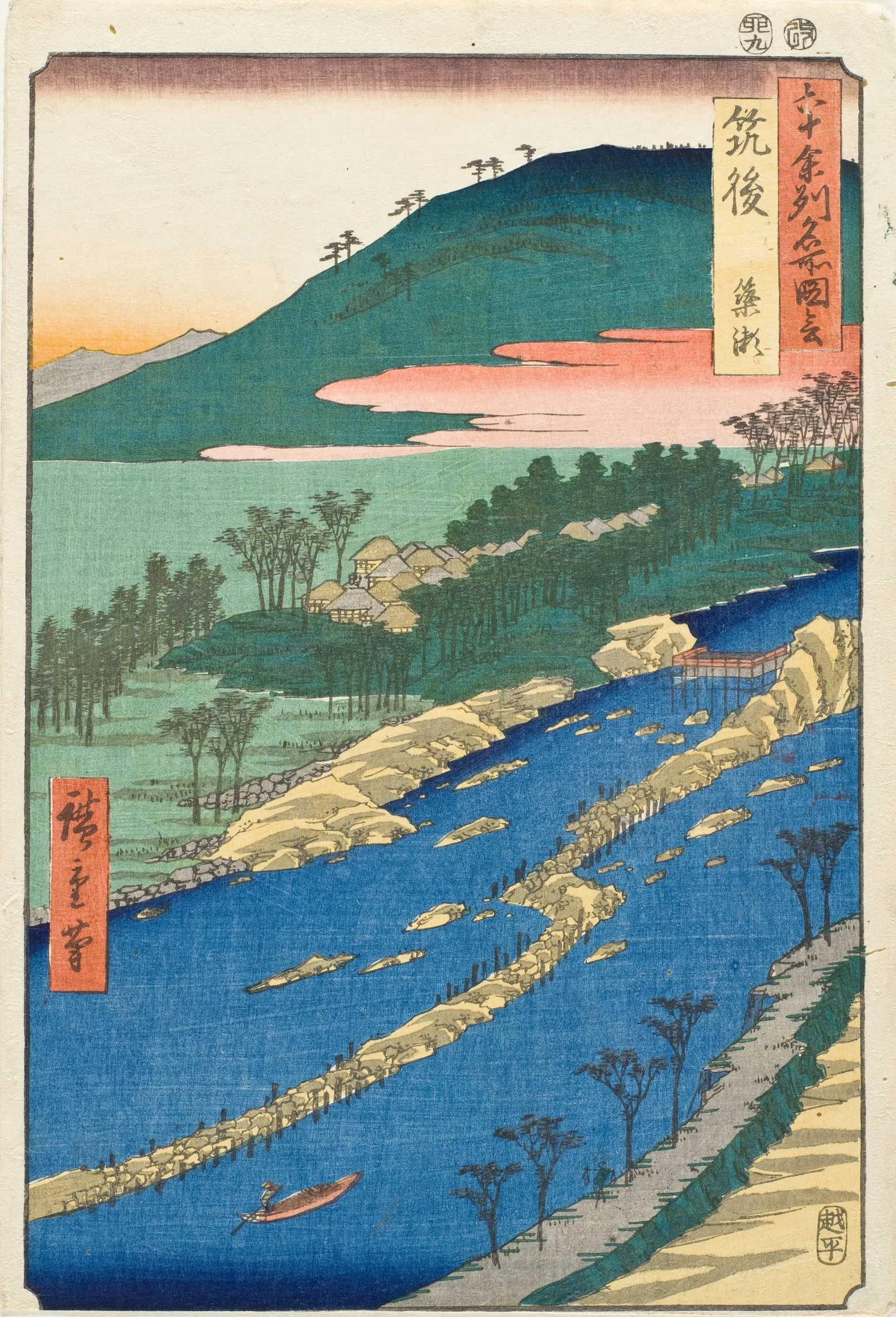
Utagawa Hiroshige designed many series of landscape prints. This view of the Chikugo River belongs to his popular Rokujūyoshū meisho zue (Famous Places of the Sixty-odd Provinces), which he designed from 1853 to 1856. The series consists of sixty-nine prints presenting well-known locales or places of particular interest from each of the sixty-eight provinces and the city of Edo. The vertical orientation was unusual for the time. The Chikugo is the largest river of Kyūshū, the southernmost of Japan’s five main islands. It separated Chikugo Province (today southwestern Fukuoka Prefecture) from the province of Chikuzen. The village of Haki is seen on the far bank. Running down the center of the river is a fishing weir, a man-made structure placed in the water to direct the flow of fish, thereby trapping them in a small area where they are gathered by fishermen. Here, the weir captures sweetfish (ayu), which were a summertime specialty of the region.
Over the course of the eighteenth and nineteenth centuries, travel became an increasingly popular recreation. Like so many other Japanese, it is said that Hiroshige journeyed on the Tōkaidō road between Edo and Kyoto and visited popular scenic sites along the Sumida River and elsewhere. On his travels, he sketched the towns, landscapes, and scenery that he encountered, drawings that he used later in designing prints. He also based some of his designs, including many of the prints from the Rokujūyoshū meisho zue series, on existing prints and printed books, in particular travel guides (meisho zue) of the time. The view captured here is based on an illustration from the early nineteenth-century book Sansui kikan (Exceptional Landscapes) by artist Fuchigami Kyokkō (1753−1816).
2024