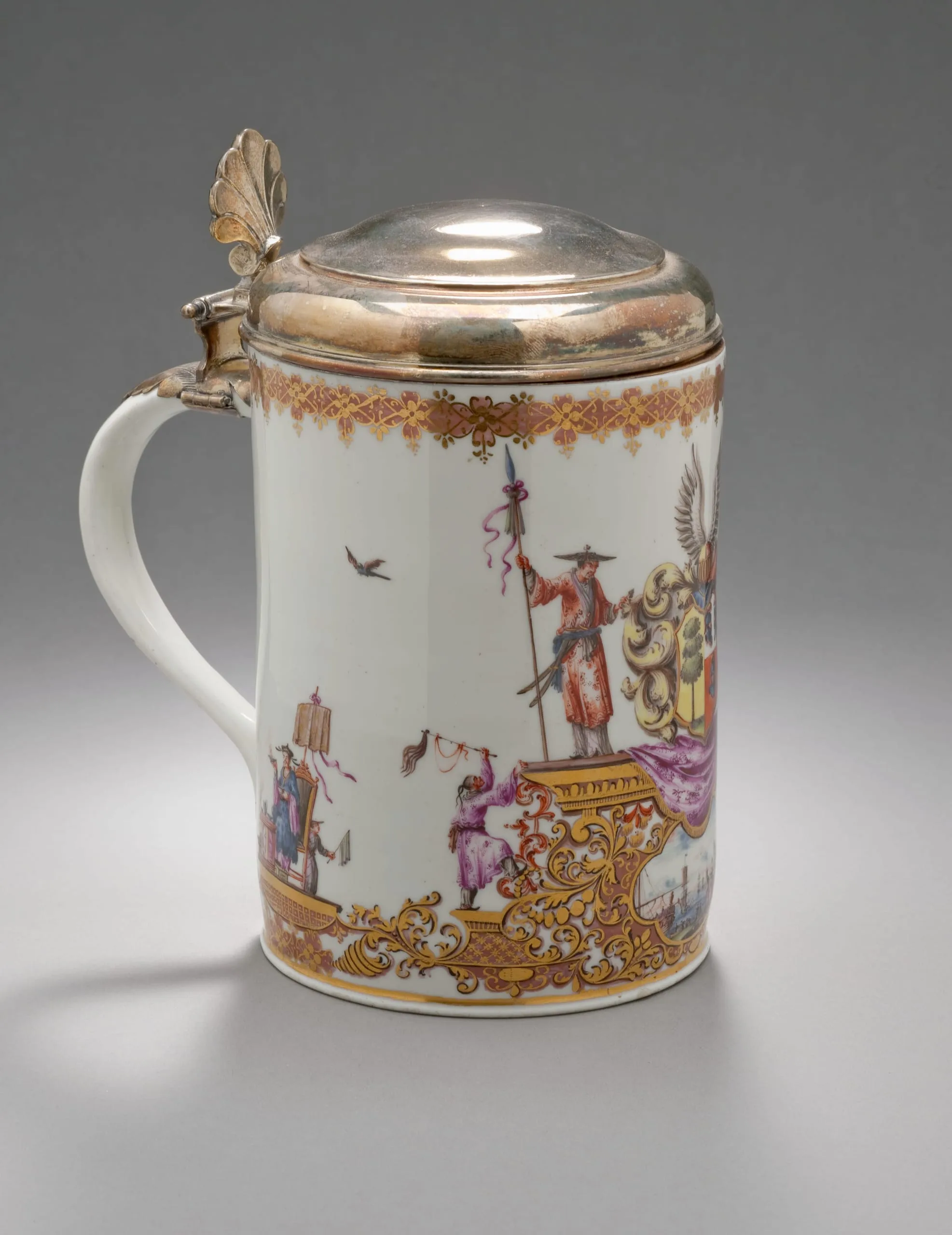
It was only in 1709 at Meissen, near Dresden, the capital of Saxony, that Europeans finally discovered the formula for producing true porcelain. For a thousand years, only the Chinese had mastered the right combination of feldspathic clay and minerals that when fired at a high temperature produced brilliant, white, translucent porcelain. In the eighteenth century, porcelain was nearly as precious as gold, and unlocking the secret of its production changed the course of European ceramics as rival factories sprang up. Augustus the Strong, the ruler of Saxony and sponsor of the Meissen factory, exulted in his kingdom’s discovery of the technique. He soon launched an ambitious program to decorate his Dresden palace with German porcelain that rivaled the Chinese wares.
A decade later, artists at Meissen developed colored pigments that could withstand the high temperature required to fire porcelain. Previously, only underglaze blue had been a reliable color. After 1720, pieces like this tankard could be painted in a full array of colors that fused with the glaze. Johann Gregor Höroldt, a Viennese artist recruited to Meissen, invented a style of painting with fanciful orientalizing figures known as “chinoiserie.” The decoration of this tankard is unusually rich, combining chinoiserie figures that flank a large (unidentified) coat of arms, landscape vignettes, and gold platforms. Such pieces were often diplomatic gifts presented to foreign hosts, serving as a political gesture while also proclaiming Saxony’s artistic achievement.