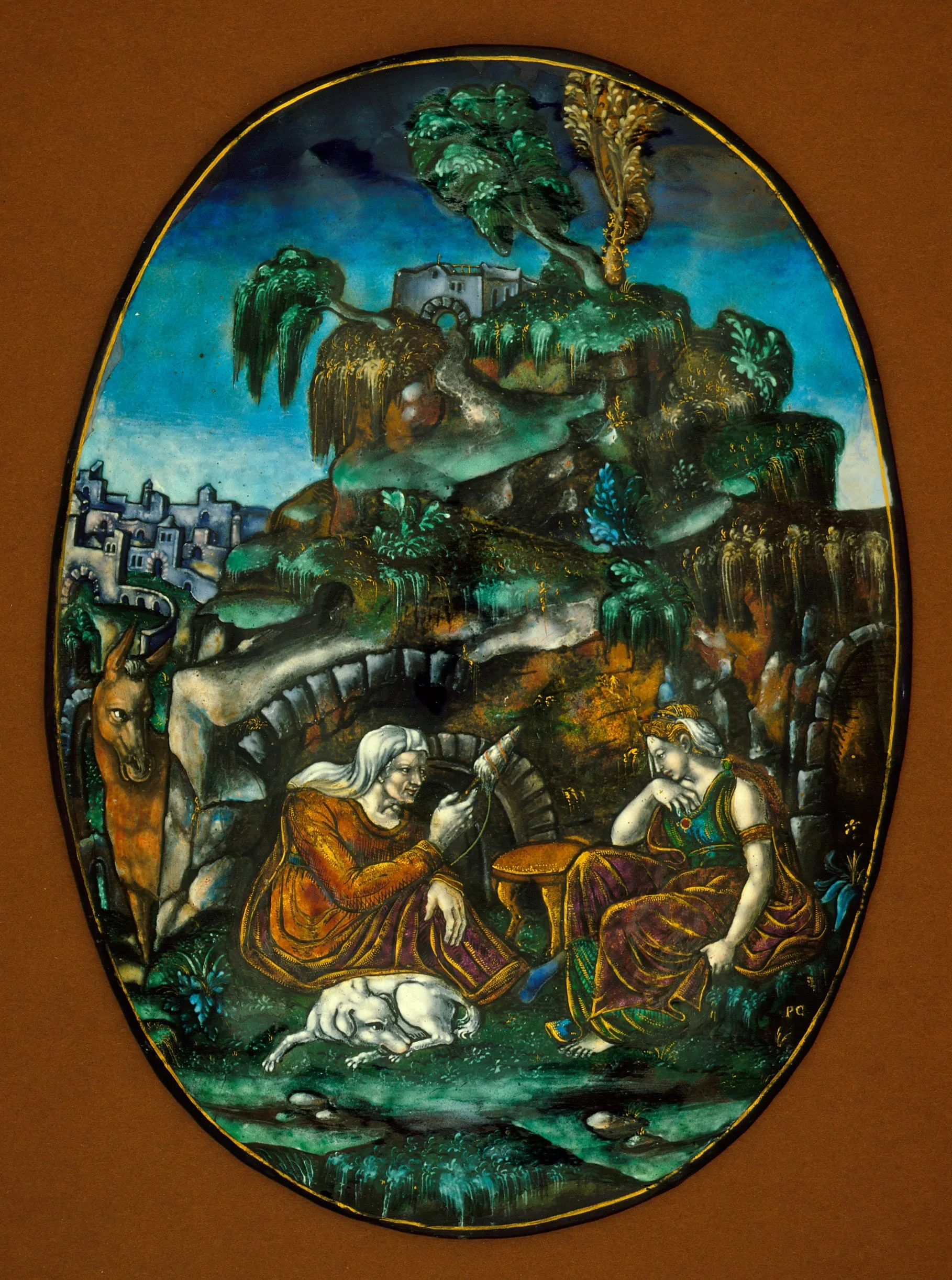
This enameled plaque by Pierre Courteys depicts the introduction to the tale of the love of the mortal Psyche for the god Cupid as told by the Roman satirist Apuleius. The protagonist, Lucius, is a Greek adventurer magically transformed into a jackass. Here he pricks up his ears to listen as an old woman tells Psyche's story to a bride kidnapped on her wedding day and awaiting ransom.
Courteys, a member of a family of skilled enamel painters from Limoges, was noted for his elegant figures and vigorous painting style. He rarely executed original compositions but, like most Limoges enamel painters, obtained ideas from other sources. He made a series of plaques depicting the story of Psyche.
Enamel painting, related to stained-glass painting, was developed in the early fifteenth century, probably in the Netherlands. The brilliant pigments were made from powdered metallic oxides suspended in liquid, applied like paint, and then fired. The demanding techniques and meticulous skills of copper enameling were brought to their highest level by artisans of Limoges, a medieval center of enamel work.
The earliest Limoges plaques (around 1470) were religious images commemorating pilgrimages, shrines, or saints' lives and were used for private worship. By the mid-1500s a more worldly and sophisticated clientele demanded secular subjects and luxury items; enameled plates, plaques, candlesticks, saltcellars, jewel boxes, and mirror backs were produced for the wealthy of Europe. Large plaques like this one were used as architectural ornaments and set into wainscoting and door panels.