- Title
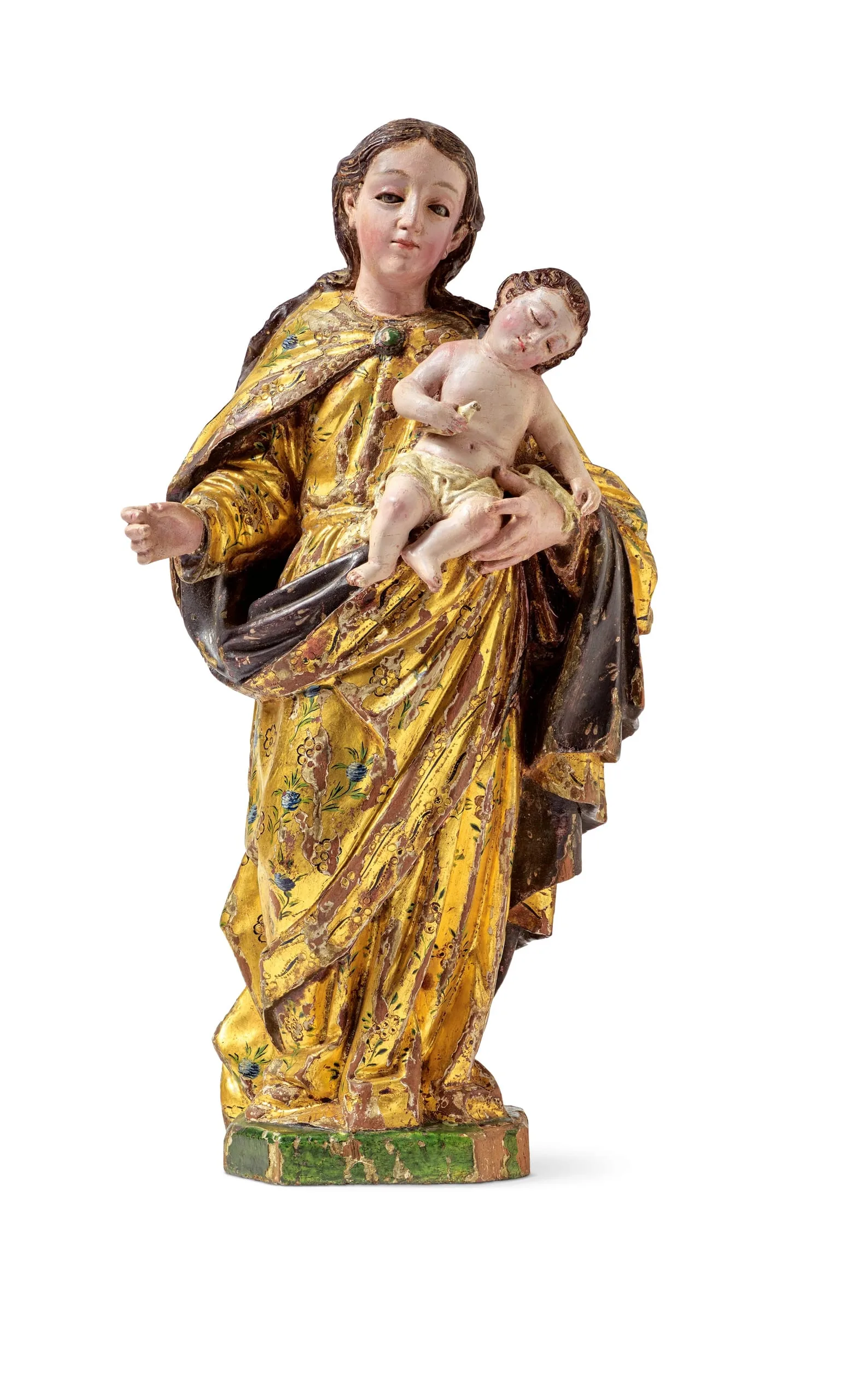
- Virgin of the Rosary (Virgen del Rosario)
- Date Made
- circa 1750-1800
- Medium
- Polychromed and gilded wood, and glass
- Dimensions
- 11 7/16 × 5 3/4 × 4 in. (29.1 × 14.6 × 10.2 cm)
- Accession Number
- M.2007.159
- Curatorial Notes
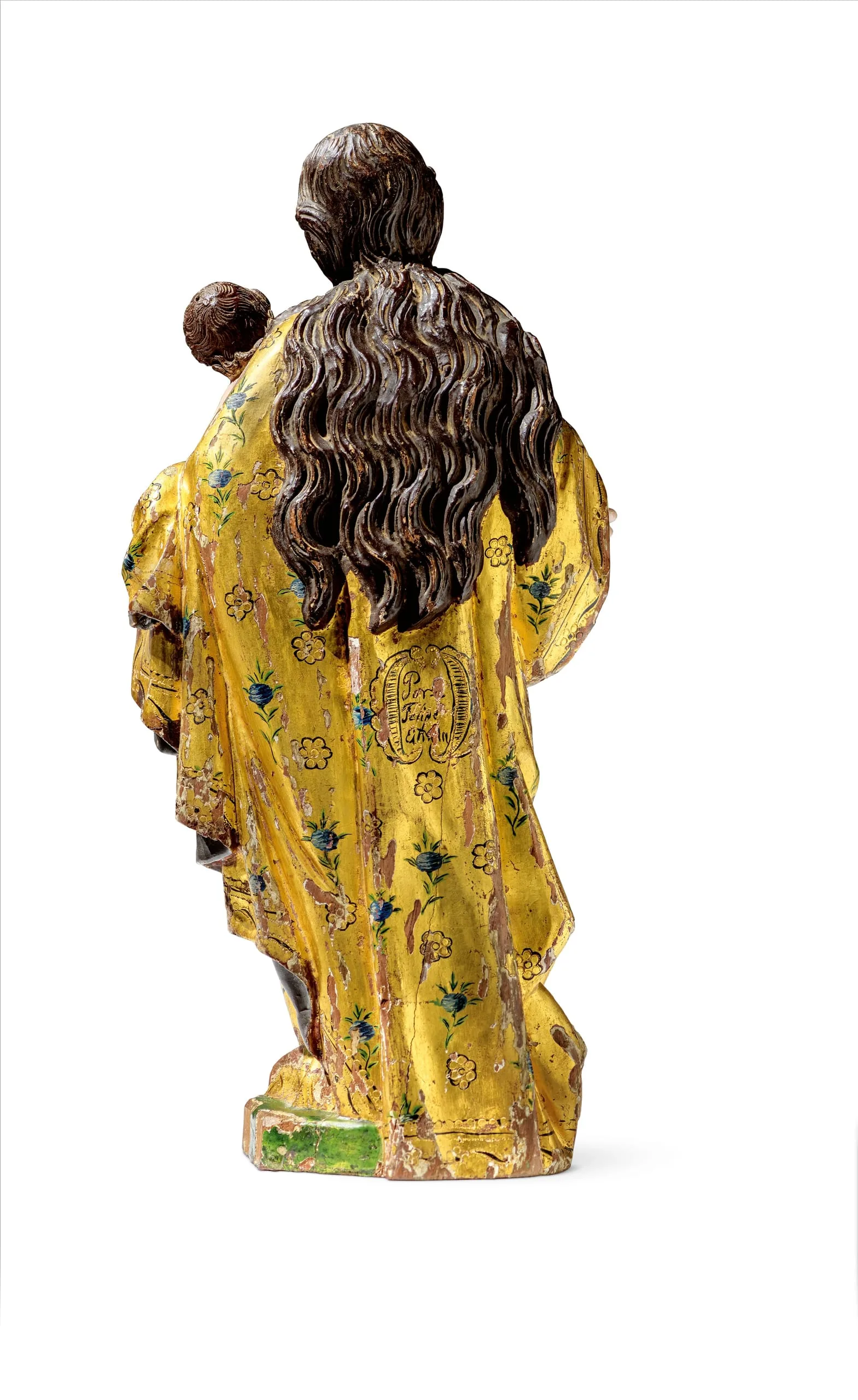
This sculpture probably once included a rosary hanging from the right hand. The Dominican order introduced the devotion of Our Lady of the Rosary to Guatemala in the sixteenth century. A famed sculpture of the Virgin was venerated in the church of Santo Domingo in Antigua before it was moved to Guatemala City, becoming an important reference for artists. Designed for private use, LACMA’s work is decorated with intricate estofados, painted and incised patterns made to emulate fine fabrics. The signature on the back corresponds to the polychromer—a rare detail pointing to a pride in craft.
The tradition of polychrome sculpture originated in Europe (the region of Andalusia in Spain was a main production center), but some of the finest practitioners were in Guatemala. Here, the figures were made more naturalistic through the addition of real eyelashes and hair, ivory and bone teeth, glass eyes and tears, and the use of encarnaciones (the technique of painting flesh tones) for the faces, hands, and feet.
Ilona Katzew
2024
- Provenance
Private collection, Germany; Hampel Fine Art Auctions, Munich, March 24, 2007, lot 974; Simois Gestión de Arte SL, Madrid, 2007; LACMA, 2007.
- Selected Bibliography
- Katzew, Ilona, ed. Archive of the World: Art and Imagination in Spanish America, 1500–1800: Highlights from LACMA’s Collection. Exh. Cat. Los Angeles: Los Angeles County Museum of Art; New York: DelMonico Books/D.A.P., 2022.
- Selected Exhibition History
- Archive of the World: Art and Imagination in Spanish America, 1500–1800. June 12, 2022 - October 30, 2022
- Archive of the World: Art and Imagination in Spanish America, 1500–1800. October 20, 2023 - January 28, 2024
- Archive of the World: Art and Imagination in Spanish America, 1500–1800. June 22, 2024 - September 08, 2024