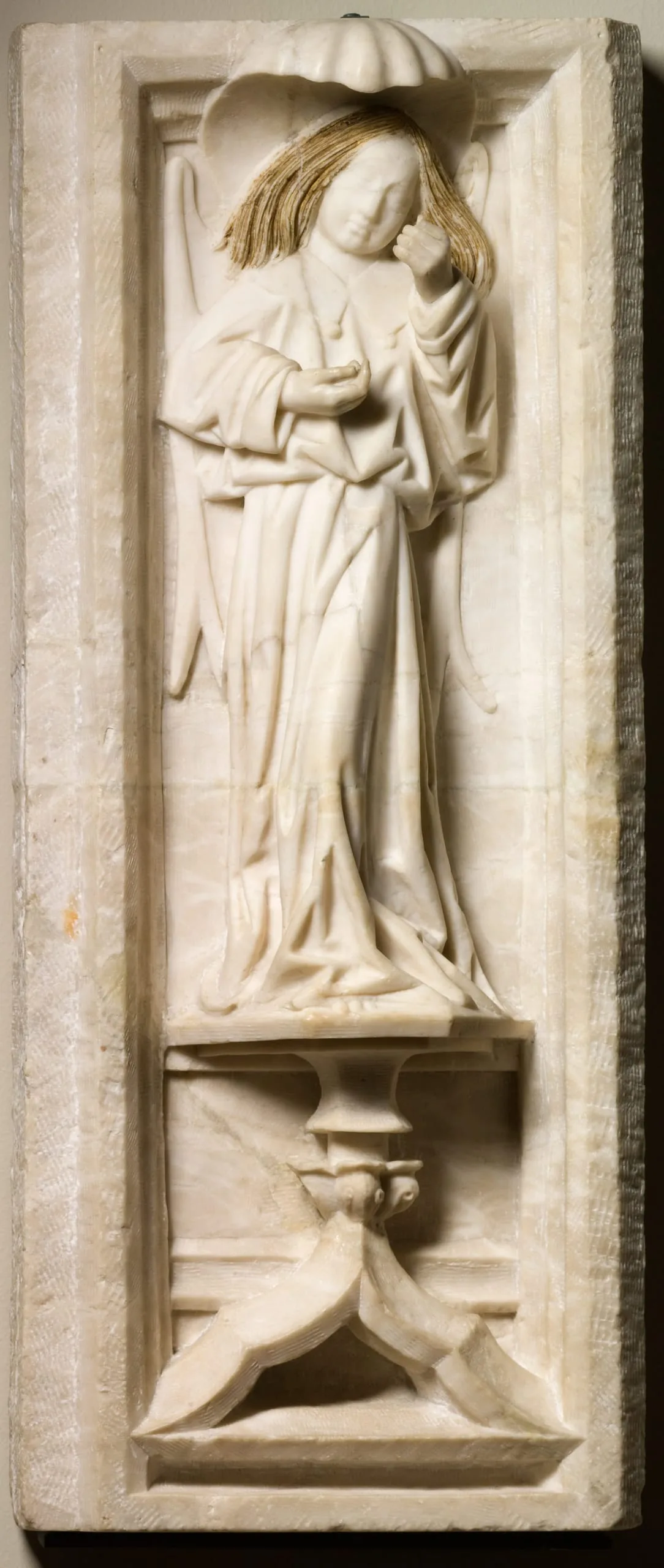
An angel with billowing, gilt-gold hair stands on an elevated plinth, gesturing perhaps in an expression of grief. Carved out of glistening white alabaster, this angel is one of two fragments in LACMA’s collection (see also 49.23.18) that were once part of a tomb commemorating Don García Osorio (d. after 1502), a knight in the Order of Santiago, and his wife Doña María de Perea (d. 1499) in the church of San Pedro, Ocaña, Spain. Located outside of Toledo, the church was both a political meeting place and a religious center for the order and even occasionally the Spanish monarchy. The Osorio family had contributed funds to build the Sangre de Cristo (Blood of Christ) chapel, at the center of which their sepulchre was later placed. As wealthy and influential individuals, the couple’s memorial functioned not only as a place of commemoration and prayers for the Osorio’s descendants but as a reminder of their social status.
Like other aristocratic Spanish tombs, this was constructed from alabaster, a soft stone that resembles marble but is easier to carve. Alabaster was also quarried locally, contributing to the material’s popularity for both private and public sculptural projects for the Spanish elite. According to a description of the Osorio tomb written before it was dismantled in the early twentieth century, it featured a joint sarcophagus for the couple topped with two recumbent effigies (portrait sculptures) and was decorated on the sides with panels featuring angels, Saint Catherine, personifications of Temperance and Prudence, and heraldic symbols, among other now-lost imagery. Related pieces of the tomb are currently held in multiple museum collections, including the figural effigy of Don García at the Victoria and Albert Museum, London.
2024