LACMA

ShopMembershipMyLACMATickets
LACMA
Los Angeles County Museum of Art
5905 Wilshire Blvd.
Los Angeles, CA 90036
info@lacma.org
(323) 857-6000
Sign up to receive emails
Subscribe
© Museum Associates 2026
  • About LACMA
  • Jobs
  • Building LACMA
  • Host An Event
  • Unframed
  • Press
  • FAQs
  • Log in to MyLACMA
  • Privacy Policy
© Museum Associates 2026
Collections

Alonso Cano
Christ in Limbocirca 1655

On view:
Geffen Galleries, floor 2
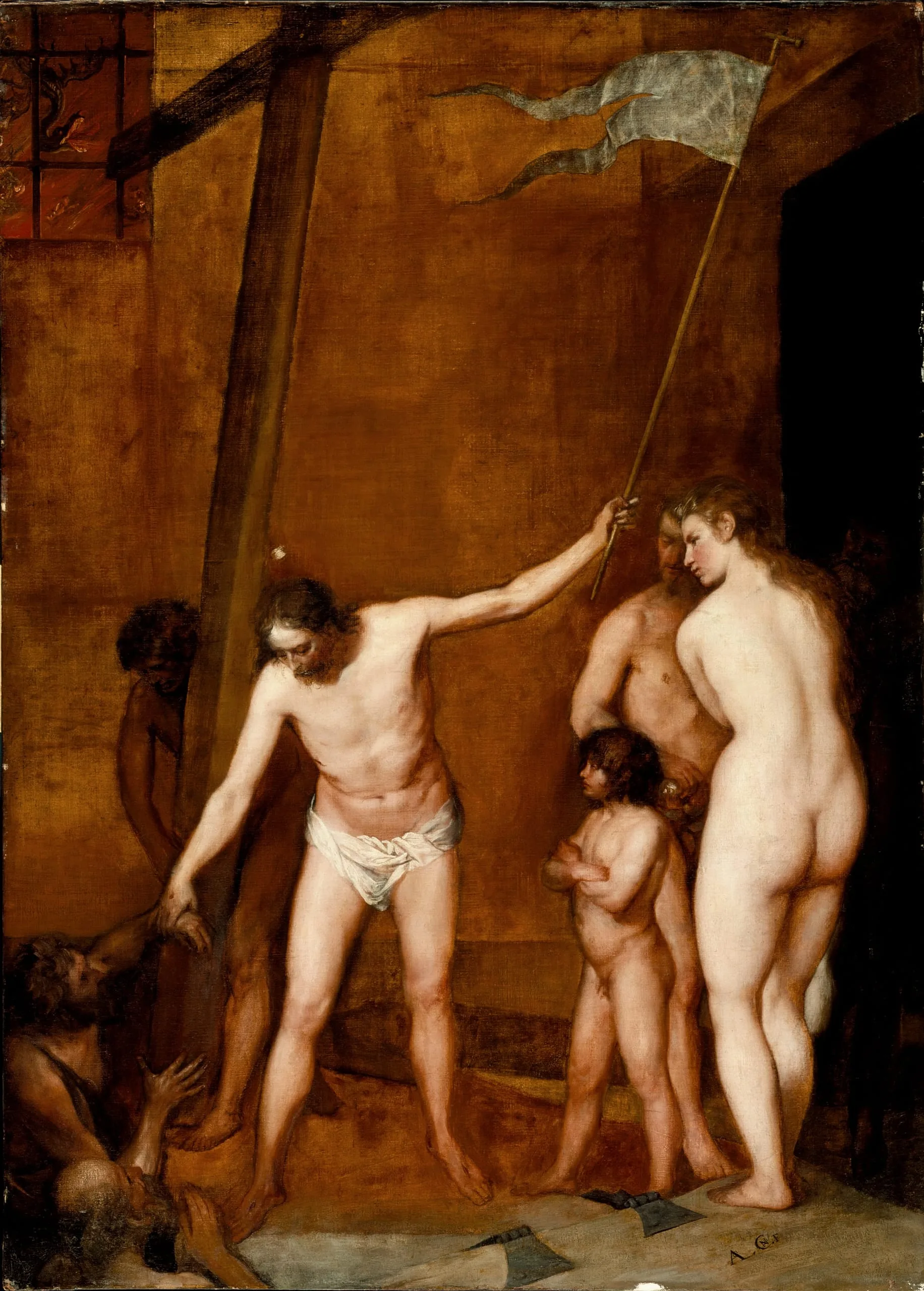
Vertical oil painting with five figures in a dim amber interior — a central nude man leaning over a dark vessel, flanked by a banner-holding male, a nude child, and a nude woman seen from behind

Alonso Cano, Christ in Limbo, circa 1655, Los Angeles County Museum of Art, Gift of Bella Mabury, photo © Museum Associates/LACMA

Artist or Maker
Alonso Cano
Spain, Granada, 1601-1667
Title
Christ in Limbo
Date Made
circa 1655
Medium
Oil on canvas
Dimensions
Canvas: 66 × 47 1/2 in. (167.64 × 120.65 cm) Framed: 89 × 58 × 3 in. (226.06 × 147.32 × 7.62 cm)
Credit Line
Gift of Bella Mabury
Accession Number
M.48.5.1
Classification
Paintings
Collecting Area
European Painting and Sculpture
Curatorial Notes

This rare depiction of female nudity in a seventeenth-century Spanish painting speaks to Alonso Cano’s preeminent position at the court. A sculptor by training, Cano created magnificent altarpieces, poignant polychrome sculpture, and refined domestic objects, even as he began to paint. Here, Christ pulls a saint from the underworld while hoisting a banner, symbol of salvation, skyward. But the most unusual aspect of the picture, given its serious religiosity, is the trio of nudes at right. While Eve modestly turns away from the viewer, the glow of her flesh tones against the wash of warm red draws the eye to her sinuously rendered body.

Cano moved to Madrid, the Spanish capital, in 1638, and there was granted access to King Philip IV’s collection of Italian paintings. These included representations of classically inspired nudes that were explicitly discouraged by the Spanish church. The strict regulation of Catholic imagery in effect banished female nudes from Spanish religious art. A royal collection such as Philip IV’s thus served as a locus of study, exchange, and transmission of artistic ideas and techniques, both classical and contemporary.

2025
Selected Bibliography
  • Hopkins, Henry T., ed. Illustrated Handbook of the Los Angeles County Museum of Art. West Germany: Bruder Hartmann, 1965.
  • Museo Nacional del Prado. Alonso Cano Dibujos. Madrid: Museo Nacional del Prado, 2001.
  • Schaefer, Scott, and Peter Fusco. European Painting and Sculpture in the Los Angeles County Museum of Art: an Illustrated Summary Catalogue. Los Angeles: Los Angeles County Museum of Art, 1987.
  • Trusted, Marjorie. The Arts of Spain: Iberia and Latin America, 1450-1700. London: Victoria and Albert Publications, 2007.
  • El Siglo de Oro: the Age of Velázquez. Munich: Hirmer Verlag, 2016.