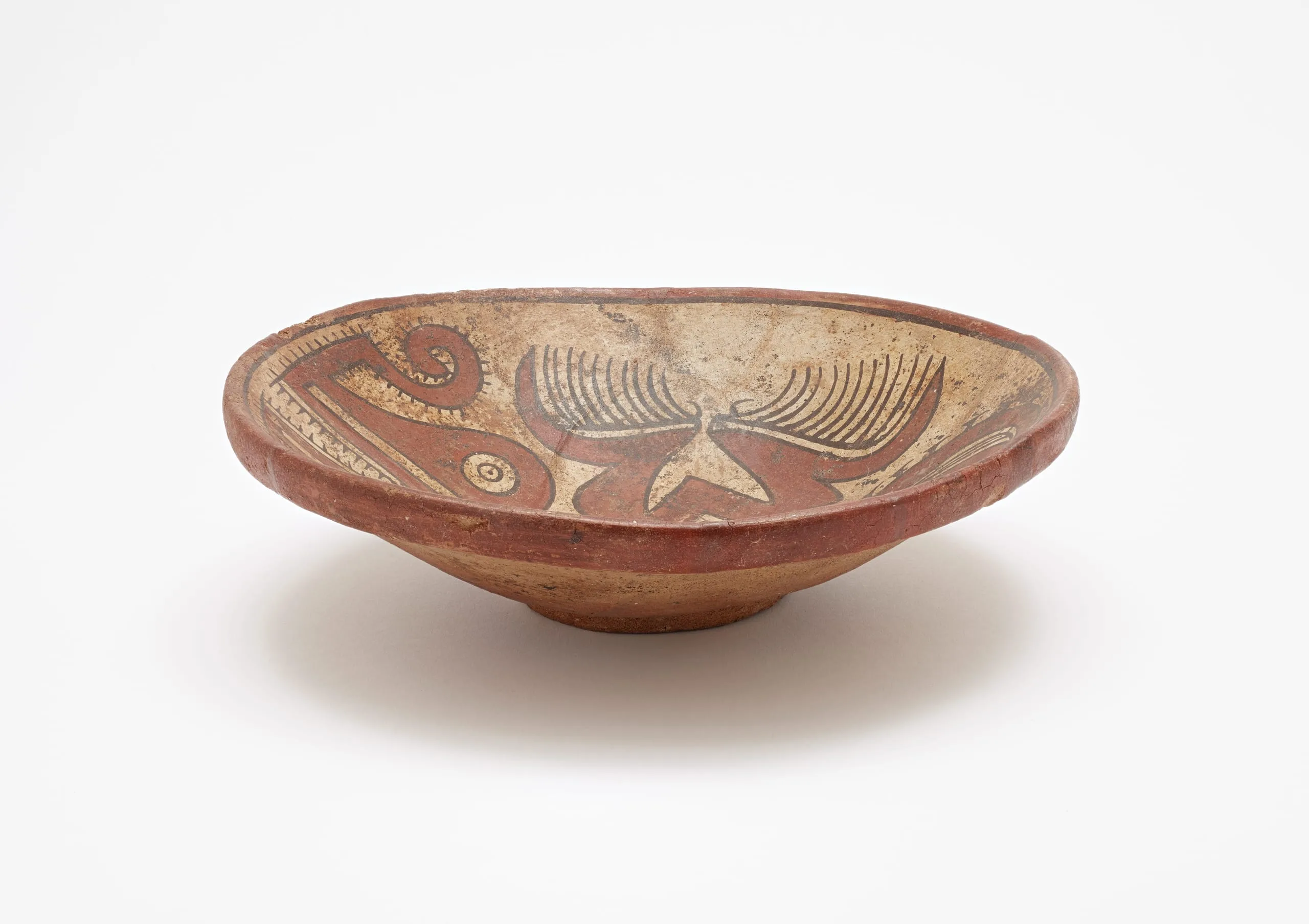
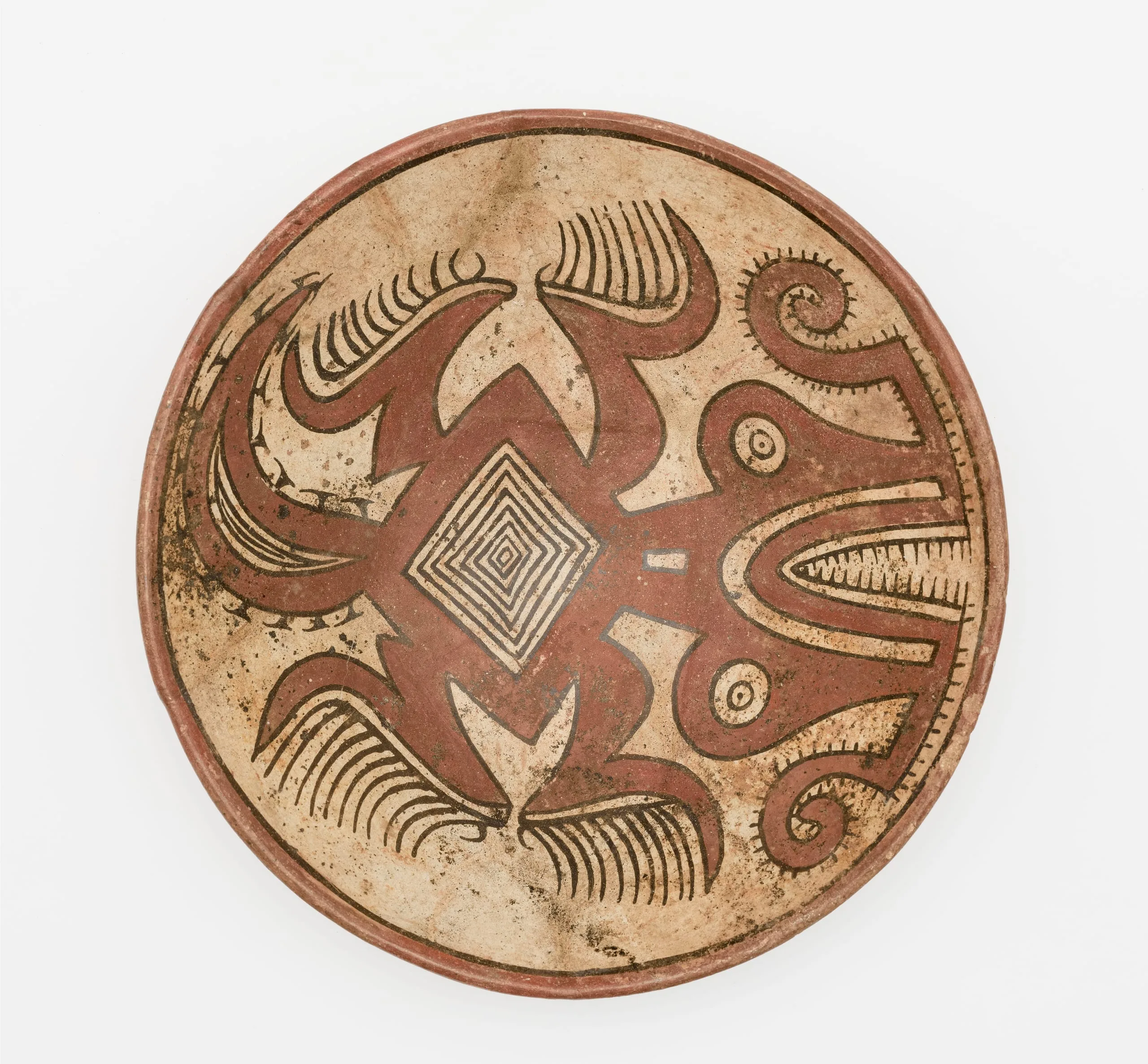
The Coclé artist here depicted what may be a stylized crocodile, with splayed claws, a diamond-patterned torso, a thick tail, and a long head that ends in a curled nose. The symmetrical body is shown from above, the head from above and in profile. The head’s flattened and split rendering allows the viewer to see the reptile’s many sharp teeth and its entire body simultaneously. The crocodilian creature’s nostrils have been elongated and wildly exaggerated to curve sideways, resembling the barbels of a catfish. The fantastical depiction is suggestive of a watery and supernatural realm.
Crocodiles were hunted and eaten in the region in earlier time periods, and their teeth were used as ornaments. However, the iconographic preeminence of crocodilians after 750 CE contrasts with the total absence of their bones in kitchen middens of later periods. Pascual de Andagoya, a sixteenth-century Spanish conquistador, noted the abundance of crocodiles and the threat they posed to human life in eastern Panama, and today the high number of crocodilians around Parita Bay remains a serious menace to fishers and bathers.
Camille Neira and Julia Burtenshaw
2024