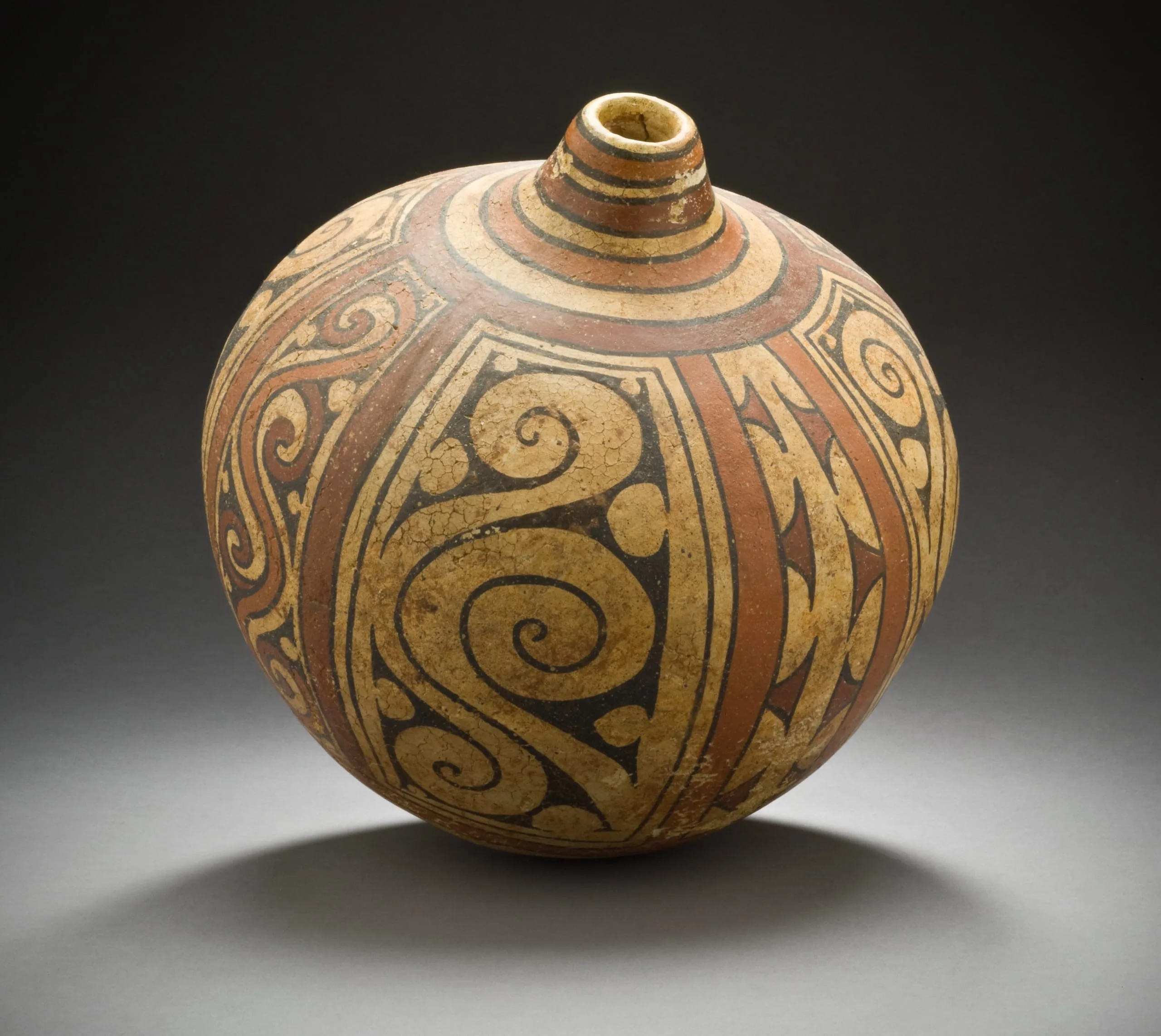
Perfectly symmetrical in both shape and painted decoration, this round jar with a narrow spout was made by an expert ceramist. The design is divided into panels featuring different swirling elements. Using a deep black paint, the artist painted Y-shaped forms that terminate in C-shaped curls, hence the name “YC scrolls” for this motif. YC scrolls were widely used as decorative patterns on Gran Coclé ceramics, often combining with other geometric as well as figurative designs.
Bands separating the panels on this vessel are variously painted using deep orange or purple slip paint. The purple color in particular is unique to ancient Panama, developed and used alongside a wide range of other colors between approximately 500 and 1100. The composition of this colorant has been the source of much speculation, but one study indicates that the purple color could be achieved by heating hematite (normally red in color when oxidized) to above 900° Celsius for a prolonged period of time. To heat a kiln to this temperature would have required a significant amount of resources and effort, not dissimilar to the sophistication necessary to smelt and cast gold, which people of the Coclé region also did in this time period. As such, the two technologies may indeed have been associated, highlighting the symbolic value and status of both materials in Greater Coclé culture.
Selected Bibliography
Etre, Kathryn. “Four-Color Polychrome Pottery from the Coclé Region of Panama: Investigating the Production of the Purple Colorant.” Michael C. Carlos Museum, Emory University, https://carlos.emory.edu/sites/default/files/2022-02/Panama%20Purple.pdf.