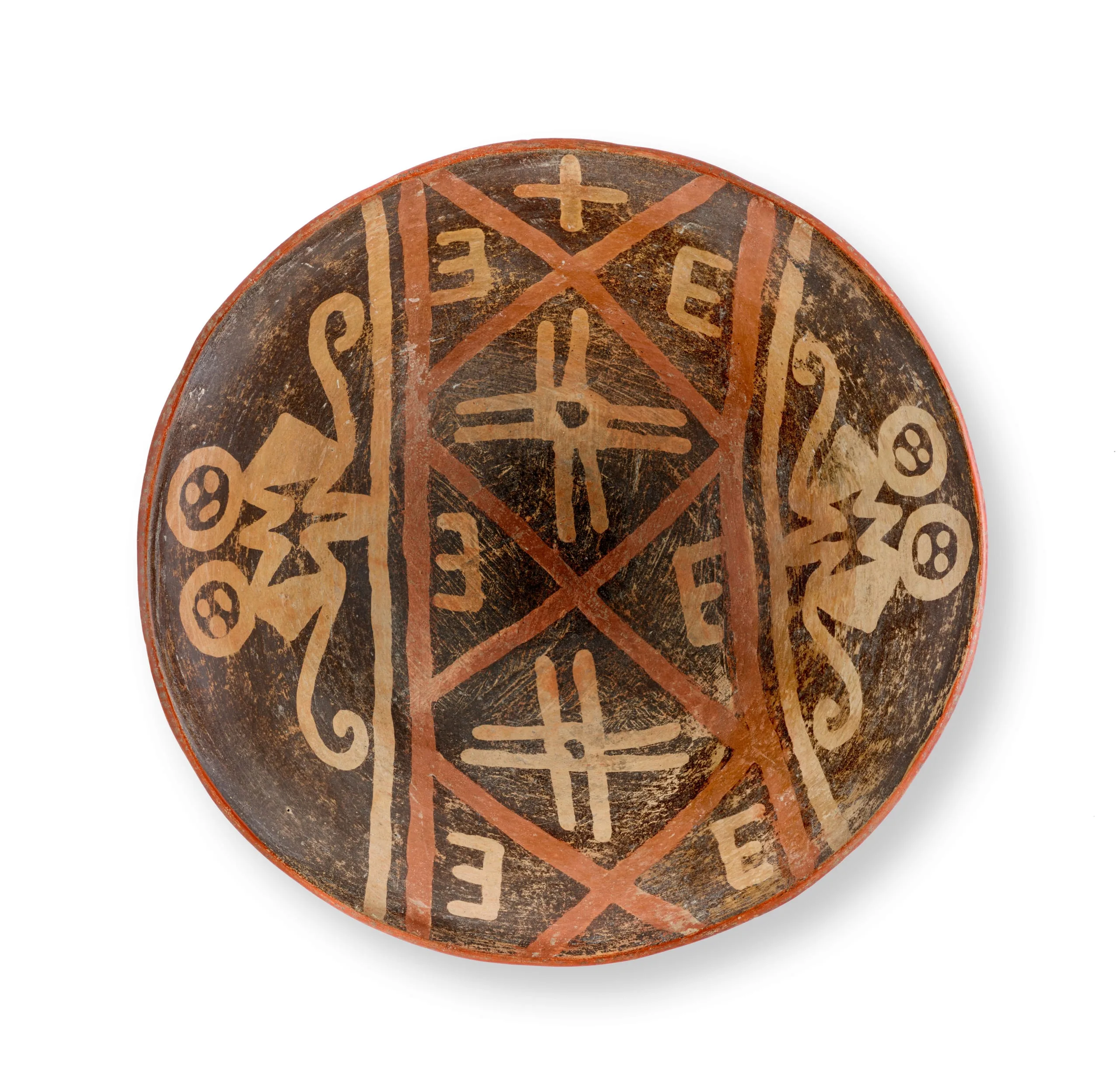
Painted using a resist technique, the design on this bowl features two pairs of monkeys flanking three starlike shapes arranged in a straight line. The design likely represents the constellation Orion, an interpretation based on a myth told by the Miraña people, a contemporary Indigenous group in Colombia. The four main stars of Orion form a trapezoid, bisected by three aligned stars called the “belt” (pictured below). The myth follows the exploits of four night monkeys, including their final resting place atop the four corner posts of the communal meeting house. Crucially, the narrative and its characters parallel the real movements of Orion across the night sky in relation to the sun, moon, and Venus at a particular time of the year.
The myth recounts the story of the Miraña hero Blowgun Shooter (symbolized by the Moon), who married Kinkajou (Venus, the Morning Star) and fathered their sole child. Kinkajou’s brothers, four Night Monkeys (associated with the stars of the Orion constellation), became jealous of Blowgun Shooter and decapitated him, then hid on the four central poles of the maloca (communal house). When Blowgun Shooter’s son came of age, he (as the Sun) avenged his father’s death by slaying his four uncles and placing their skulls on top of the maloca houseposts, where they turned into the four main stars of Orion.
If our interpretation is correct, this bowl depicts characters of a myth and creates a direct parallel between monkeys (with their reflective eyes at night) and stars, the communal house and the cosmos. Furthermore, it is a way of recording and remembering a recurring astronomical event related to seasonal cycles.
Thermoluminscence testing of a sample drilled from the foot of the bowl confirmed that it was made between 1000 and 1300.
Julia Burtenshaw
2022
Selected Bibliography
Karadimas, Dimitri. “Monos y Estrellas entre el Amazonas y los Andes: Interpretación Etno-arqueoastronómica de los motivos de Carchí-Capulí (Colombia-Ecuador).” Amazonia Peruana (Lima) 27 (2000): 145–92.
Constellation of Orion
will need R&R confirmation