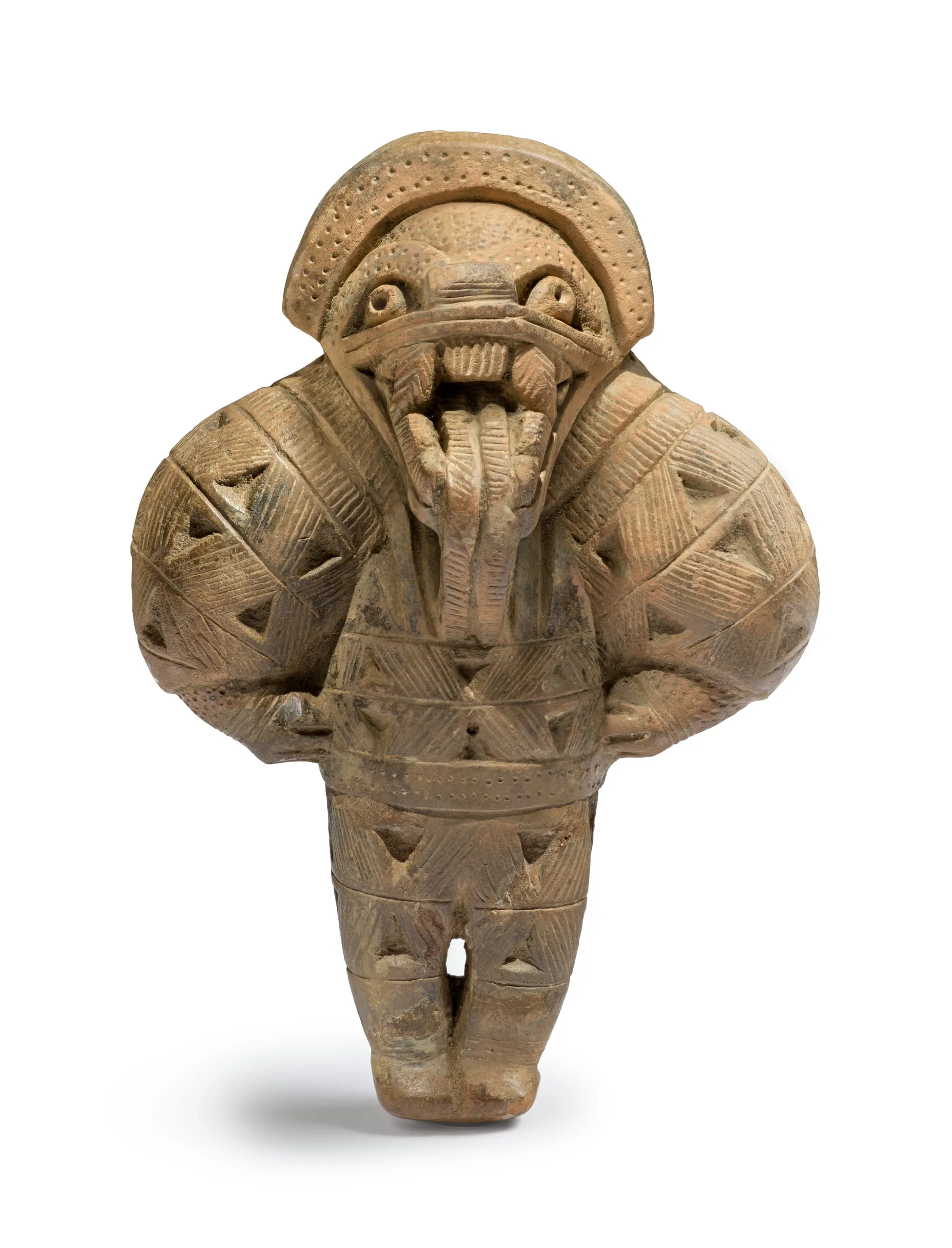
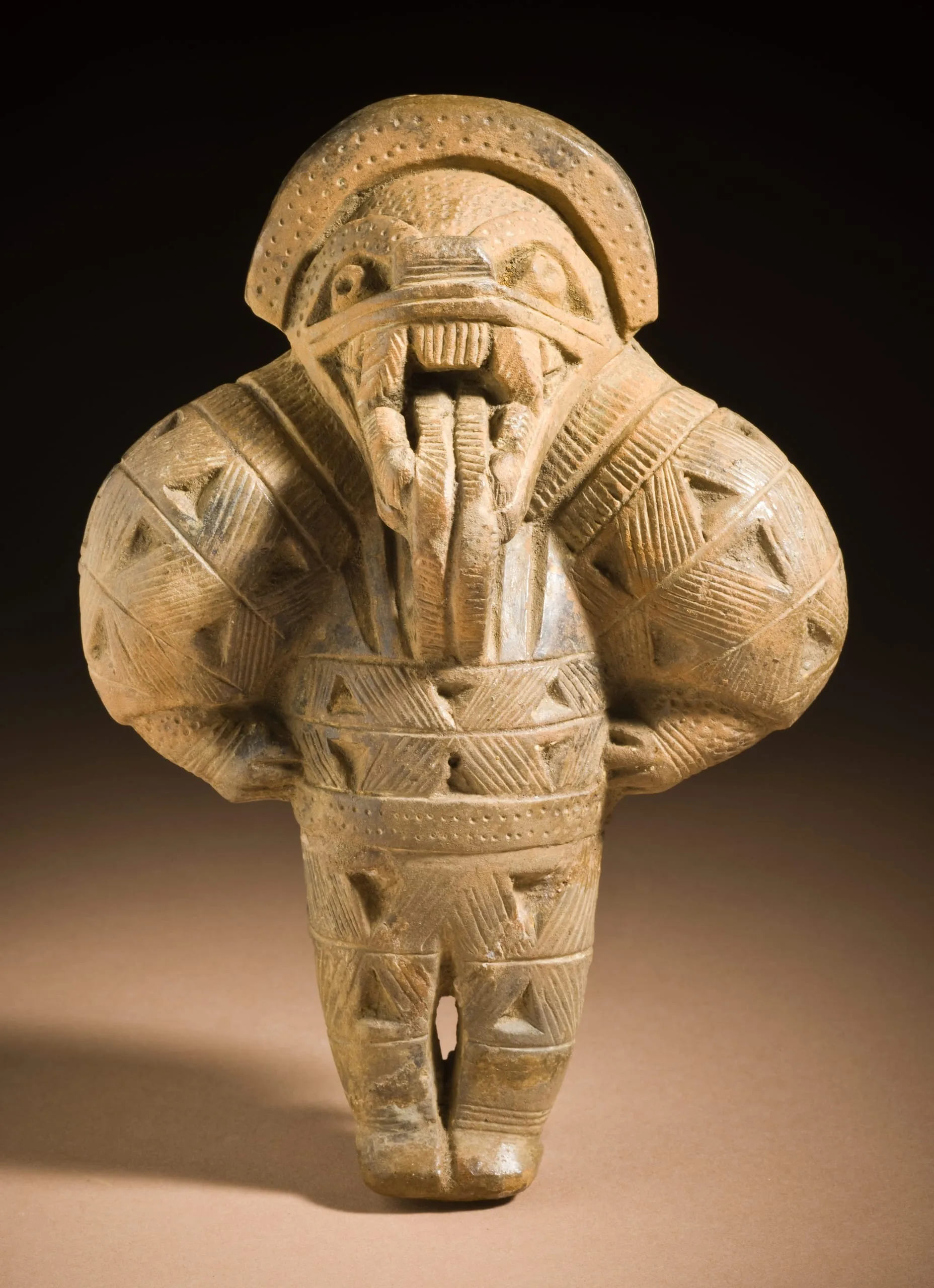
This fierce figure functions as a whistle, with the mouthpiece at the top and an opening with a blade cut into the back. Although the body is anthropomorphic, its head features an enormously long tongue that protrudes from a prominent fang-filled snout and extends to the chest (see also M.2007.146.448), the meaning of which eludes us. The body is incised with fine lines. Numerous triangles that were carved out of the wet clay are reminiscent of the diamond patterns seen on many species of snake. With its billowing shoulders and narrow legs, the figure’s overall shape is similar to another Tairona whistle in LACMA’s collection (M.2007.146.462).
Over a number of years of close collaboration between LACMA and the Arhuaco community (see Burtenshaw et al. 2022), we learned that deciphering the narrative encoded in ancestral objects and motifs is not the only way to expand our understanding of them. As well as their iconography or function, their essence matters. According to Arhuaco elders, pieces like this whistle were created as reciprocal gifts to the earth—physically offered or through their sound—to maintain balance in the network of life; in other words, to help manage the universe. Even removed from their original context or use, such objects contain the essence of living creatures and ancestral beings and can be used to communicate with them. They create bridges between different cultures, us and them, past and present. By inviting us to consider a different perspective or worldview, they foster cross-cultural tolerance and can continue to fulfill a balancing role today.
Julia Burtenshaw
2025
Selected Bibliography
Burtenshaw, Julia, Diana Magaloni, Maria Alicia Uribe, and Hector Garcia Botero, eds. The Portable Universe/El Universo en tus Manos: Thought and Splendor of Indigenous Colombia. LACMA/DelMonico Prestel, 2022.