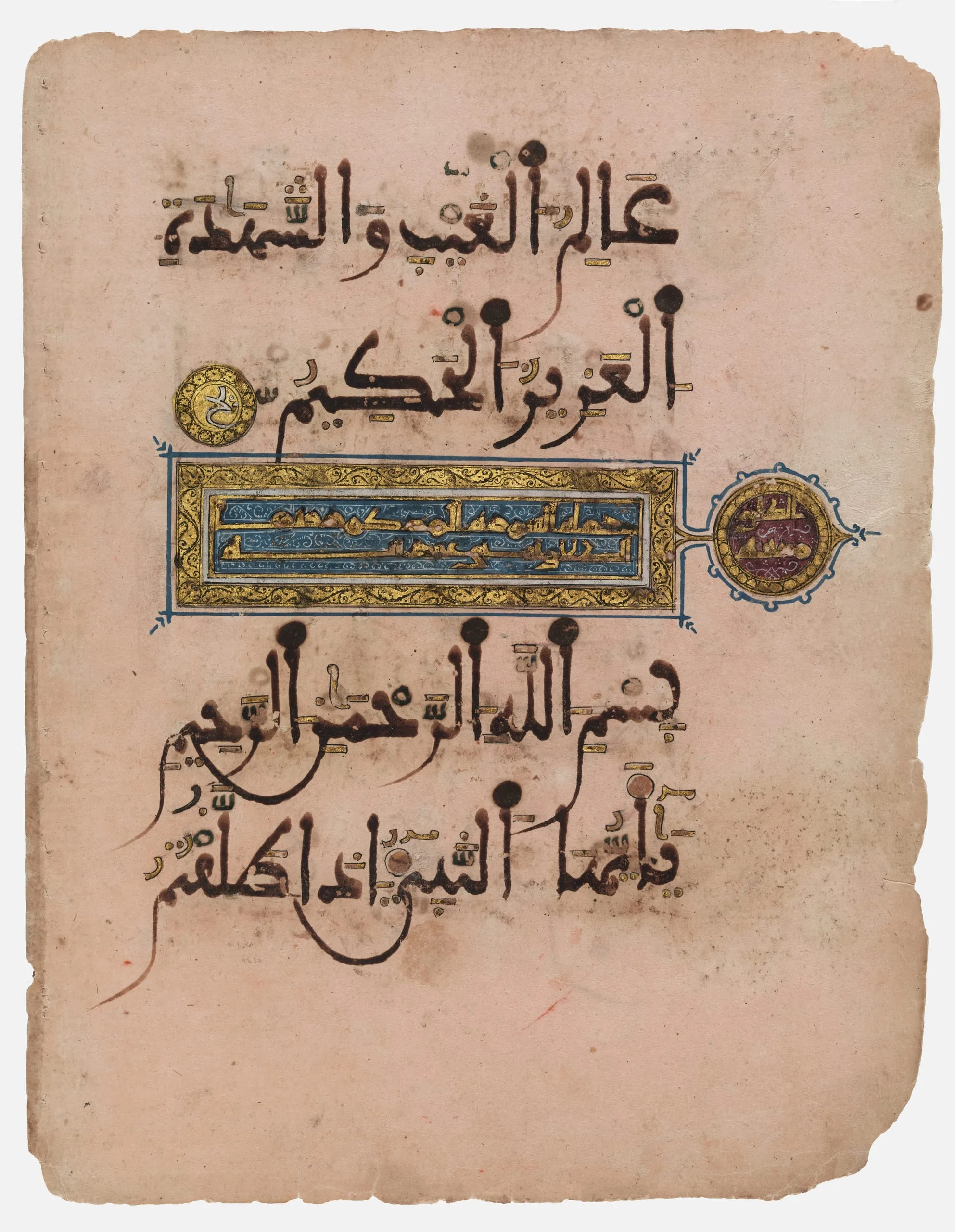
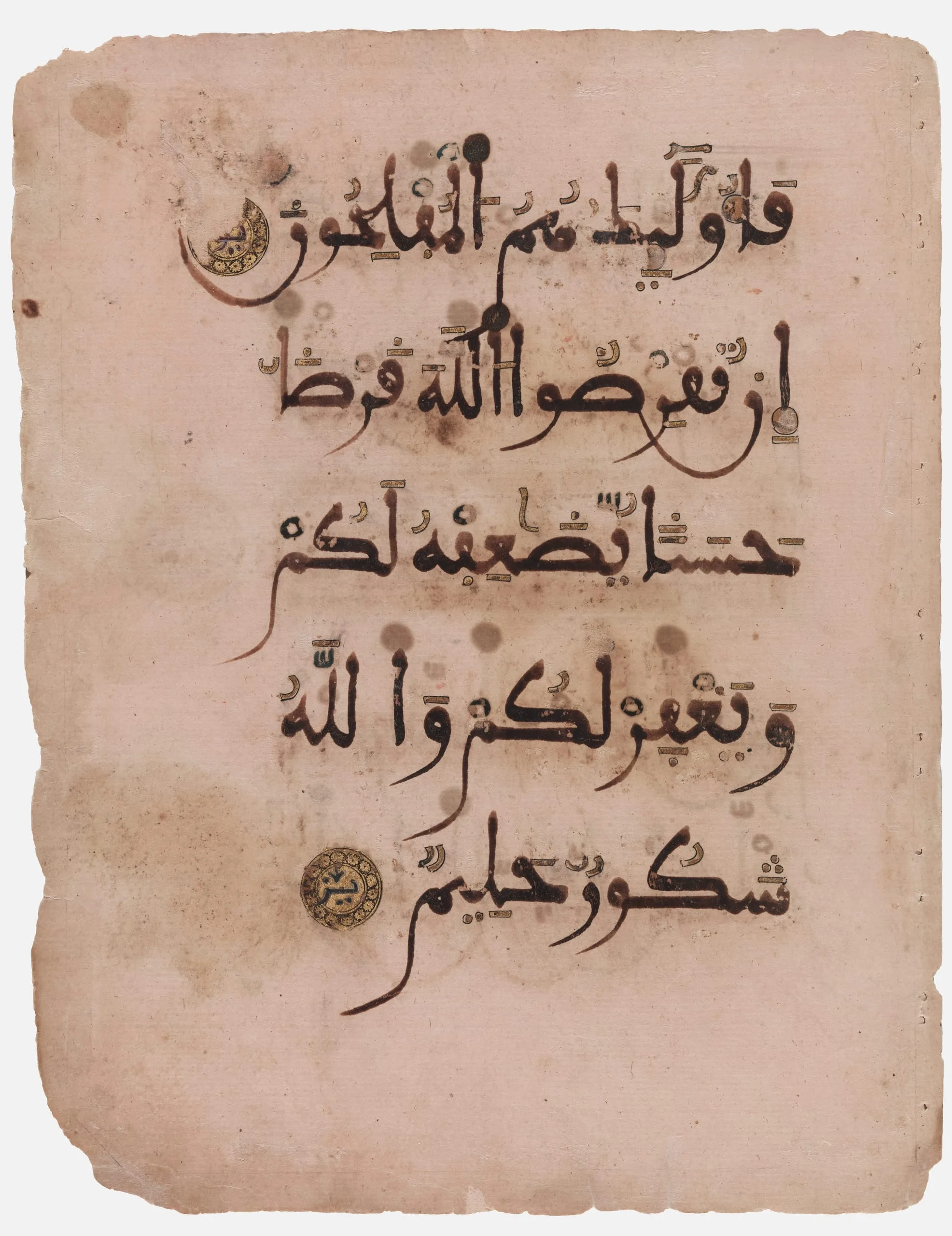
From the early eighth century until 1492, Spain, known as Al-Andalus, was the western frontier of Islam. Among the various cultural innovations introduced to the Iberian Peninsula was papermaking in the tenth century. Both Muslim and Christian manuscripts on paper survive from the second half of the tenth century. By the eleventh century, paper mills were established throughout the Iberian Peninsula, most notably at the city of Shatiba (Játiva), in Valencia. Colored paper, produced in red, purple, and pink, as here, is associated with Granada under the Nasrid dynasty (12321492), while Shatiba was also known for its dyed paper. The use of dyed paper in various colors indicates the attention and cost lavished on a manuscript.
The manuscript from which LACMA’s folio came is known as the Pink Qur’an because of its distinctive tinted paper. The text is written in the maghribi script, named after the region of North Africa that roughly encompasses modern Morocco. This graceful cursive script, which descended from kufic, developed in the twelfth century in both Spain and North Africa, and its use is restricted to these regions. Here, the end of one sura (chapter) and the beginning of the next are marked by an illuminated cartouche. The folio also includes the Arabic word hubus, or “pious foundation,” which is pricked with a needle at the top right corner. The same designation appears on other pages from this twenty-volume set dispersed in various museum collections, as well as one partially complete volume in the Ben Yusuf Library, Marrakesh. These marks would have likely been added after the production of the manuscript, though it is unclear whether this was before or after its dispersal.
Many Qur’ans, along with other Arabic texts, were destroyed after the Christian Reconquest at the close of the fifteenth century. On that account, most such manuscripts are preserved in collections outside Spain. Interestingly, during this period, based on the surviving Spanish Qur’ans, rectangular parchment pages remained the more favored material for copying the holy text (see M.88.37 and M.2002.1.25).
2025