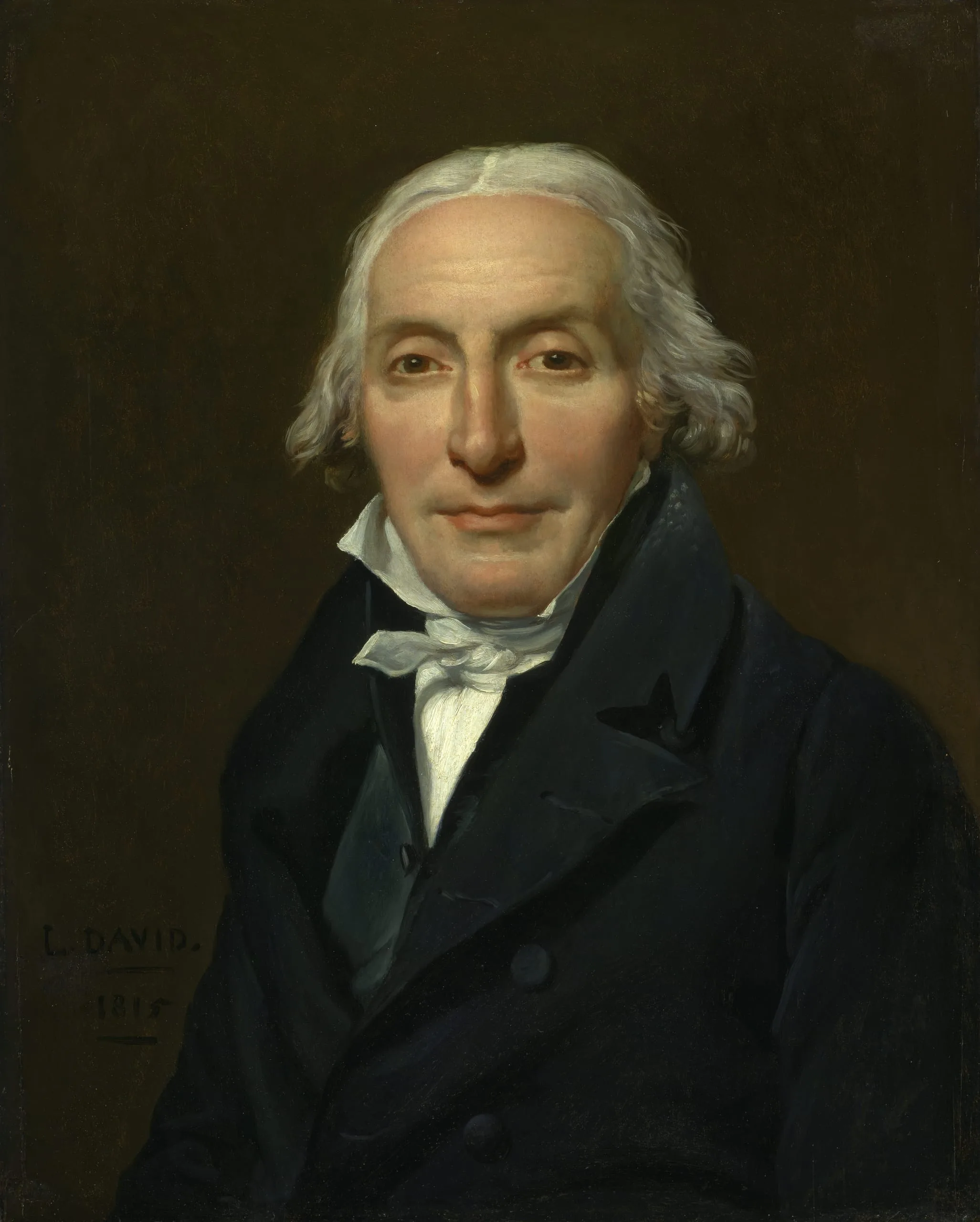
This portrait is the last picture that Jacques-Louis David painted in France, shortly before his exile to Brussels. The years 1814−15 were volatile times for the French, especially those who had played a public role or whose livelihood depended on government support. The sitter, Jean-Pierre Delahaye, was a lawyer who had worked closely with the French monarchy and continued to thrive in his legal career after the Revolution. The painter was a staunch antimonarchist and deeply engaged in revolutionary politics. In 1793, as a representative of the city of Paris to the National Convention, he supported the death penalty for King Louis XVI and Marie Antoinette, even sketching the queen on her way to the guillotine. David later aligned himself with Napoleon, whose defeat by the British in 1815 led to the restoration of the French monarchy. Due to his allegiance to Napoleon, the artist was banished to Belgium.
As suggested by the posthumous inventory of the Delahaye estate, David shared a close friendship with the sitter: “it is not possible to estimate any dues on account of the nature of the relationship between M. Delahaye and M. David.” The painting was likely a gift from the artist to the man who was both friend and legal counsel, capturing him as “a respectable man . . . full of zeal for his profession . . . a great colleague at heart . . . of unpretentious, even rough, manners.” After Delahaye’s passing in 1819, his son Jean-Louis continued to handle David’s affairs while he was in exile, including the sale and transfer of some of the painter’s most prized works to the French government.
2024