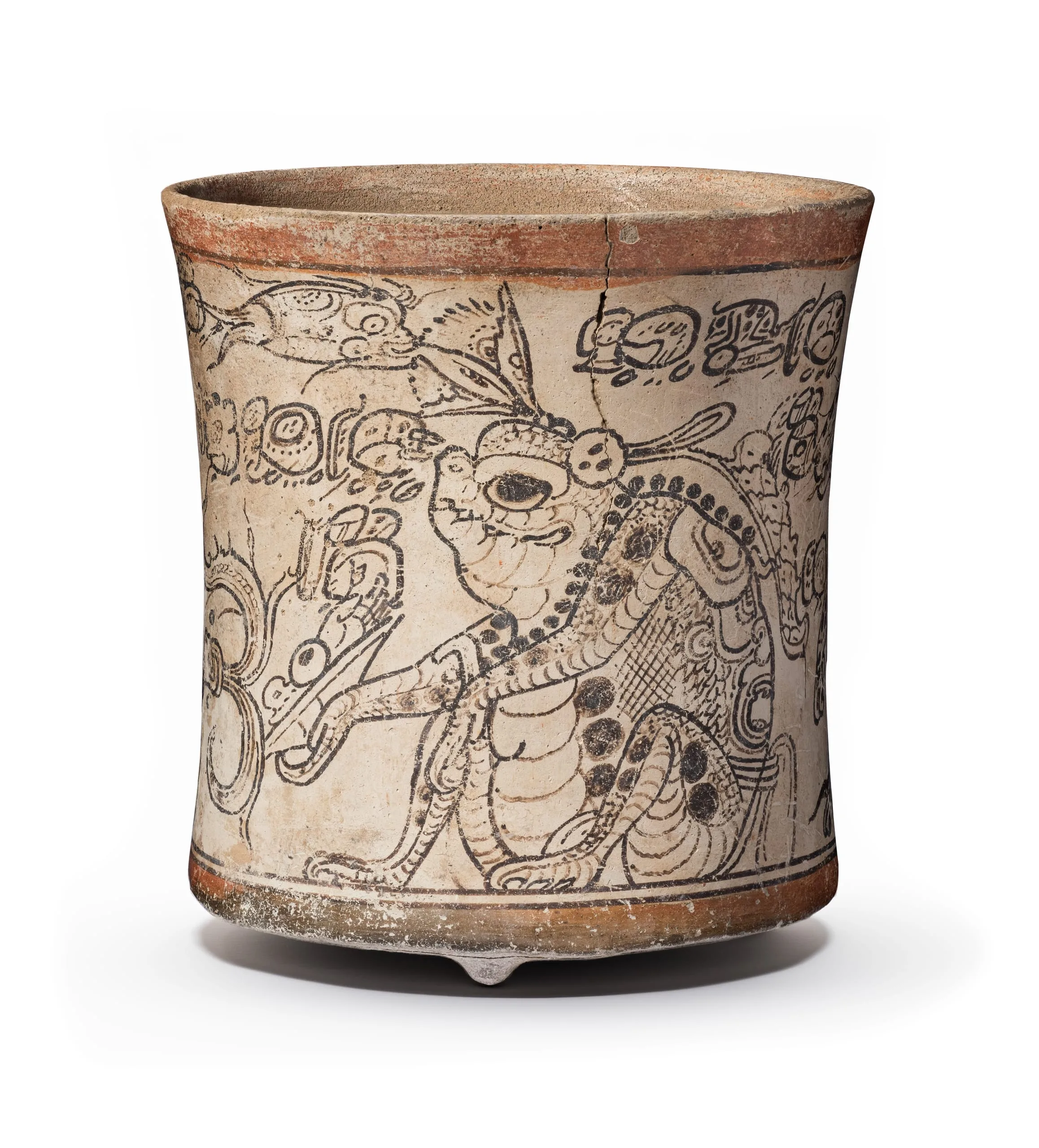
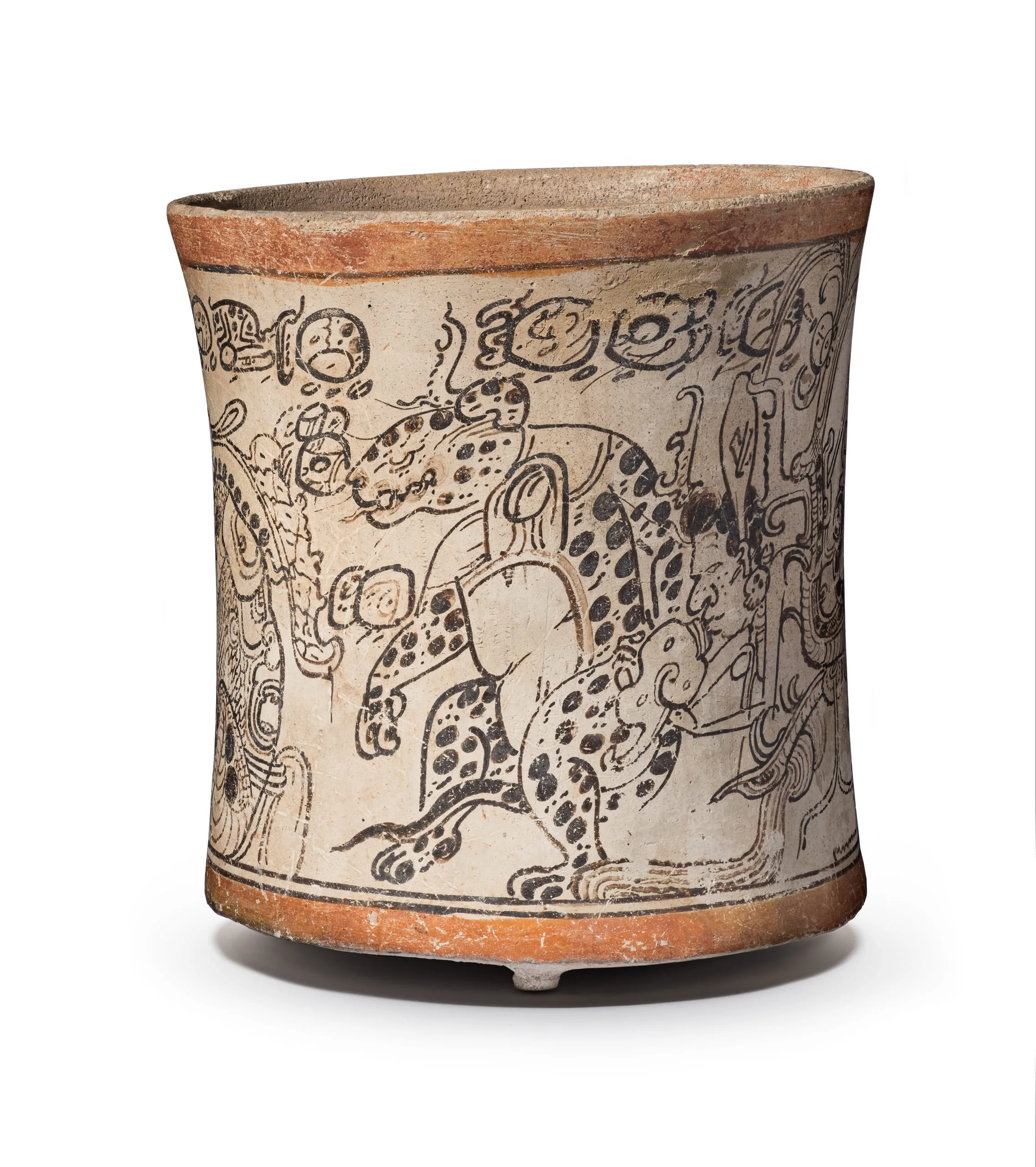
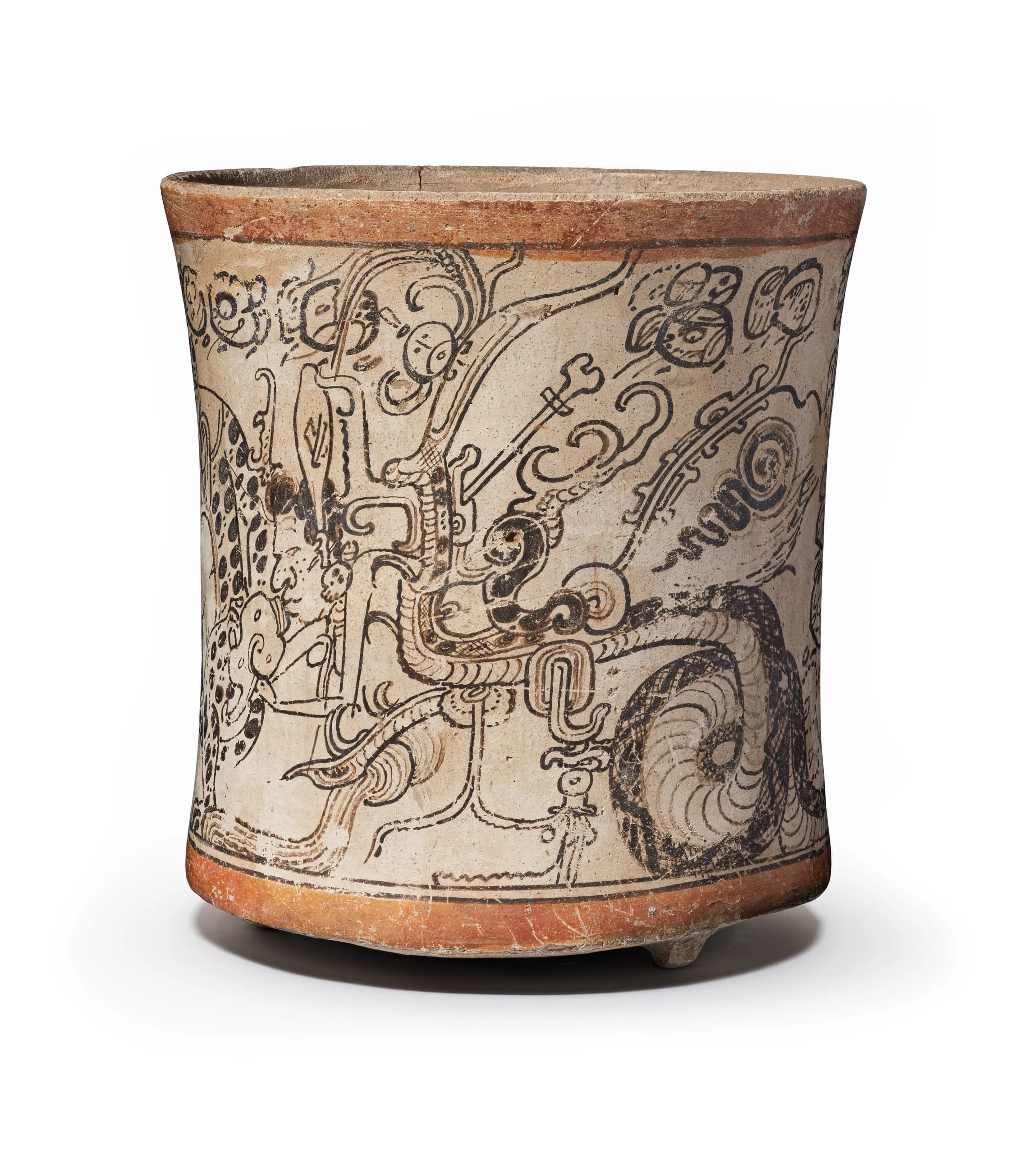
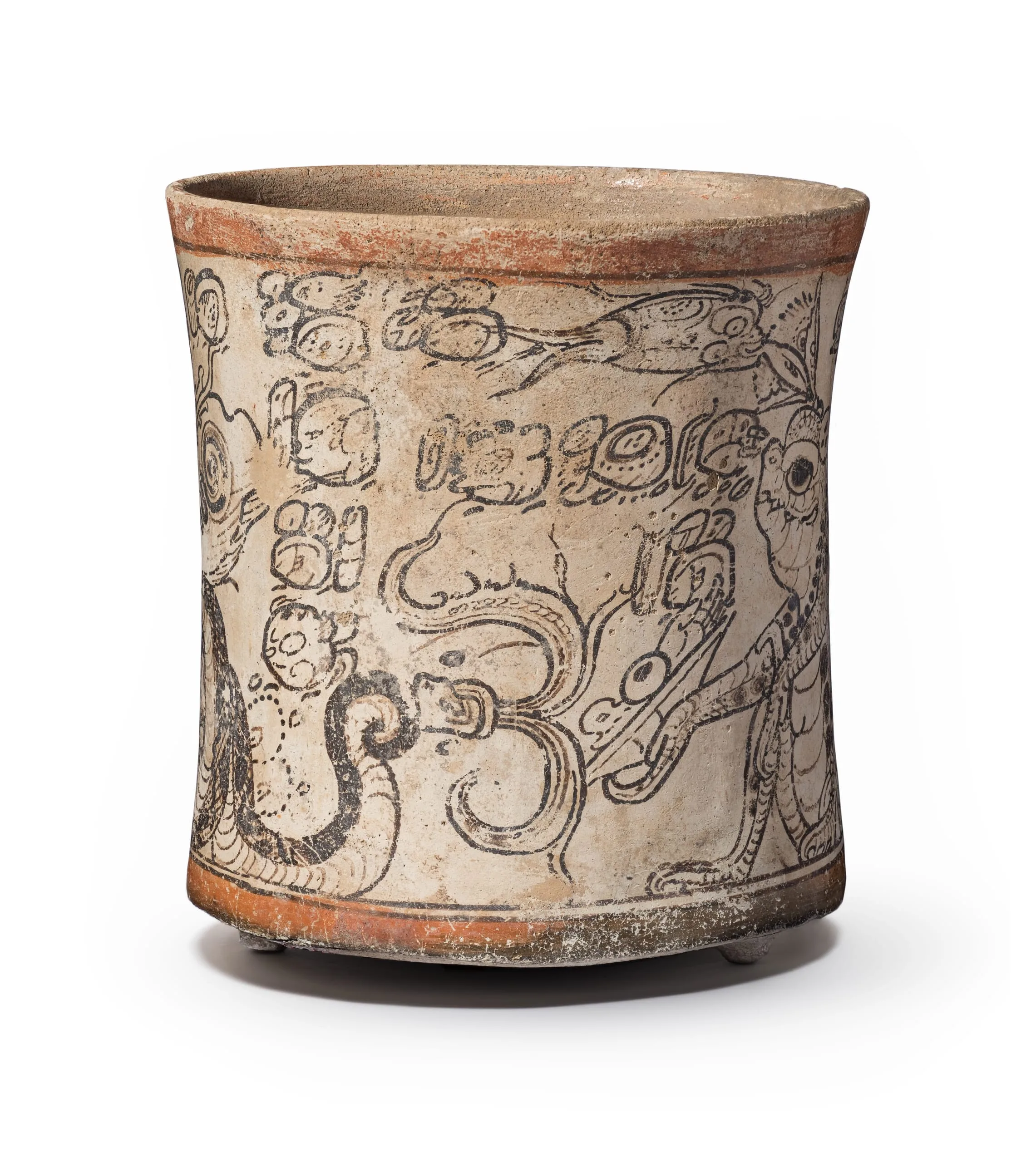
Elegantly painted ceramic vessels constituted the premier form of artistic expression during the Late Classic period (550-850 AD) of ancient Maya civilization, and none were more beautifully painted than those known as codex style. Named for their resemblance to the Maya codices, or painted books, codex style ceramics such as this Drinking Vessel depict highly esoteric scenes describing the fundamental concepts of Maya religious belief and practice and the special role of kings as participants in the supernatural realm. These concepts are embedded within a layered matrix of complex imagery and hieroglyphic writing that describe the ritual actions of rulers, who engaged with ancestors and supernatural beings in order to maintain the delicate balance of the cosmos.
Codex style ceramics were produced for a very brief period in a restricted region of the Maya lowlands, encompassing southern Mexico and the northeastern corner of the Petén, Guatemala. Vessels are typically covered with a cream colored ground; red slip adorns the rim and basal bands and the imagery is painted with a fine black line. The figures portrayed on this vessel are rendered with the characteristic whiplash line that constitutes the most refined Maya painting on both ceramics and murals.
The content of codex style imagery is almost exclusively mythological or cosmological, and this vessel, acknowledged as the work of an extraordinary artist known as the Metropolitan Master, is no exception. The scene shows three sinister and otherworldly beings with both animal and human characteristics. They represent wayob', the companion spirits of Maya rulers. These composite beings with their supernatural attributes share in the consciousness of the person who owns them, coming to life when the person is asleep in order to roam the world. Wayob' may take the form of animate or inanimate beings, but are commonly depicted on Maya ceramics as powerful forest creatures.
On this vessel, the wayob' include a plump toad wearing a jade bead necklace, a dashing jaguar with knotted scarf and deer antler, and a bearded serpent with a deer ear and a young man emerging from his opened jaws. The creatures, whose names appear in the brief texts adjacent to their images, signal a complex relationship between the supernatural realm and lineage ancestors, the powerful beings contacted by the living king to sustain the well-being of the human community. The vertical text describes the vessel as one used to drink cacao (chocolate), which was first cultivated by the Maya and whose consumption was the prerogative of royalty.
This vessel is recognized as one of the finest known in the codex style tradition. It provides complementary imagery to the rare fluted vessel in the pre-Columbian collection (M.2005.133), together they present extraordinary insights into ancient Maya religious belief and royal performance in the words and images of the artists themselves.