LACMA

ShopMembershipMyLACMATickets
LACMA
Los Angeles County Museum of Art
5905 Wilshire Blvd.
Los Angeles, CA 90036
info@lacma.org
(323) 857-6000
Sign up to receive emails
Subscribe
© Museum Associates 2026
  • About LACMA
  • Jobs
  • Building LACMA
  • Host An Event
  • Unframed
  • Press
  • FAQs
  • Log in to MyLACMA
  • Privacy Policy
© Museum Associates 2026
Collections

Unidentified artist
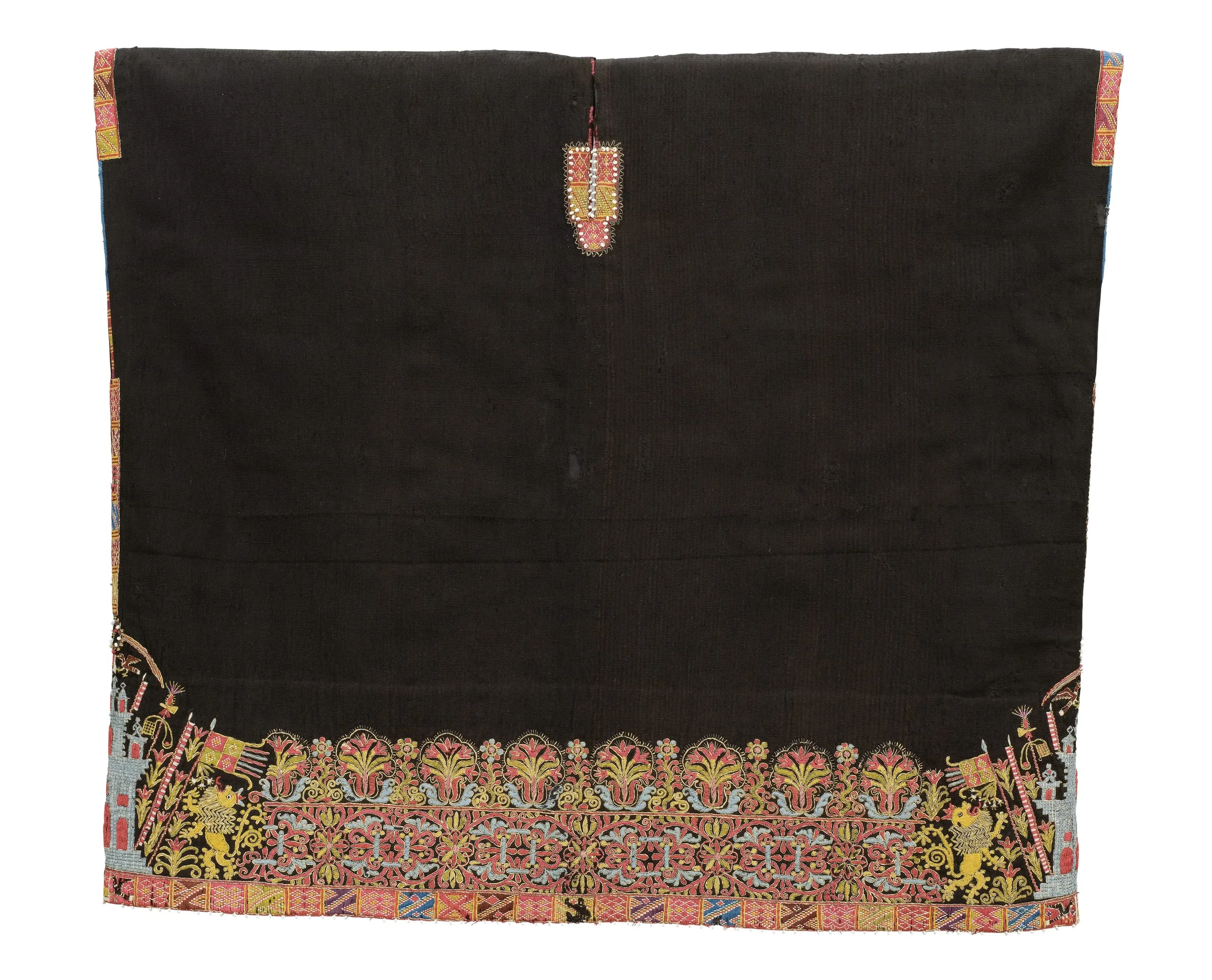
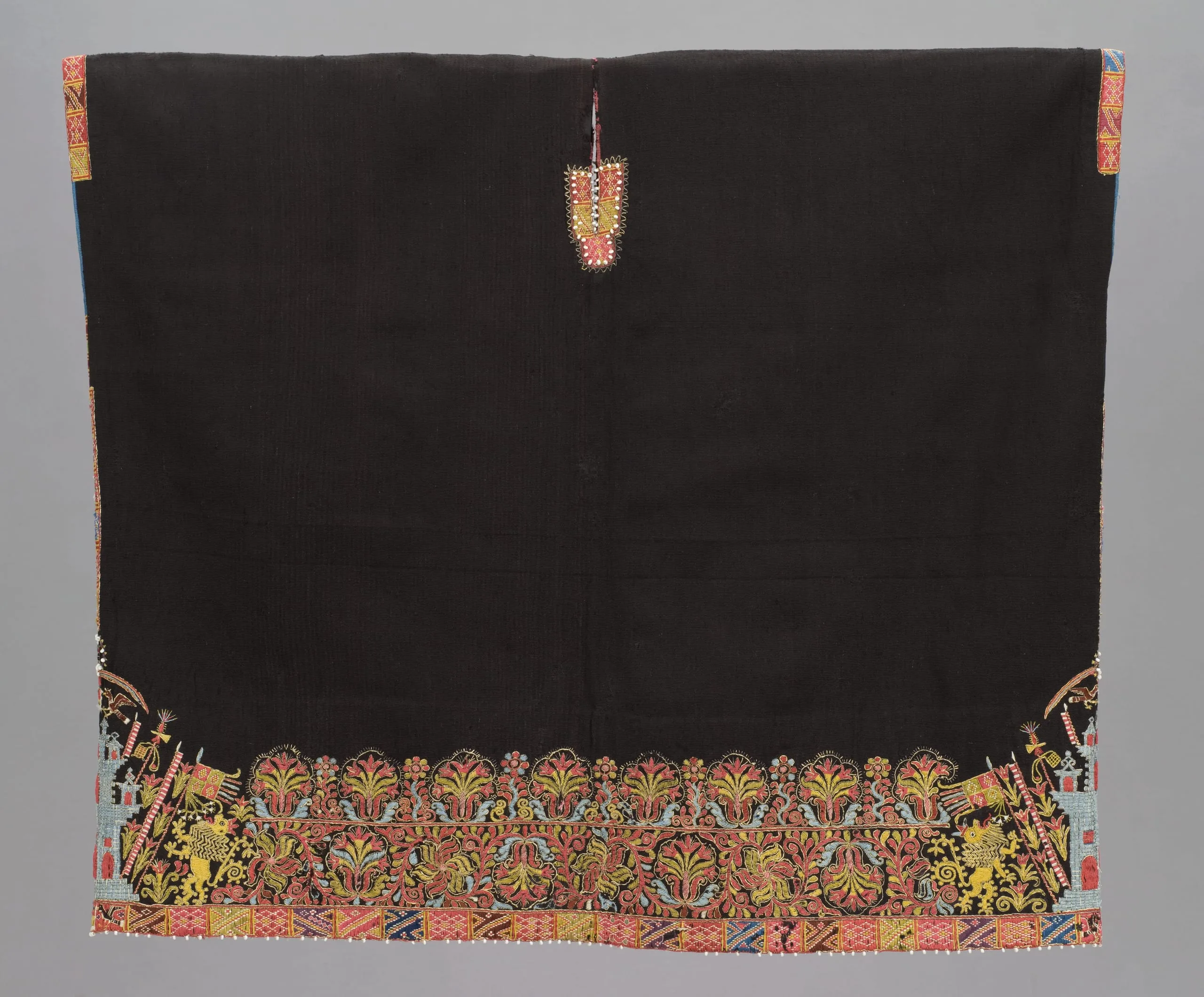
Man’s Processional Tunic (Uncu) (Túnica procesional masculina [uncu])late 17th–early 18th century

Not on view
Flat textile panel with deep black ground, wide multicolored embroidered border along the bottom with palmette and floral motifs in coral, gold, and sky blue
Embroidered textile garment with a deep black ground, featuring a wide decorative border along the hem with dense multicolored embroidery in red, yellow, green, and blue, depicting stylized floral and foliate motifs, animals, and architectural forms. Colorful woven trim lines the top and side edges, and a small beaded ornament hangs at the center neckline.
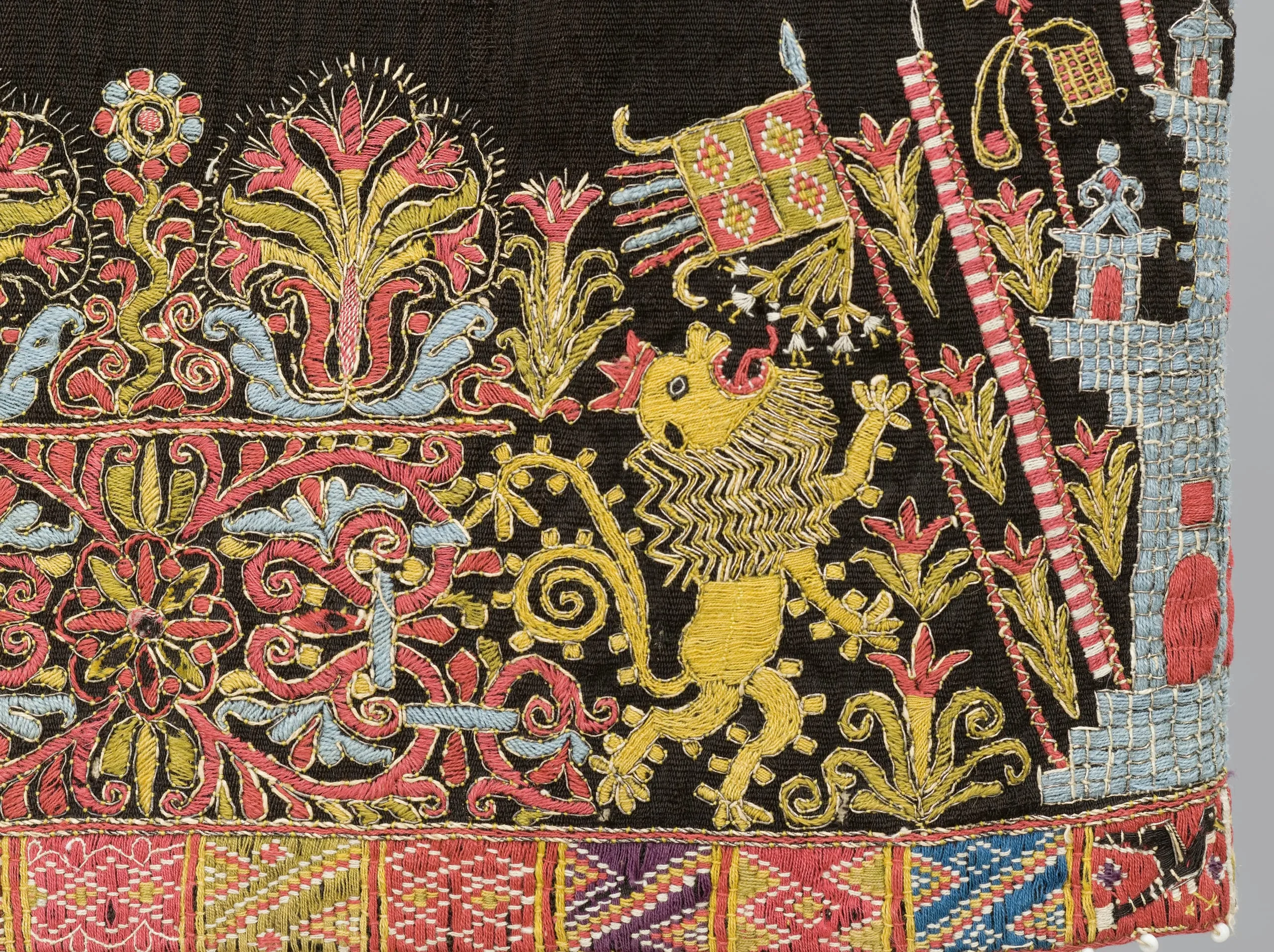
Textile embroidery on dark ground with dense polychrome stitching; a rampant lion figure in yellow thread holds a flag at center right, surrounded by scrolling floral vines in red, gold, and pale blue; geometric border in multicolor at lower edge.
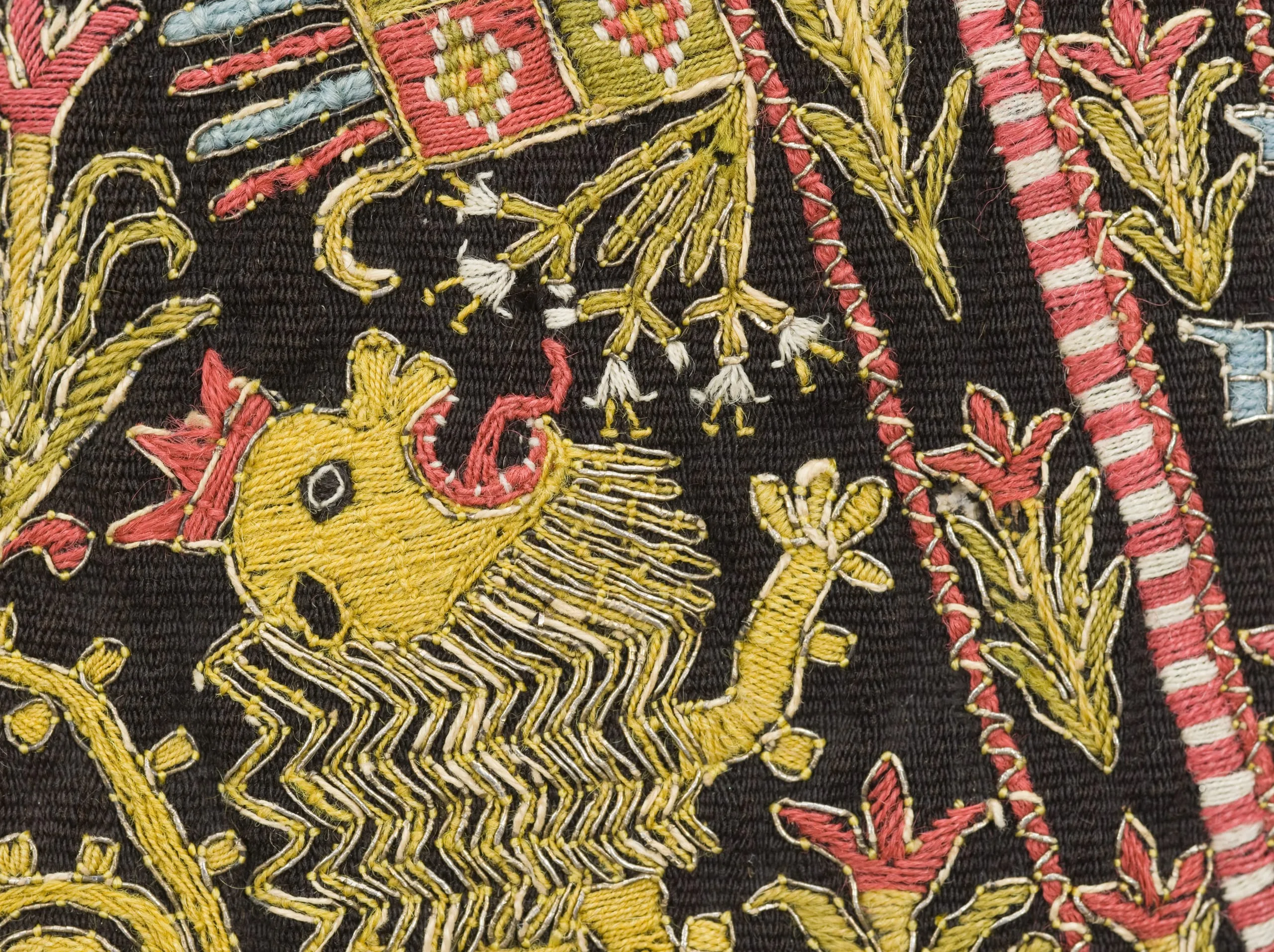
Close-up of embroidered textile on dark ground, featuring a fantastical bird-like creature in yellow and white thread with zigzag feathers, surrounded by flowering vines, foliage, and red-and-white striped tree trunks in red, yellow, and blue silk thread.
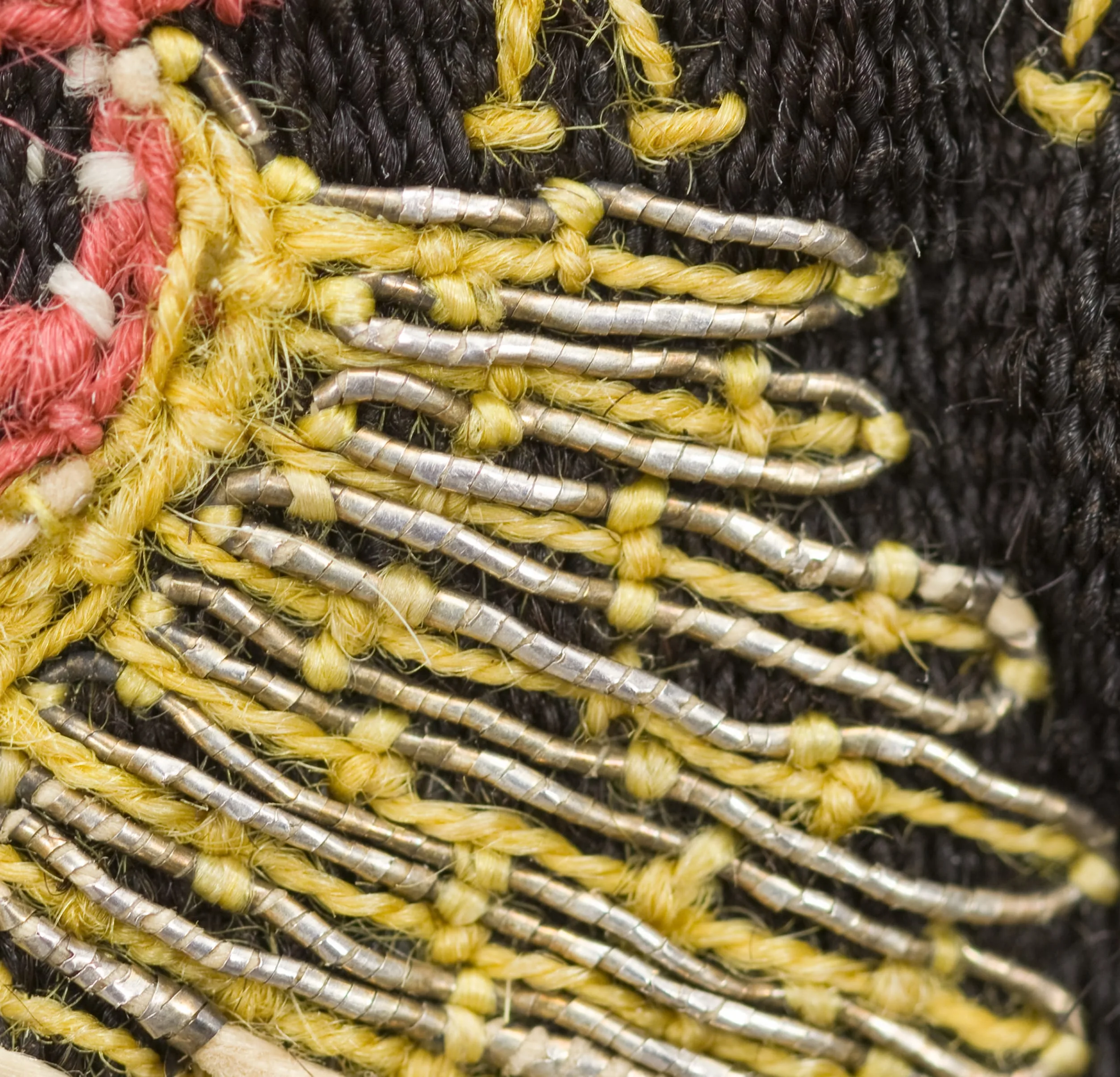
Close-up detail of embroidered textile, yellow twisted threads wrapped with coiled metal wire forming a fan-like fringe pattern against a black woven ground, with red and white embroidered elements at upper left.
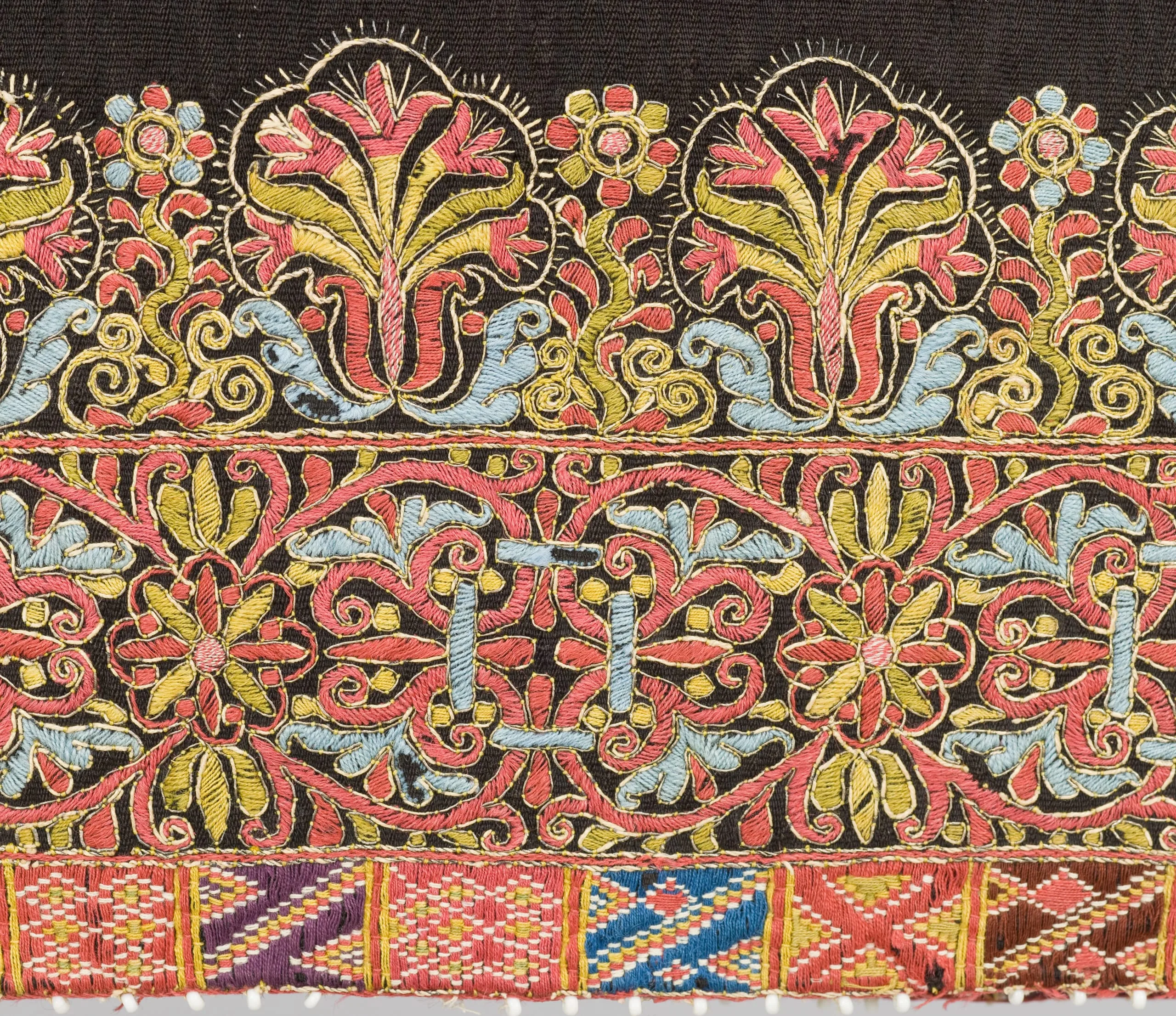
Textile fragment with dense silk embroidery on black ground, featuring two horizontal bands of scrolling floral and foliate motifs in red, gold, blue-gray, and olive green; upper band displays palmette forms with arching scalloped border, lower band shows interlaced stems and rosettes; geometric woven trim in multicolor along the bottom edge with small white beads.
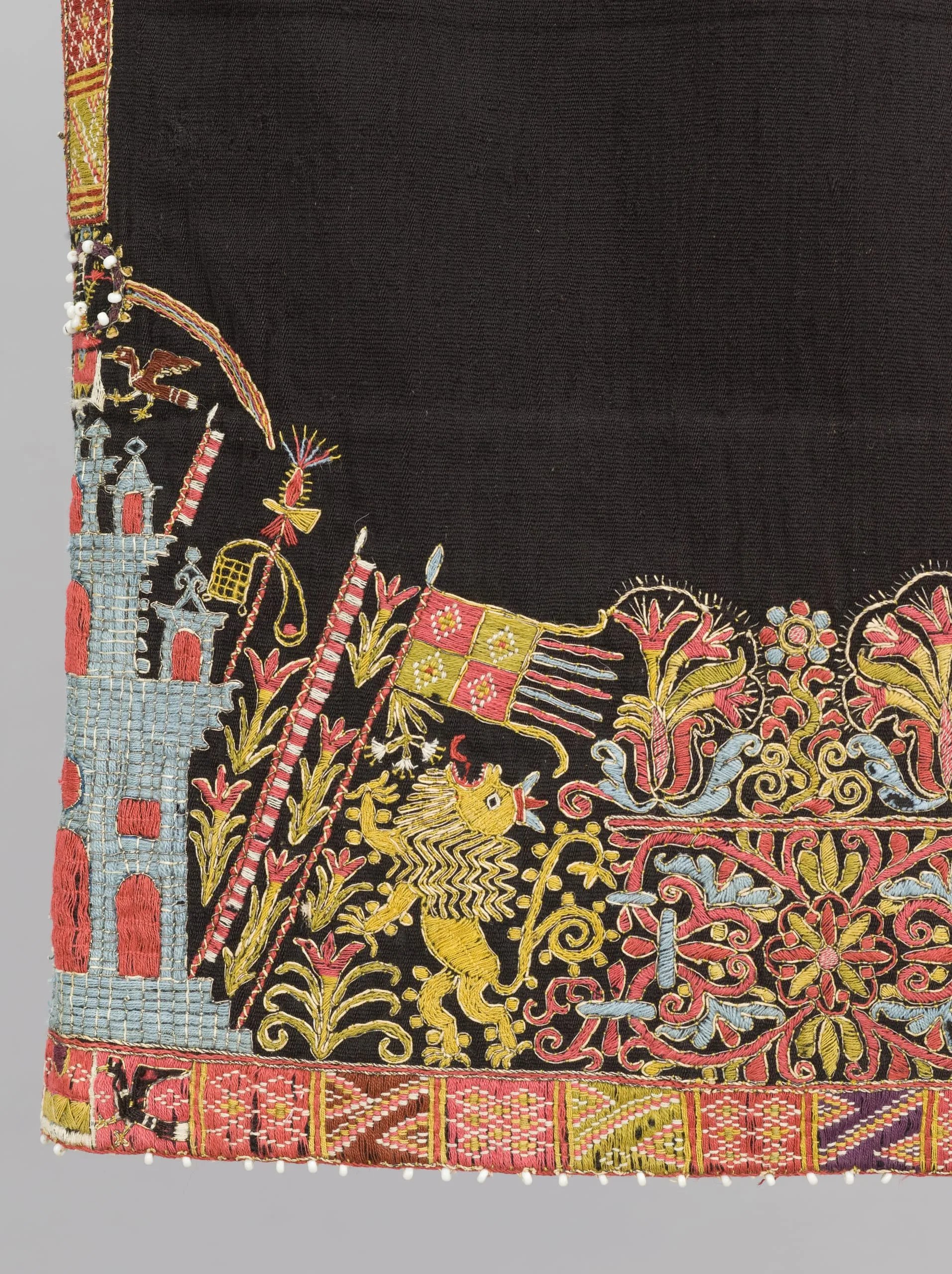
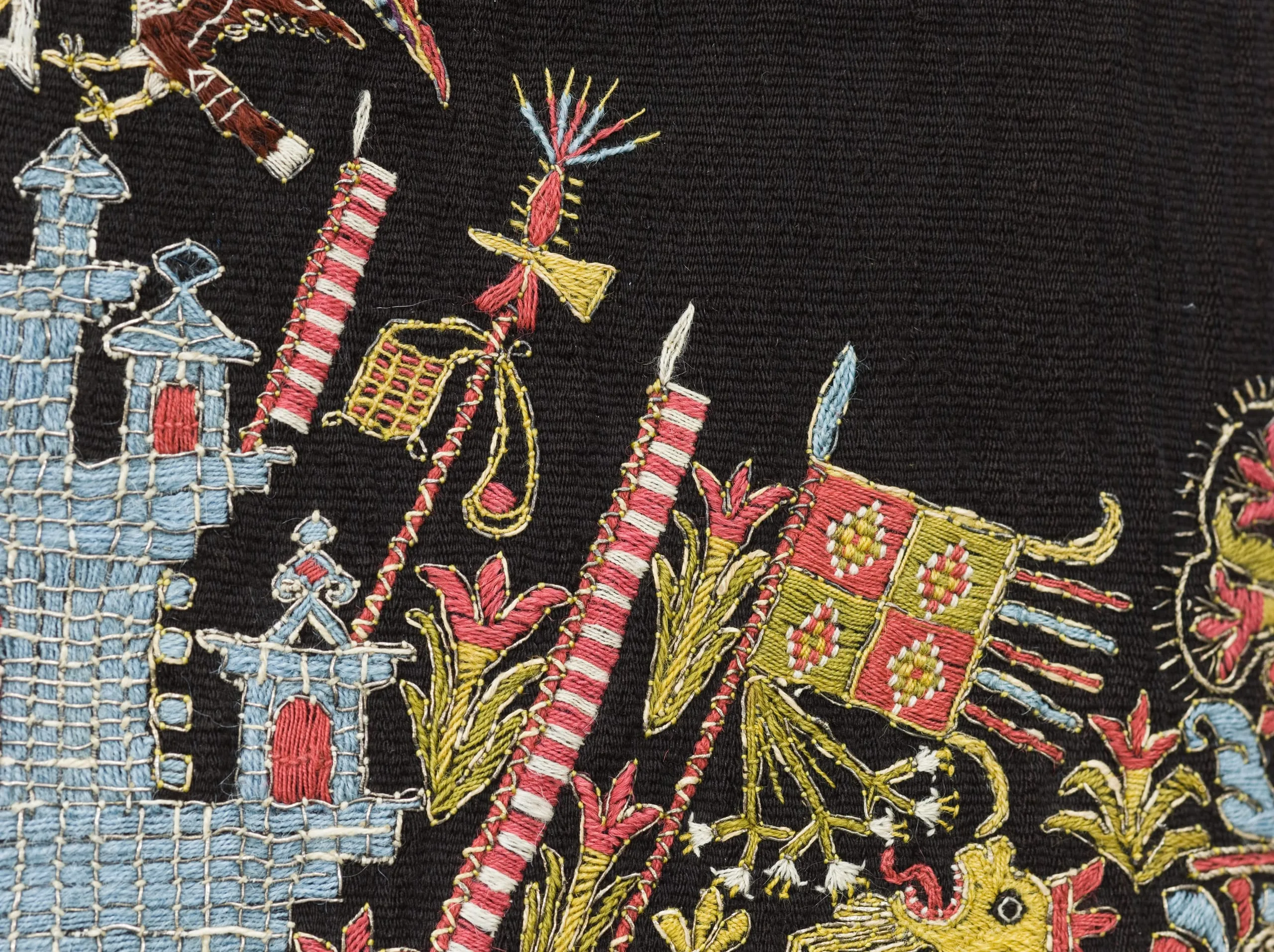
Corner detail of a black textile with dense polychrome embroidery along two borders, featuring a stylized tower or fortress in blue-gray, a heraldic lion-like creature in gold, a checkered banner, scrolling floral vines in red, blue, and gold, and a geometric woven border at the hem edged with small white beads.
Close-up detail of a woven textile with a dense diagonal twill weave in deep black, showing subtle texture variation and fine fiber irregularities across the surface.
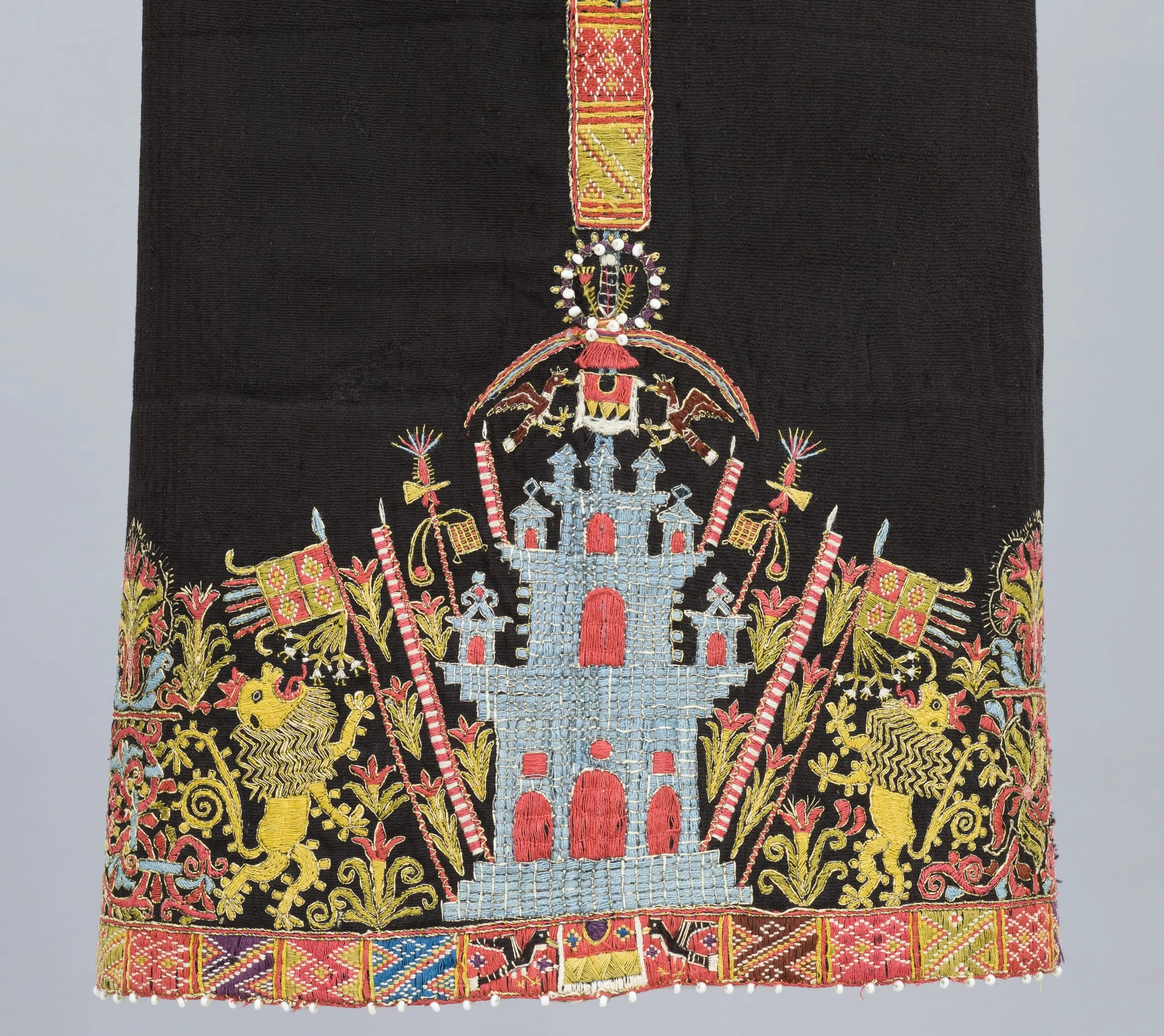
Embroidered textile panel on black cloth, featuring a central multi-tiered tower or temple structure in blue and red, flanked by yellow mythical animal figures, decorative flags, and dense floral motifs; multicolored geometric border along the bottom hem with small bead fringe, and a narrow woven band extending from the top center.
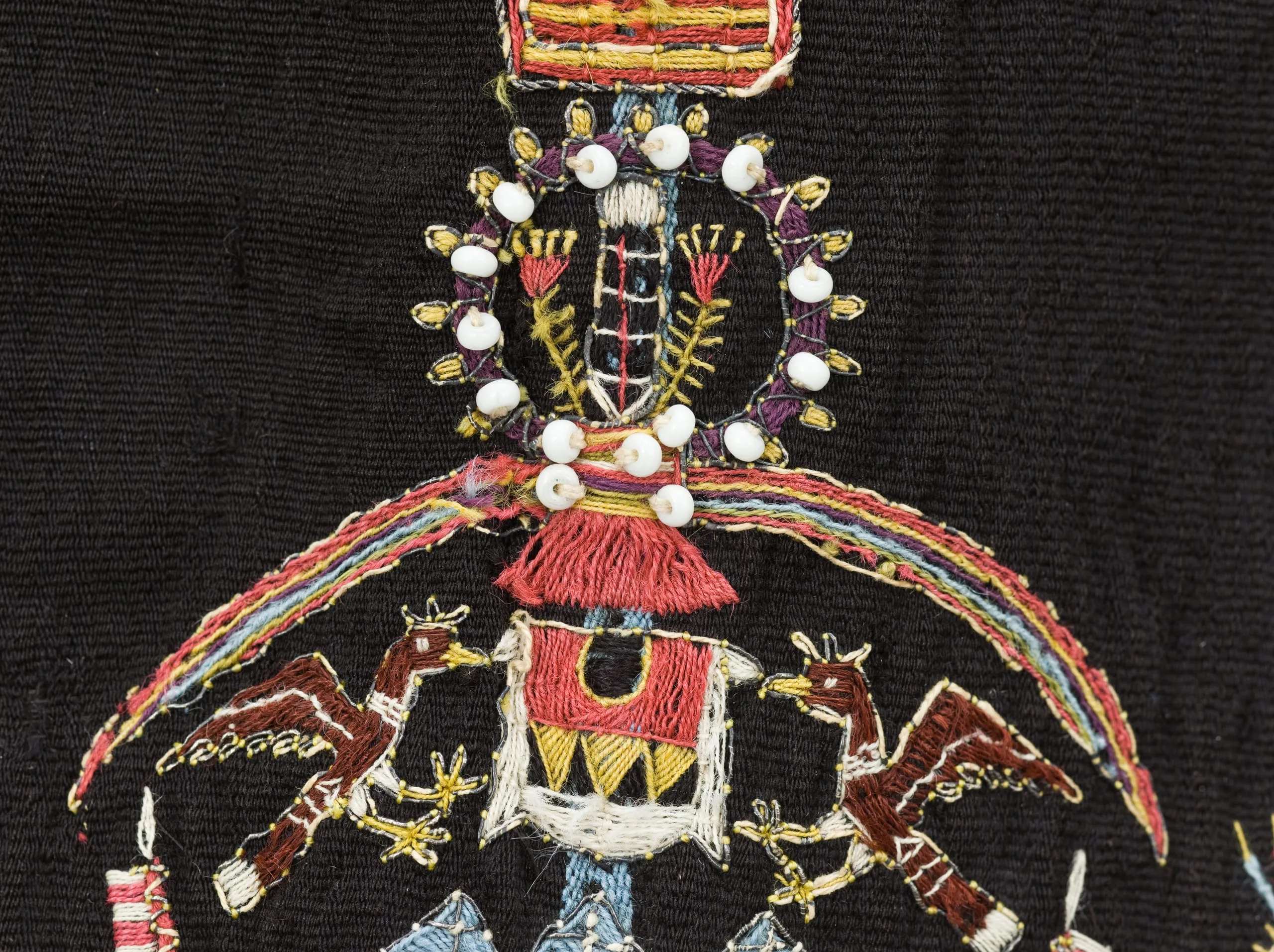
Textile embroidery on black fabric depicting a frontal ceremonial figure with elaborate headdress, collar of white beads, and outstretched wings or arms in red, blue, and multicolor threads; flanked by brown deer or camelid figures in yellow and white below.
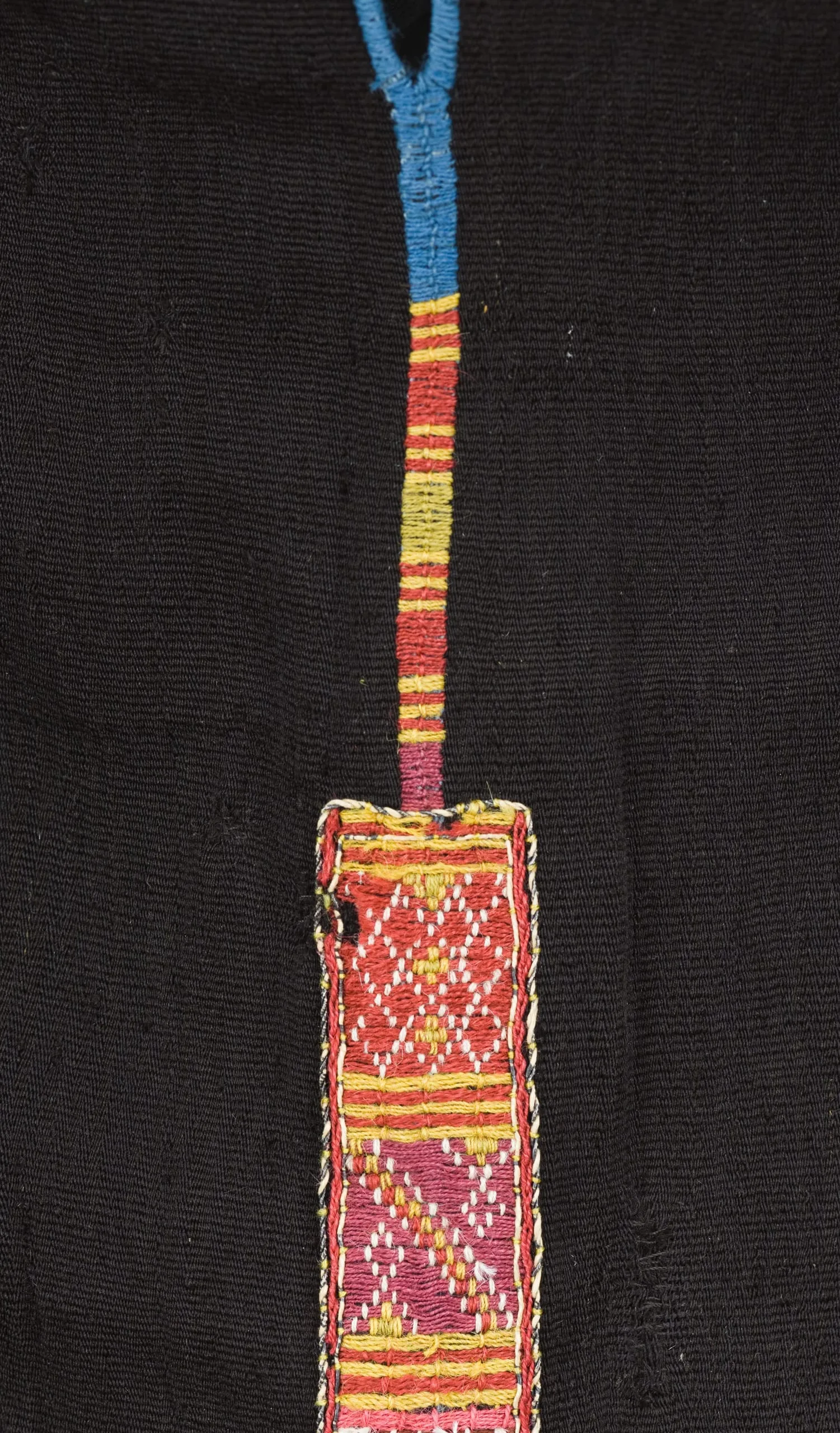
Black textile with a vertical embroidered band descending from a blue looped cord at the neckline, transitioning through yellow and red stripes to a rectangular panel with dense geometric diamond patterns in red, white, and yellow.
Embroidered textile on black fabric featuring densely stitched motifs in red, blue, yellow, and white, including a multi-tiered tower at left, striped cylindrical forms, decorative banners, floral scrollwork, and a caparisoned animal at lower right.
Artist or Maker
Unidentified artist
Title
Man’s Processional Tunic (Uncu) (Túnica procesional masculina [uncu])
Place Made
Peru, Cuzco
Date Made
late 17th–early 18th century
Medium
Camelid-fiber plain weave with silk and metallic thread embroidery and glass beads
Dimensions
30 1/2 × 36 in. (77.5 × 91.4 cm)
Credit Line
Art Museum Council Fund
Accession Number
M.2007.68
Classification
Costumes
Collecting Area
Costume and Textiles
Curatorial Notes

Brilliantly colored designs adorn this knee-length men’s uncu (tunic). Geometric bands of tocapu, a type of rank insignia used by Inka rulers and their allies, appear alongside Spanish heraldic motifs of lions, flags, and castles. The sides are ornamented with a mascaypacha, the red fringe symbolic of Inka kingship worn at the forehead. While the designs employ European embroidery techniques and materials, the black fabric was made of local yarns (likely alpaca) woven on looms used in the Andean highlands for hundreds of years. After colonization, the Indigenous nobility asserted their status under Spanish rule by wearing these tocapu-banded tunics in annual processions celebrating the Catholic Feast of Corpus Christi. The tunic was woven using yarns of the same color but different spin directions. This special technique produced a shimmering effect that further emphasized the wearer’s status.

Ilona Katzew

2024

Provenance
Mrs. Grace of the William Russell Grace family (probably Lillius Gilchrist Grace [1839–1922]), New York, first quarter of the 20th century; William Russell Grace family, New York, 1922; Sotheby’s East, New York, early 1970s; private collection, early 1970s; Textile Arts Inc. (Mary Hunt Kahlenberg), Santa Fe, New Mexico; LACMA, 2007.
Selected Bibliography
  • Phipps, Elena. "Woven Brilliance: Approaching Color in Andean Textile Traditions." The Textile Museum Journal 47 (2020): 28-69.
  • Katzew, Ilona, ed. Archive of the World: Art and Imagination in Spanish America, 1500–1800: Highlights from LACMA’s Collection. Exh. Cat. Los Angeles: Los Angeles County Museum of Art; New York: DelMonico Books/D.A.P., 2022.
Selected Exhibition History
  • Contested Visions in the Spanish Colonial World. November 6, 2011 - January 29, 2012
  • Archive of the World: Art and Imagination in Spanish America, 1500–1800. June 12, 2022 - October 30, 2022
  • Archive of the World: Art and Imagination in Spanish America, 1500–1800. October 20, 2023 - January 28, 2024
  • Archive of the World: Art and Imagination in Spanish America, 1500–1800. June 22, 2024 - September 08, 2024

Related Exhibitions