LACMA

ShopMembershipMyLACMATickets
LACMA
Los Angeles County Museum of Art
5905 Wilshire Blvd.
Los Angeles, CA 90036
info@lacma.org
(323) 857-6000
Sign up to receive emails
Subscribe
© Museum Associates 2025

Museum Hours

Monday

11 am–6 pm

Tuesday

11 am–6 pm

Wednesday

Closed

Thursday

11 am–6 pm

Friday

11 am–8 pm

Saturday

10 am–7 pm

Sunday

10 am–7 pm


  • About LACMA
  • Jobs
  • Building LACMA
  • Host An Event
  • Unframed
  • Press
  • FAQs
  • Log in to MyLACMA
  • Privacy Policy
© Museum Associates 2025
Collections

Unknown
Goddess (Devi)9th-early 10th century, with later reworkings

Not on view
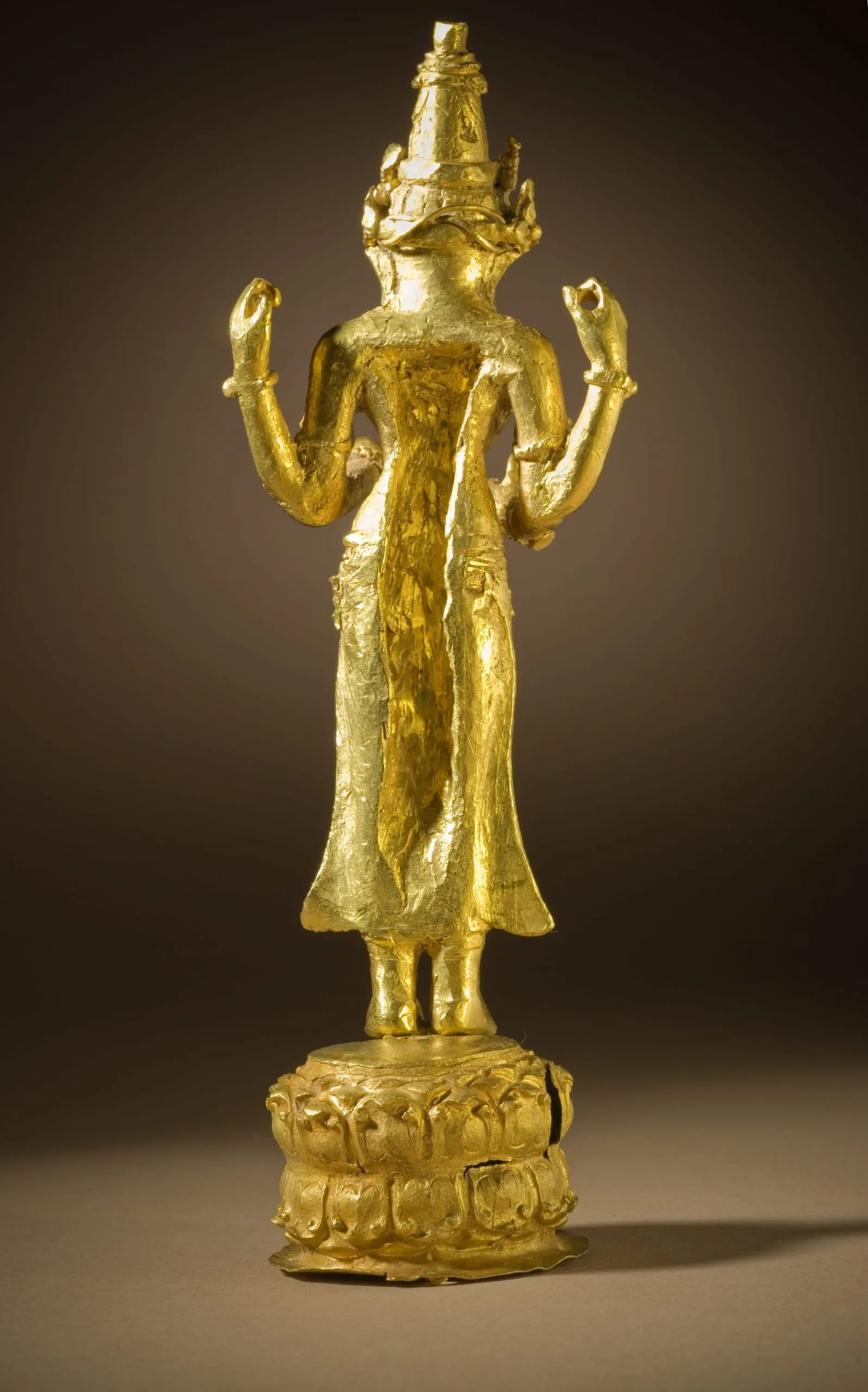
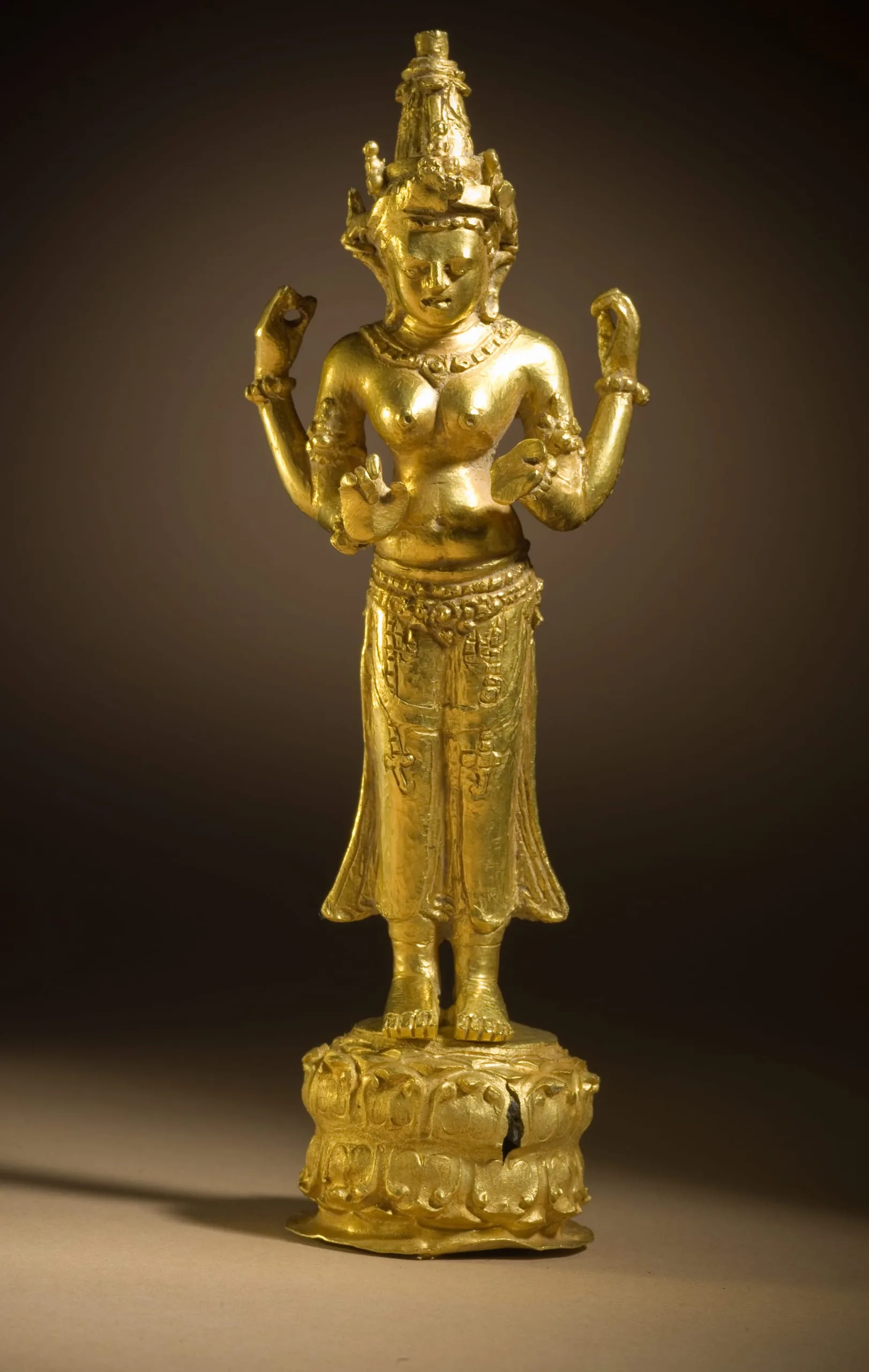
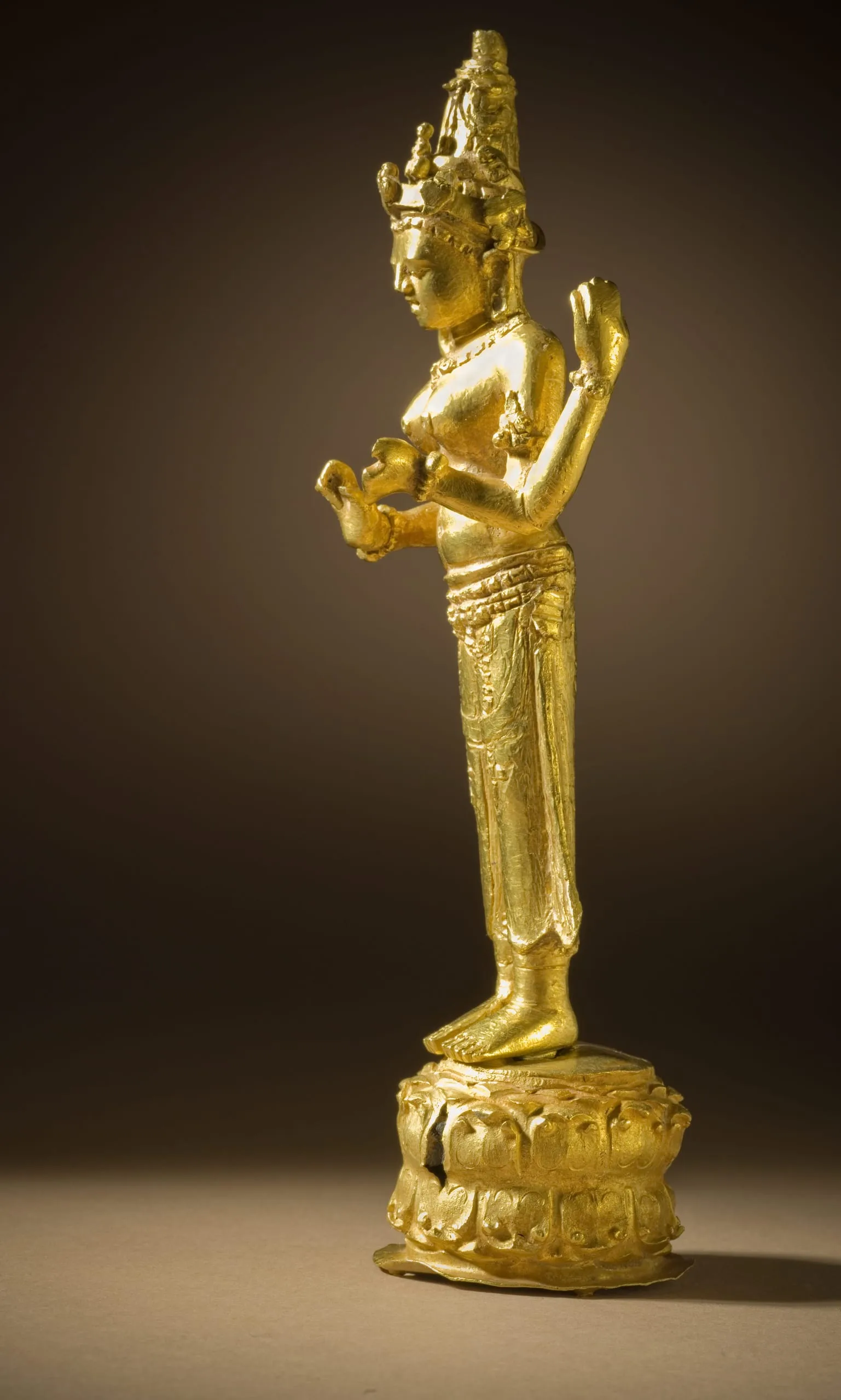
Small gilt bronze sculpture of a four-armed standing figure with tiered crown, wearing a decorated skirt, standing on a lotus pedestal
Gilt bronze standing bodhisattva figure with four arms, wearing an elaborate crown, jewelry, and draped lower garment, standing on a lotus pedestal with finely cast surface detail.
Gold-leafed bronze sculpture of a standing four-armed deity with a tall crown, raising hands in mudra gestures, standing on a tiered lotus pedestal with petal relief.
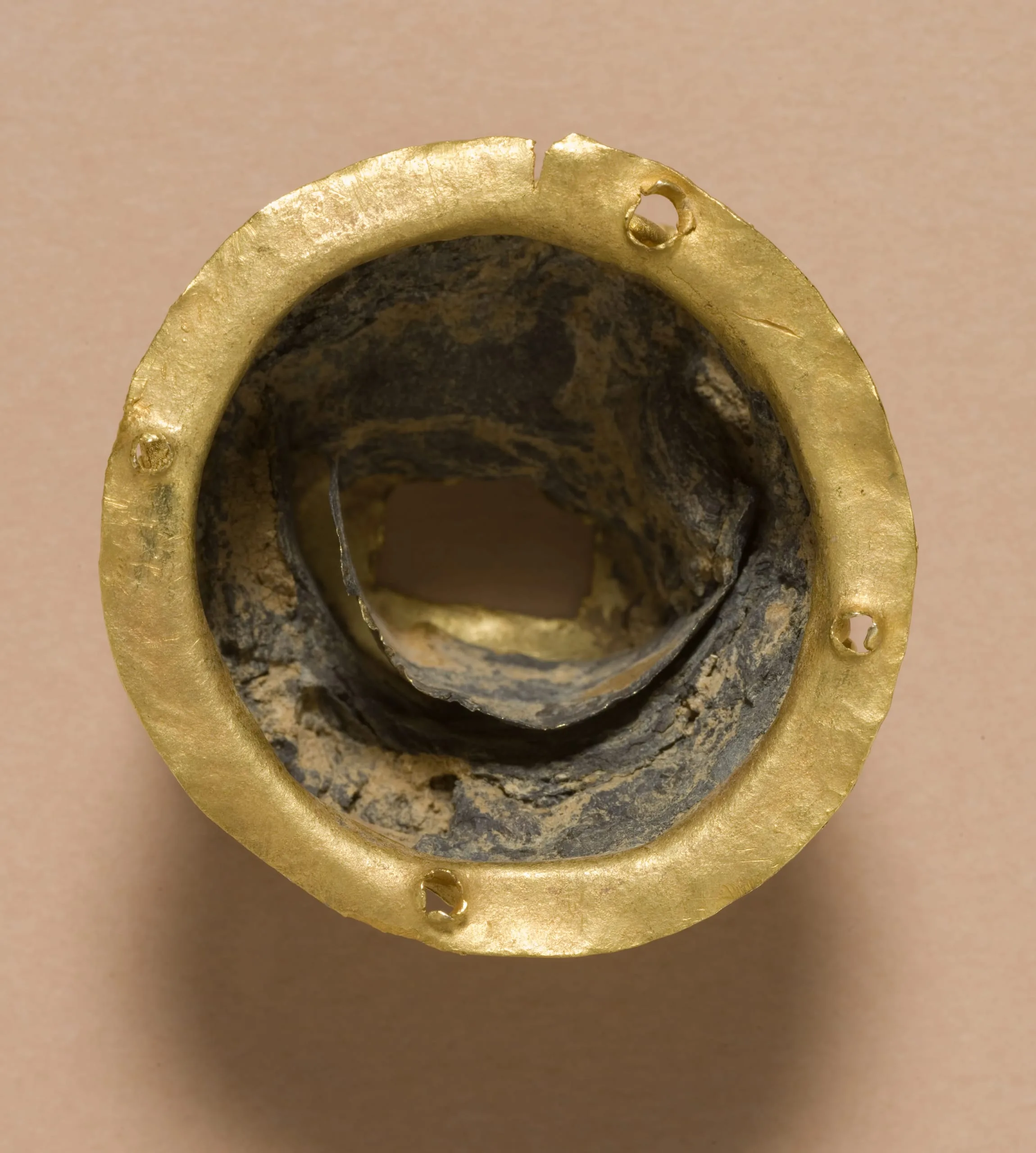
Gold sheet-wrapped cylindrical object photographed from above, showing a circular gold rim with small perforations around the edge and a dark corroded interior core of degraded material.
Artist or Maker
Unknown
Title
Goddess (Devi)
Place Made
Indonesia, Central Java
Date Made
9th-early 10th century, with later reworkings
Medium
Gold
Dimensions
a) Figure: 6 7/8 x 2 1/2 x 1 1/2 in. (17.46 x 6.35 x 3.81 cm); b) Base height: 1 1/8 in. (2.86 cm); b) Base diameter: 1 7/8 in. (4.76 cm)
Credit Line
Gift of Nancy Wiener in honor of the museum's 40th anniversary
Accession Number
M.2005.213a-b
Classification
Sculpture
Collecting Area
South and Southeast Asian Art
Curatorial Notes

The art of the goldsmith was a highly sophisticated and culturally symbolic craft in ancient Indonesia. Gold was regarded as a symbol of immortality on account of its everlasting brilliance and immunity to decay; accordingly, its earliest use in prehistoric times seems to have been as symbolic burial offerings. Subsequently, gold was used for two primary purposes: as an economic medium of exchange and for jewelry and ornamentation. Historical references from Indonesia, India, China, the West, and the Arab world all attest to the abundance of gold in ancient Indonesia. Although myriad golden objects were fashioned in Java, in actuality deposits of gold are extremely rare there and most of the ancient Javanese gold was probably imported from Kalimantan (Borneo) and Sumatra. The latter island was in fact called the "Golden Island" (Suvarnadvipa) by the Indians who traded extensively with its merchants. Indeed, Indonesia's legendary gold was thought so bountiful that as late as the 16th century a Portuguese traveler in western Indonesia fantastically claimed that "there was so much gold in Java that even dogs had golden collars" (John Miksic, Old Javanese Gold [Singapore: Ideation, 1990], p. 37).

This crowned solid gold goddess with four arms is attributed to Central Java, 9th-early 10th century. Its attributes are now missing, so the goddess is now unidentifiable. A large trough on the back of the solid gold figure has been hollowed out, and sections of the fingers and hands were later removed, both presumably for the gold content. The lotus base is hollow.

A comparable Central Javanese gold image of Vishnu, attributed to circa 8th-9th century, is in the Museum Nasional, Jakarta (A2/486). See Jan Fontein, The Sculpture of Indonesia (Washington: National Gallery of Art, 1990), pp. 205-206, no. 53.
Selected Bibliography
  • Brown, Robert L. "Selections From the Southeast Asian Art Collection of the Los Angeles County Museum of Art." Arts of Asia 38 (3): 75-87 (May-June 2008)