LACMA

ShopMembershipMyLACMATickets
LACMA
Los Angeles County Museum of Art
5905 Wilshire Blvd.
Los Angeles, CA 90036
info@lacma.org
(323) 857-6000
Sign up to receive emails
Subscribe
© Museum Associates 2025

Museum Hours

Monday

11 am–6 pm

Tuesday

11 am–6 pm

Wednesday

Closed

Thursday

11 am–6 pm

Friday

11 am–8 pm

Saturday

10 am–7 pm

Sunday

10 am–7 pm


  • About LACMA
  • Jobs
  • Building LACMA
  • Host An Event
  • Unframed
  • Press
  • FAQs
  • Log in to MyLACMA
  • Privacy Policy
© Museum Associates 2025
Collections

Jai Ram (attributed to)
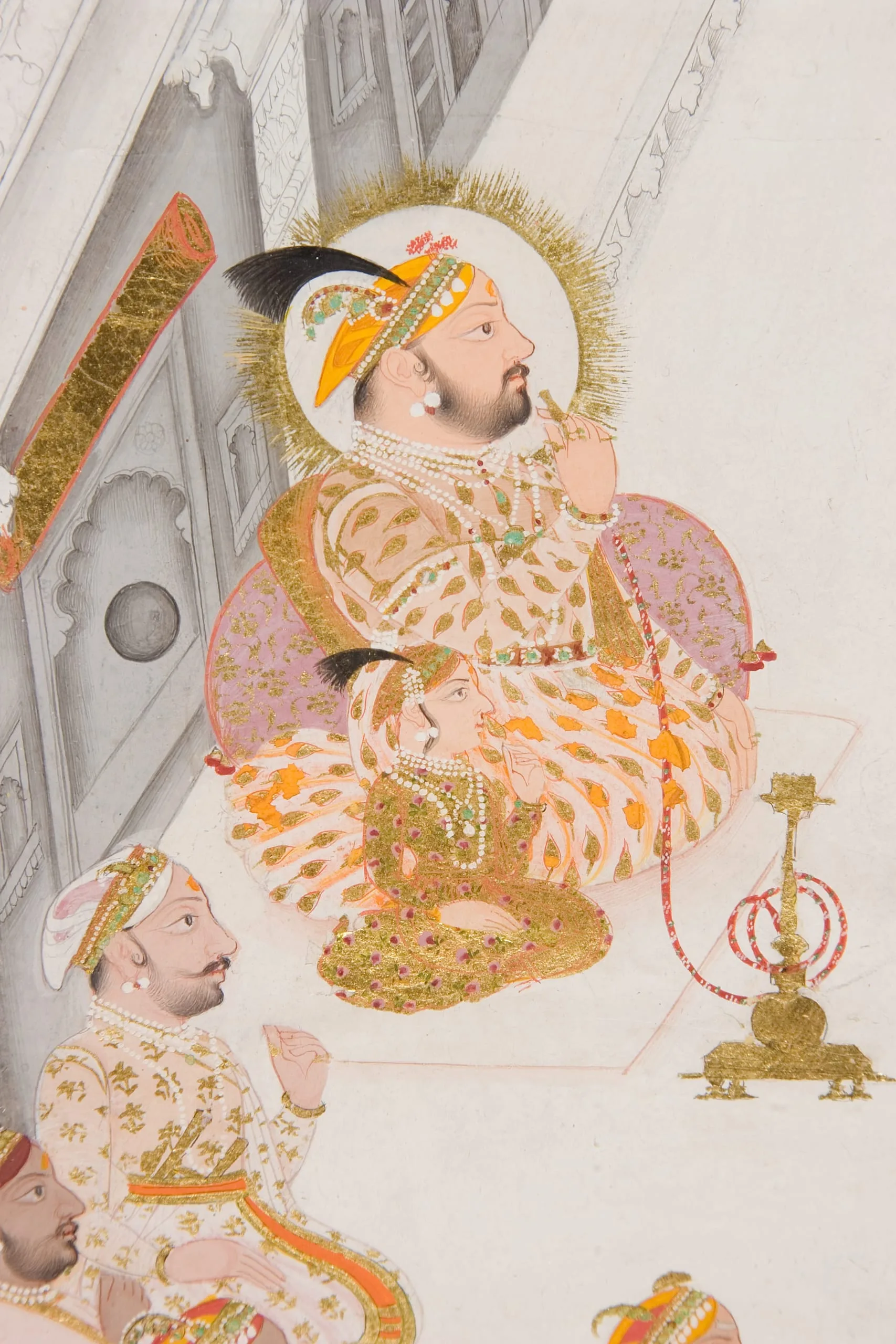
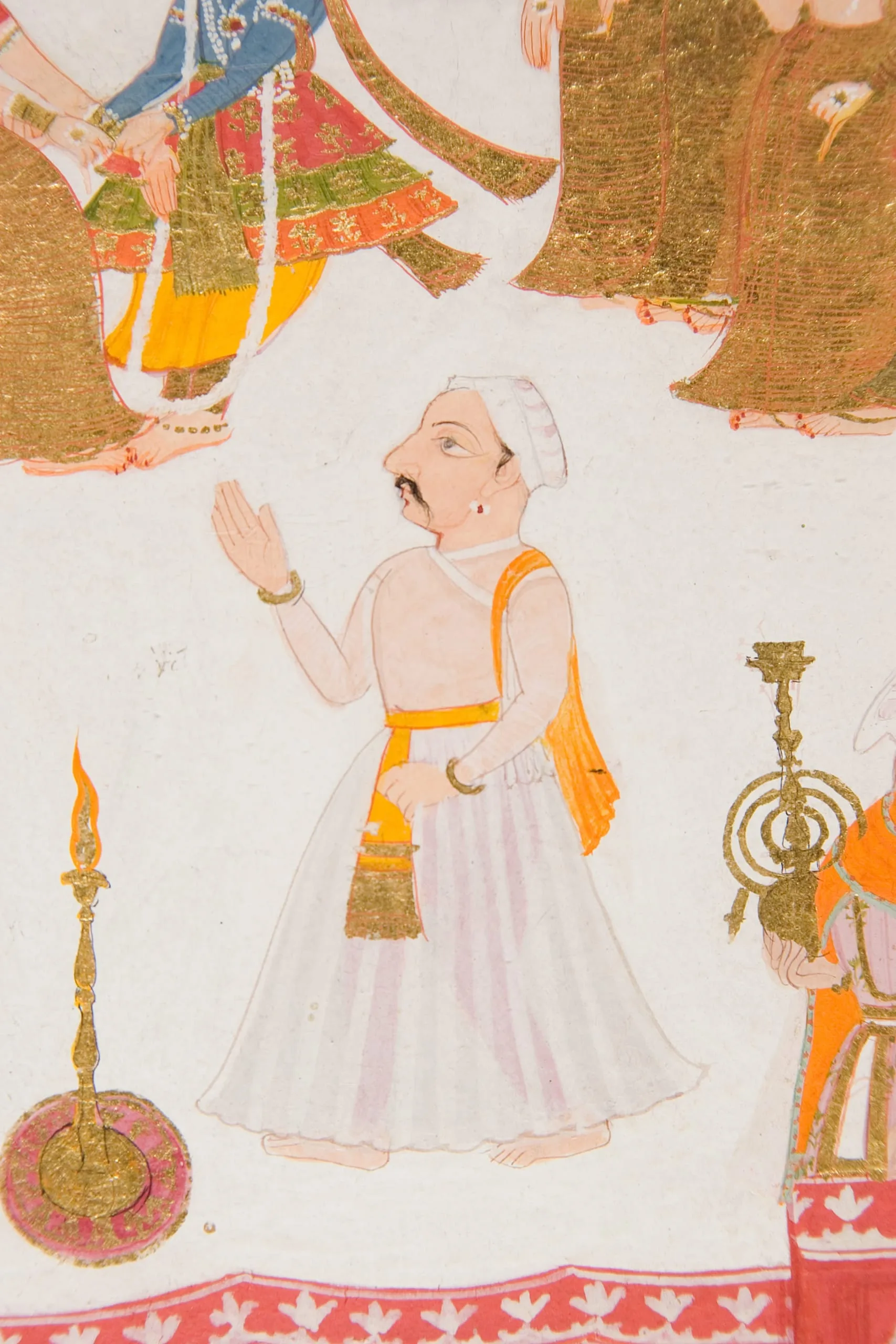
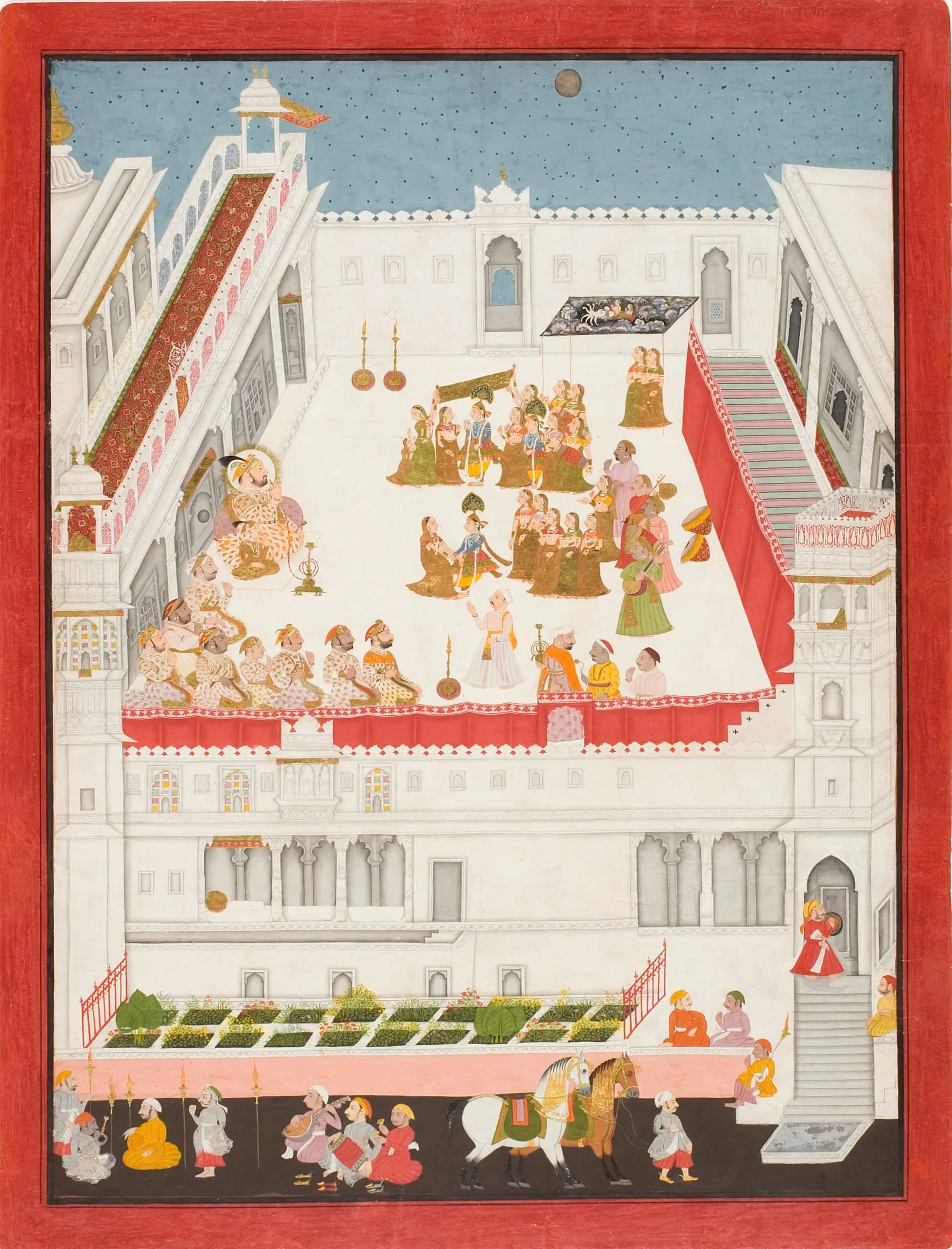
Maharana Jagat Singh II of Mewar (r. 1734-1751) Watching Krishna's Dance of Delight (Rasa Lila) Performed in the Courtyard of the Udaipur City Palace1736-circa 1740

Not on view
Indian miniature painting of a multi-tiered palace courtyard filled with dozens of courtly figures in jewel-toned dress, with a nighttime blue sky above and a street procession below
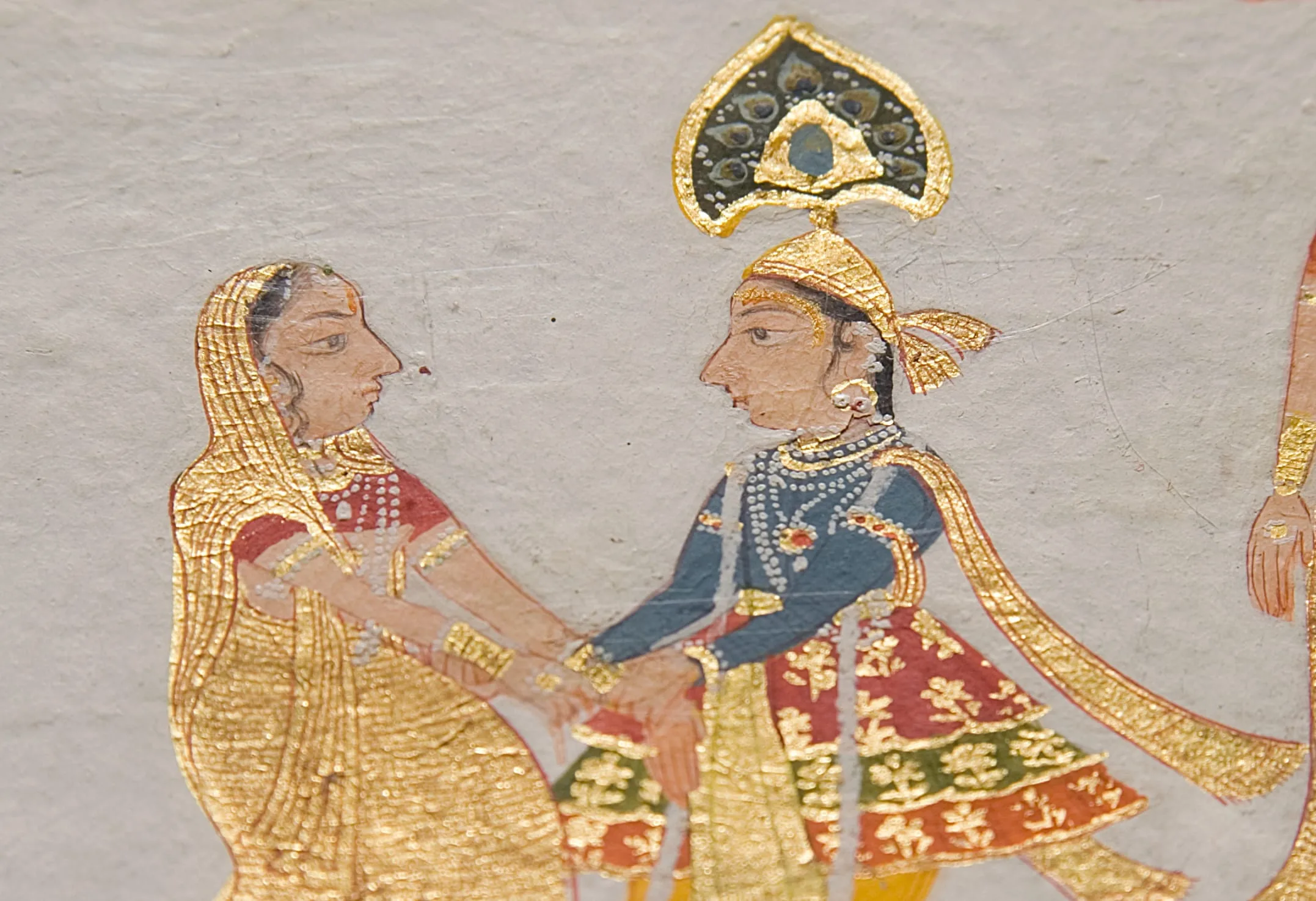
Opaque watercolor and gold painting on paper depicting two figures in profile facing each other and joining hands; the left figure wears a gold sari with red blouse, the right wears a dark blue garment with layered skirts and an elaborate gold crown with a dark pointed top; both adorned with gold jewelry and pearl necklaces, rendered in a Rajput miniature painting style with flat color and fine detail.
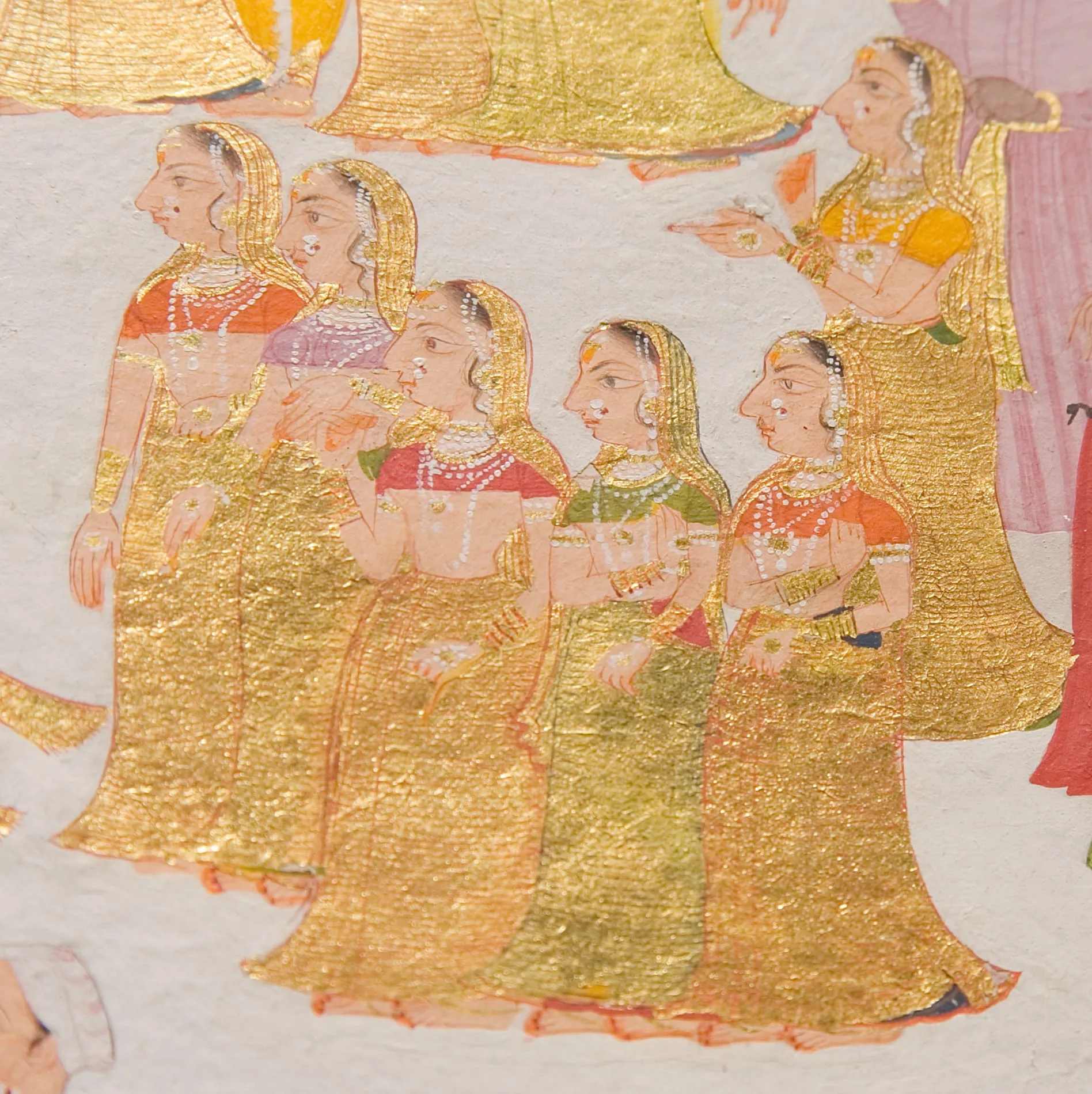
Rajput-style opaque watercolor and gold manuscript painting depicting a group of women in profile, dressed in gold ghagras with red and green bodices, adorned with pearl jewelry and dupatta veils, clustered together against a pale ground with liberal application of gold leaf.
Opaque watercolor and gold leaf depicting a multi-tiered Mughal-style pavilion with white carved jali screens, red and white decorative arcade, and a gold-banded balcony; red textile panels and striped awning at the edges.
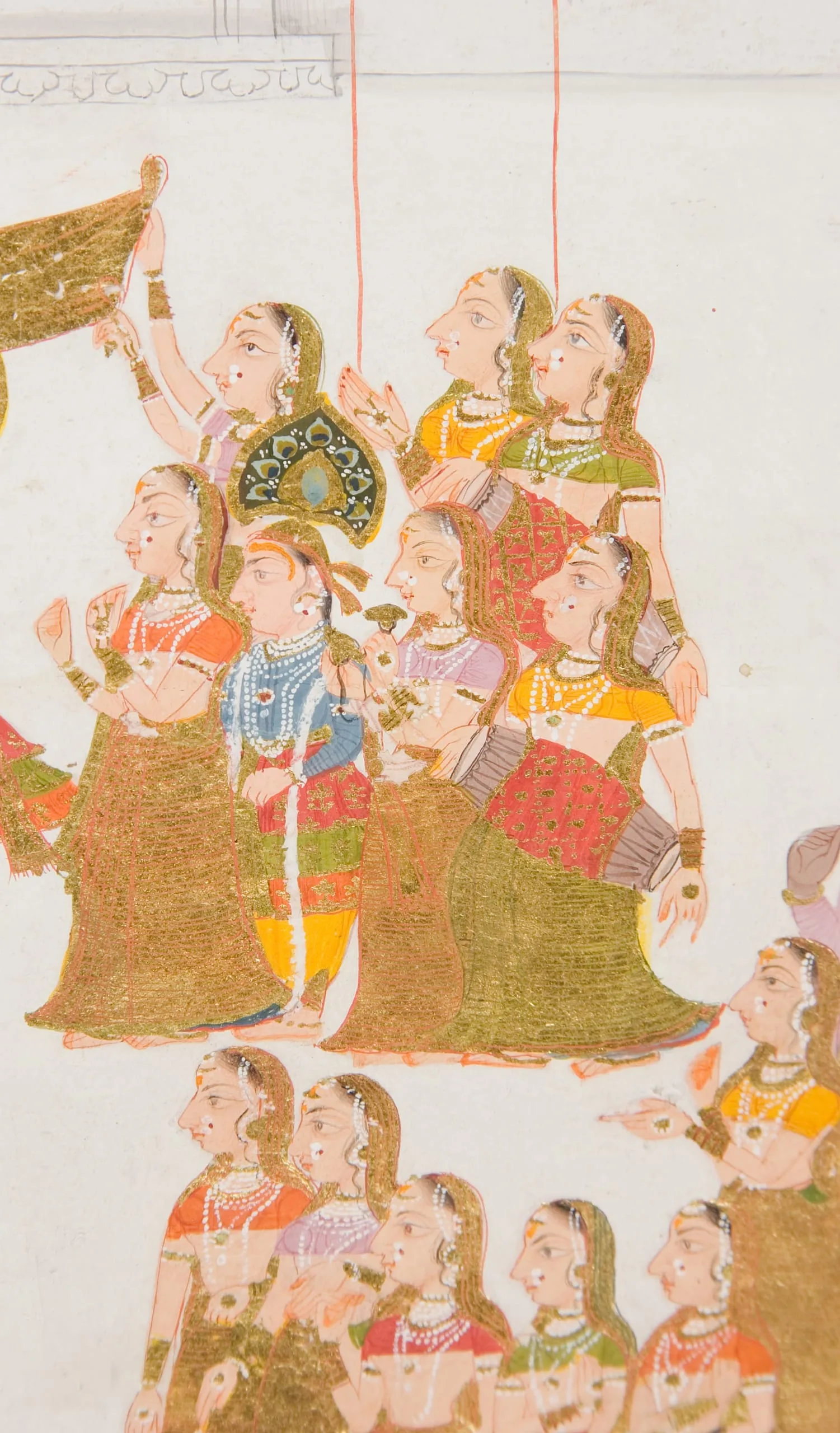
Rajput-style opaque watercolor and gold painting depicting a group of women in vibrant saris and jewelry, arranged in a tightly clustered composition; one figure raises a fan overhead while others look toward the right; rich golds, oranges, and greens with fine detail in ornaments and clothing; a line of additional women visible below.
Mughal-style opaque watercolor and gold painting depicting a bejeweled male figure with a radiant halo seated on a terrace, wearing pearl necklaces and a yellow turban with feather; a second smaller figure in gold-patterned robes kneels below, with a gold hookah at right and two male attendants in turbans at lower left.
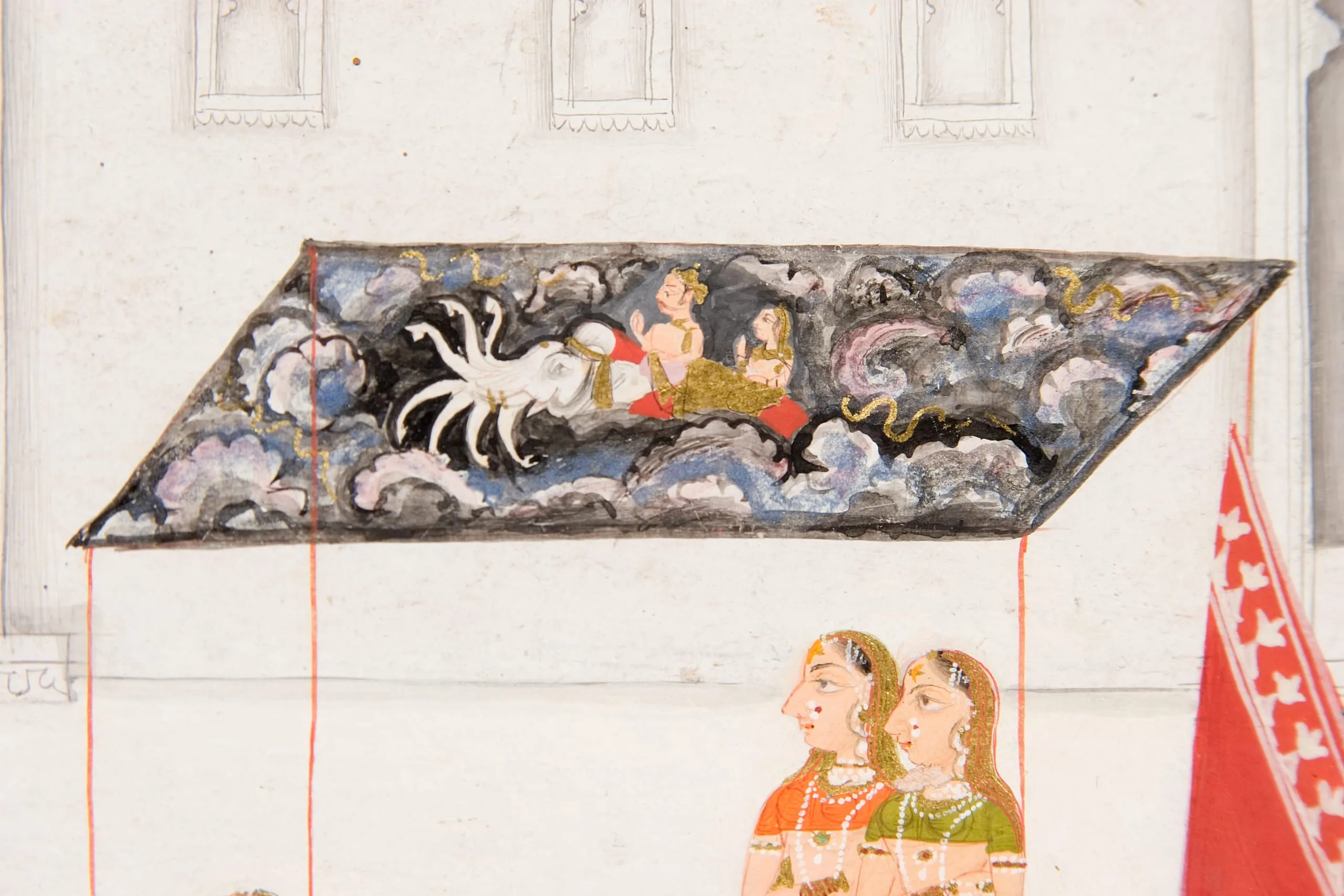
Indian manuscript-style painting, likely Rajput or Mughal tradition, showing two scenes: an upper panel with two figures riding a white multi-headed serpent or celestial creature amid dark swirling clouds with gold accents; below, three women in profile wearing jewelry and colorful garments. A red banner with white floral motifs appears at right.
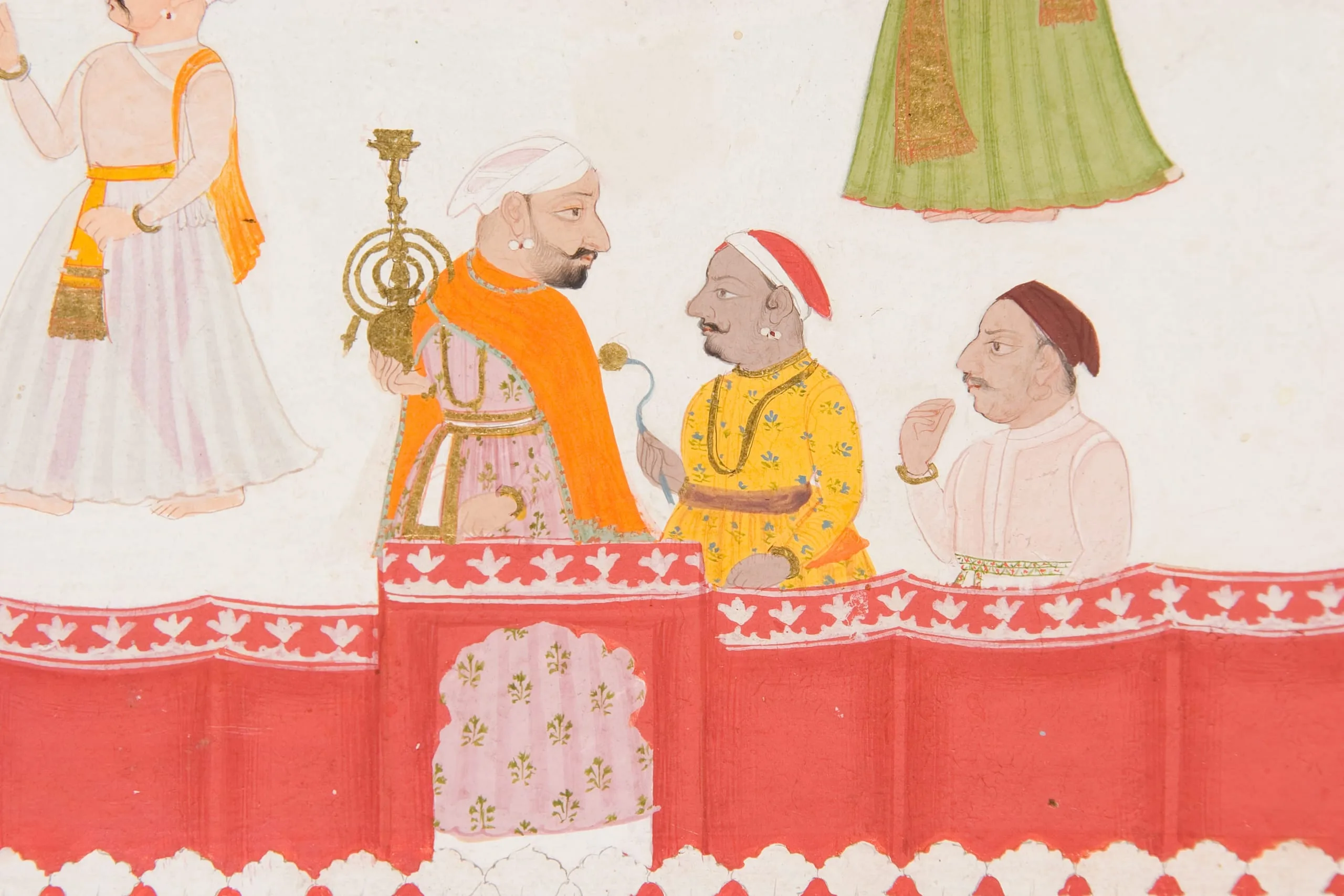
Indian opaque watercolor miniature painting depicting several figures on a red-bordered terrace; a central standing man in white turban and orange shawl holds a gold hookah or ceremonial object, facing two seated men in yellow and white kurtas wearing red caps, with additional figures partially visible at the edges.
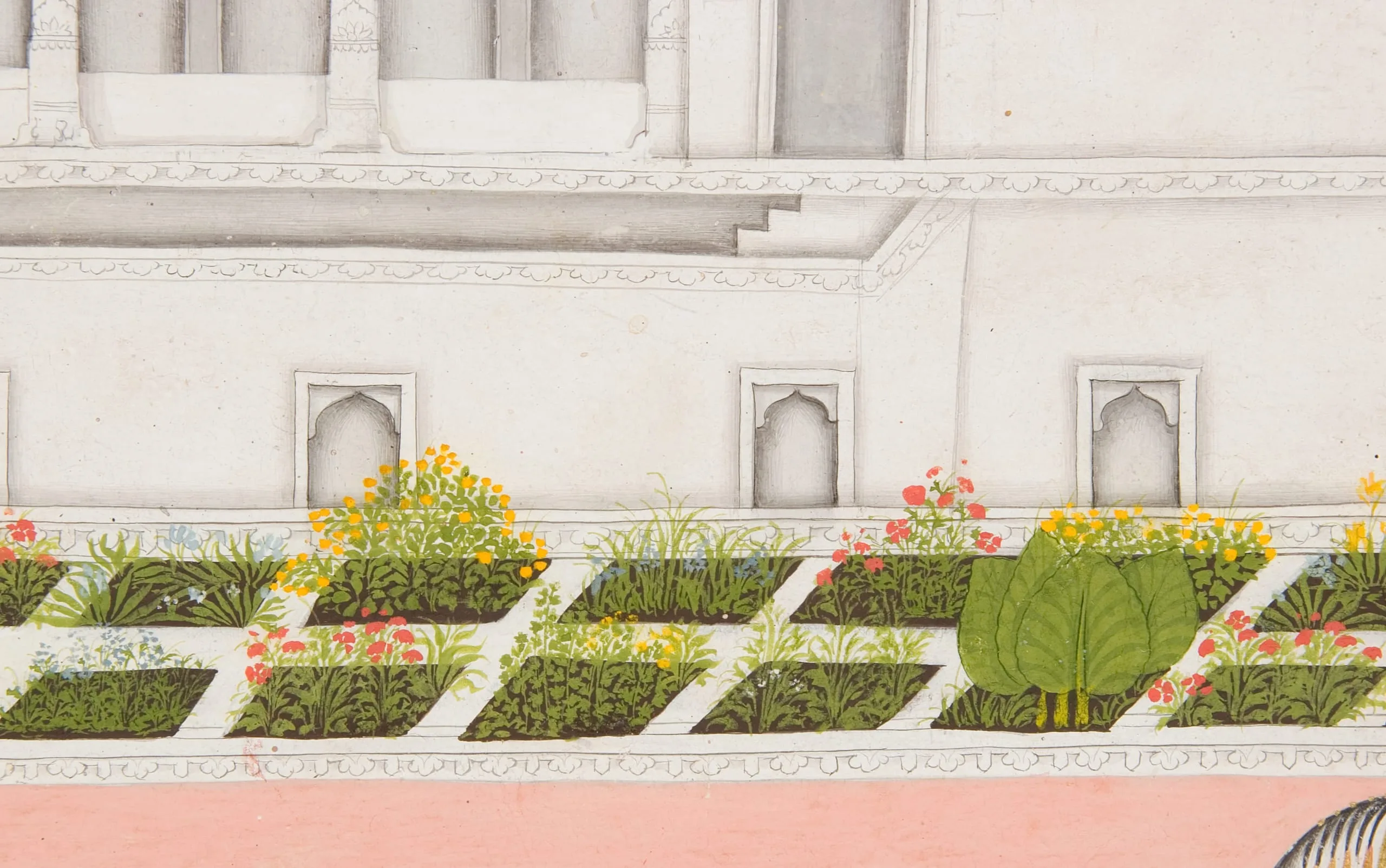
Mughal-style opaque watercolor detail depicting a formal garden terrace with geometric planting beds filled with red, yellow, and blue flowers and lush green foliage, set against a white marble architectural facade with cusped arched niches and decorative molding.
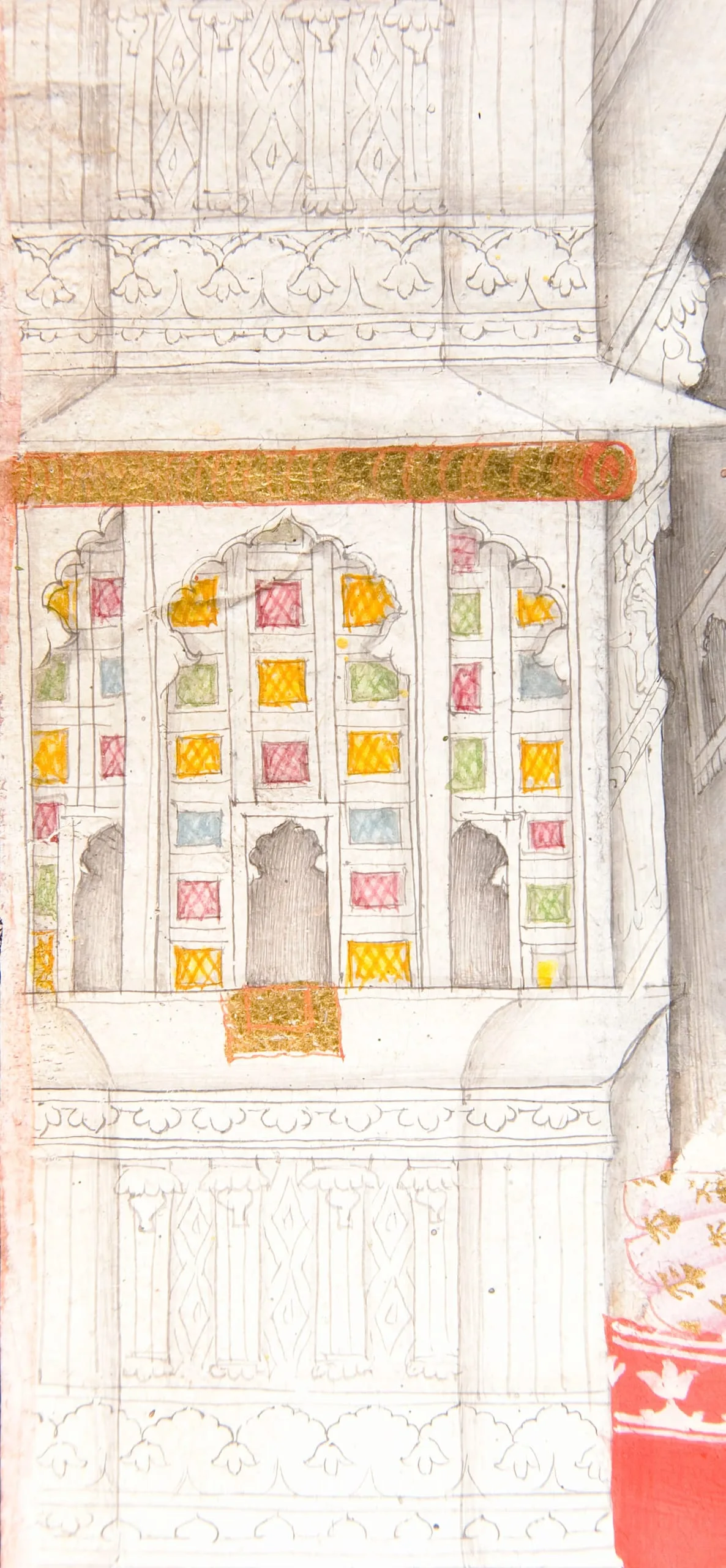
Pencil and watercolor sketch of a Mughal-style architectural facade featuring multi-arched jali screens with small panes colored in yellow, orange, pink, and green; orange-red and gold horizontal band above; carved decorative friezes above and below.
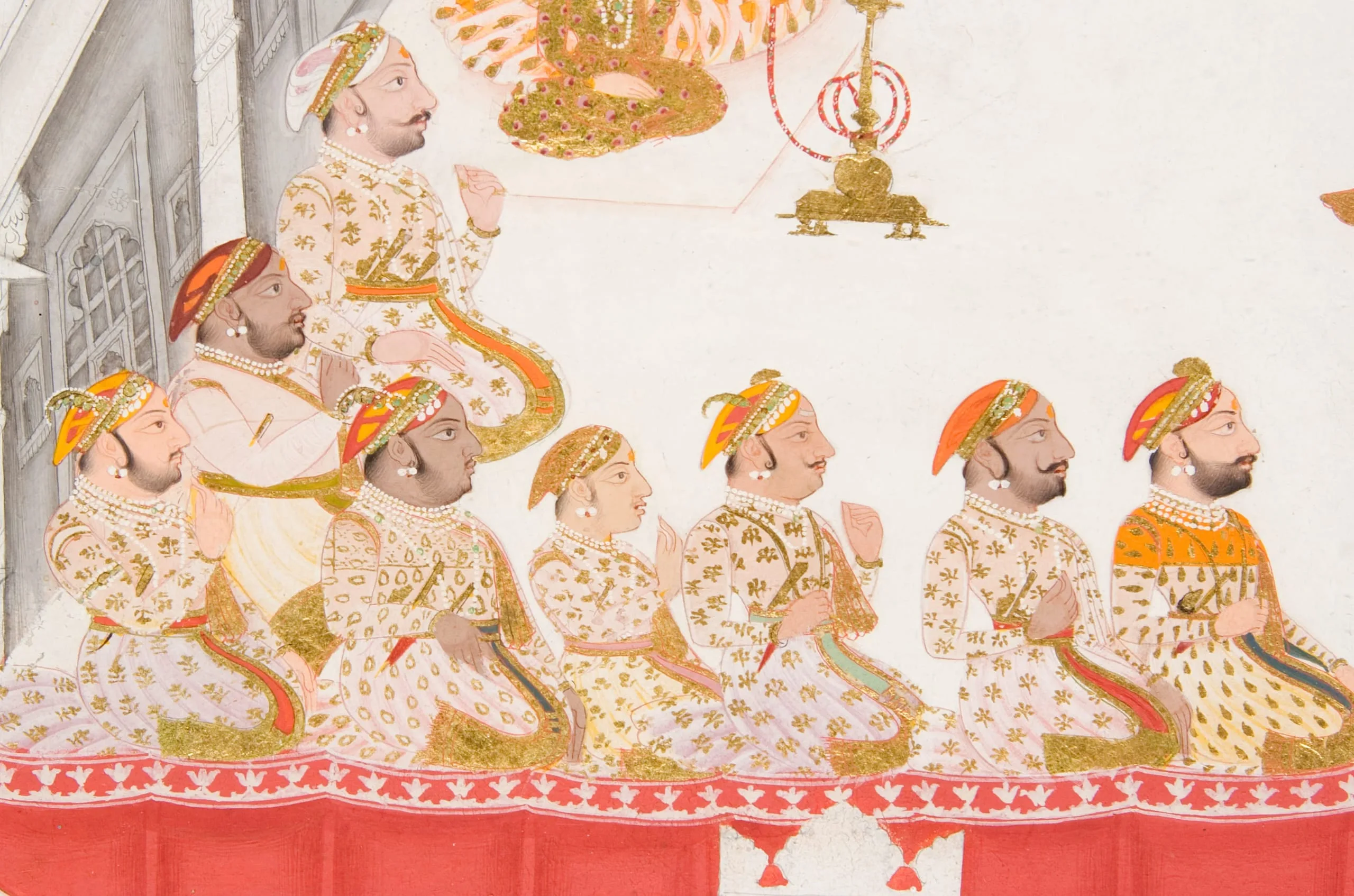
Indian court painting, opaque watercolor and gold on paper, depicting eight noblemen in profile seated on a red-bordered terrace, wearing white and gold jamas with orange and red turbans adorned with feathers and pearls; one elevated figure gestures toward a gold ritual vessel at upper right, architectural elements visible at left.
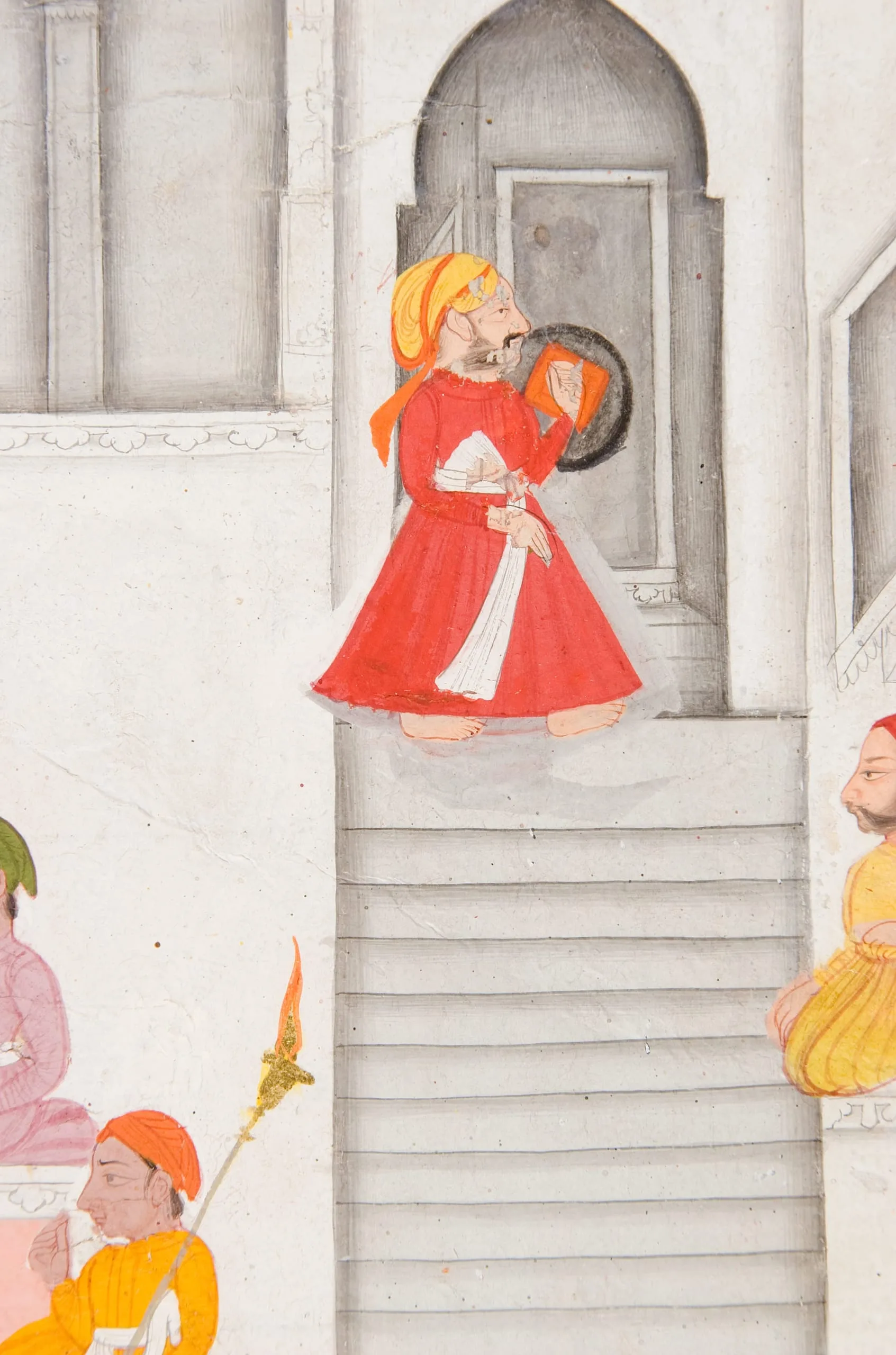
Opaque watercolor painting in Rajput style; a male figure in a red jama and yellow turban stands on palace steps holding a round object, with attendant figures in turbans visible at lower left, one holding an ornate staff.
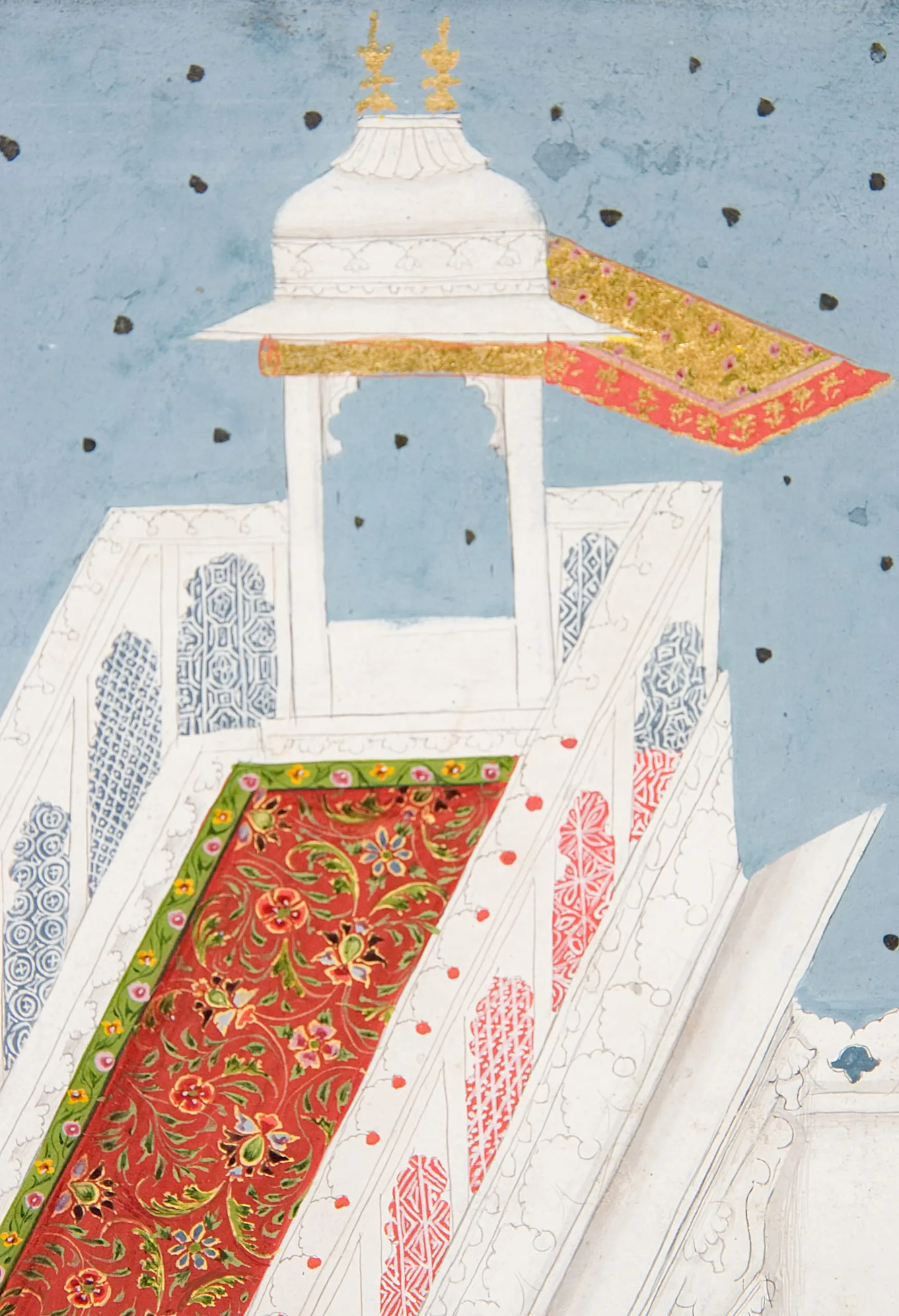
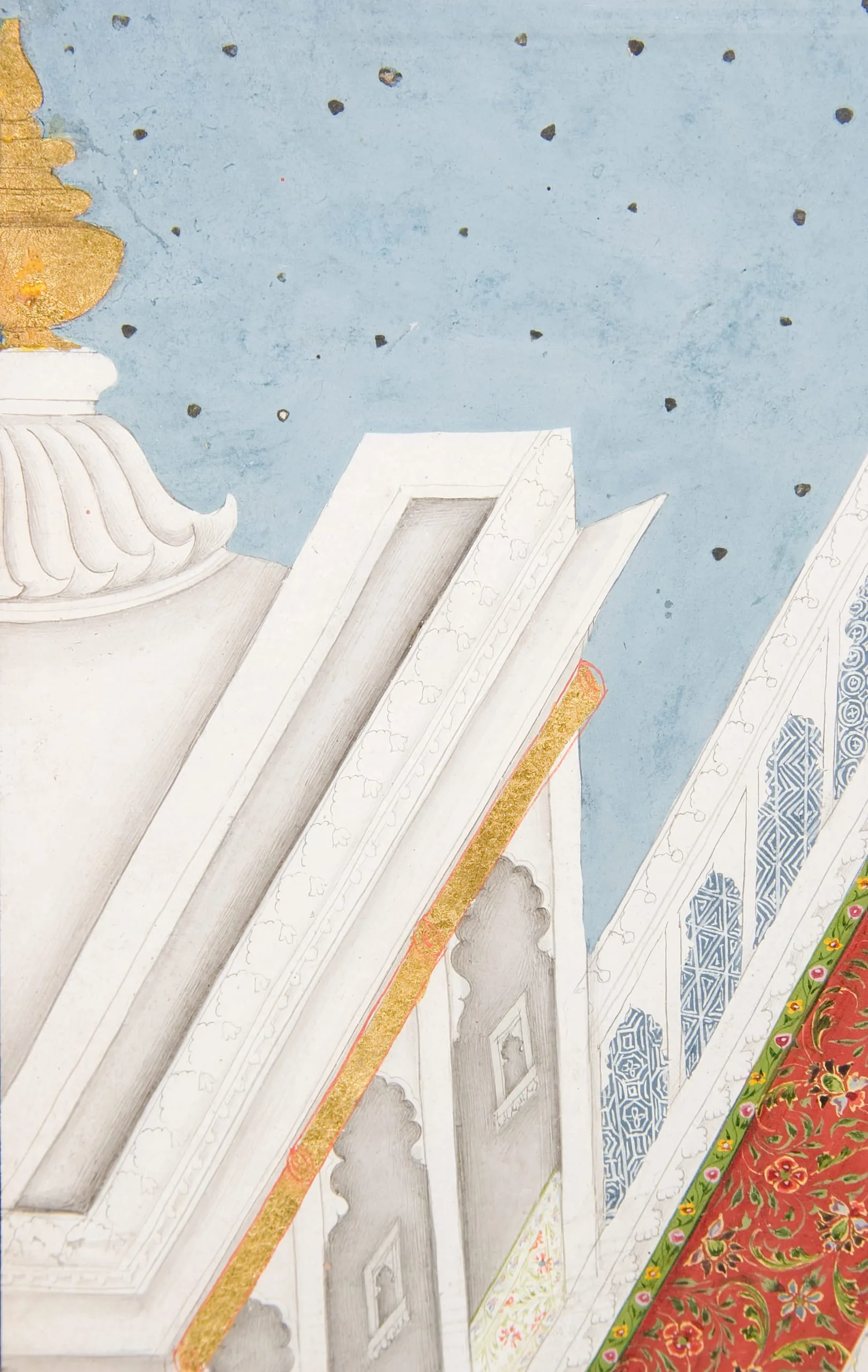
Indian opaque watercolor depicting a white marble pavilion with a domed chattri finial in gold against a pale blue sky with scattered dark birds; red and gold carpets with dense floral arabesque patterns drape over the architectural terraces.
Mughal-style opaque watercolor on paper; a standing male figure in white jama and white turban with orange sash raises one hand, flanked by gilded oil lamps; richly dressed figures visible at upper edge.
Opaque watercolor and gold on paper depicting architectural details of a white marble structure with gilded finial at upper left, diagonal rooflines converging sharply, patterned blue latticework and red floral textile panels at right, against a pale blue sky with scattered dark flecks.
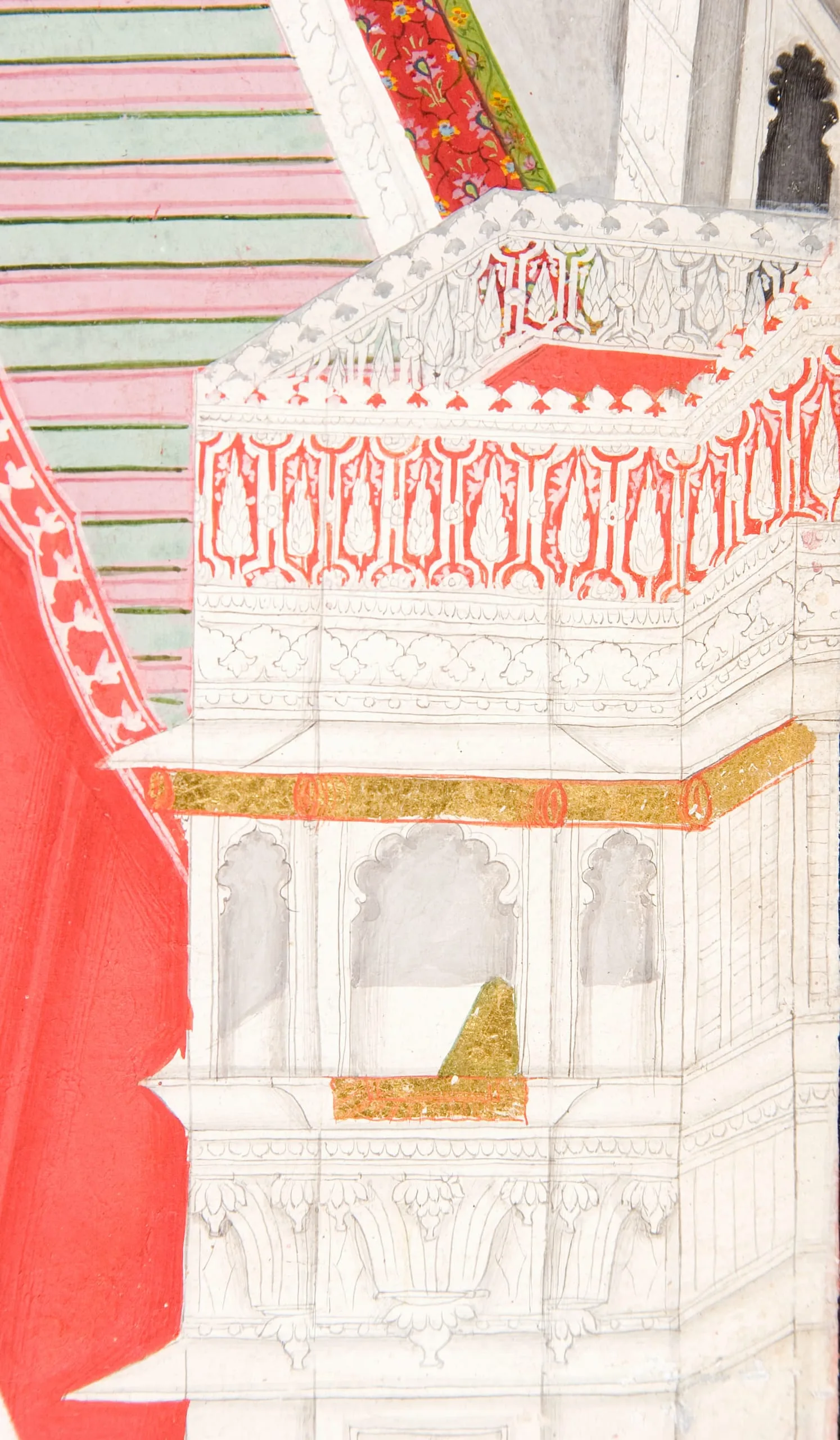
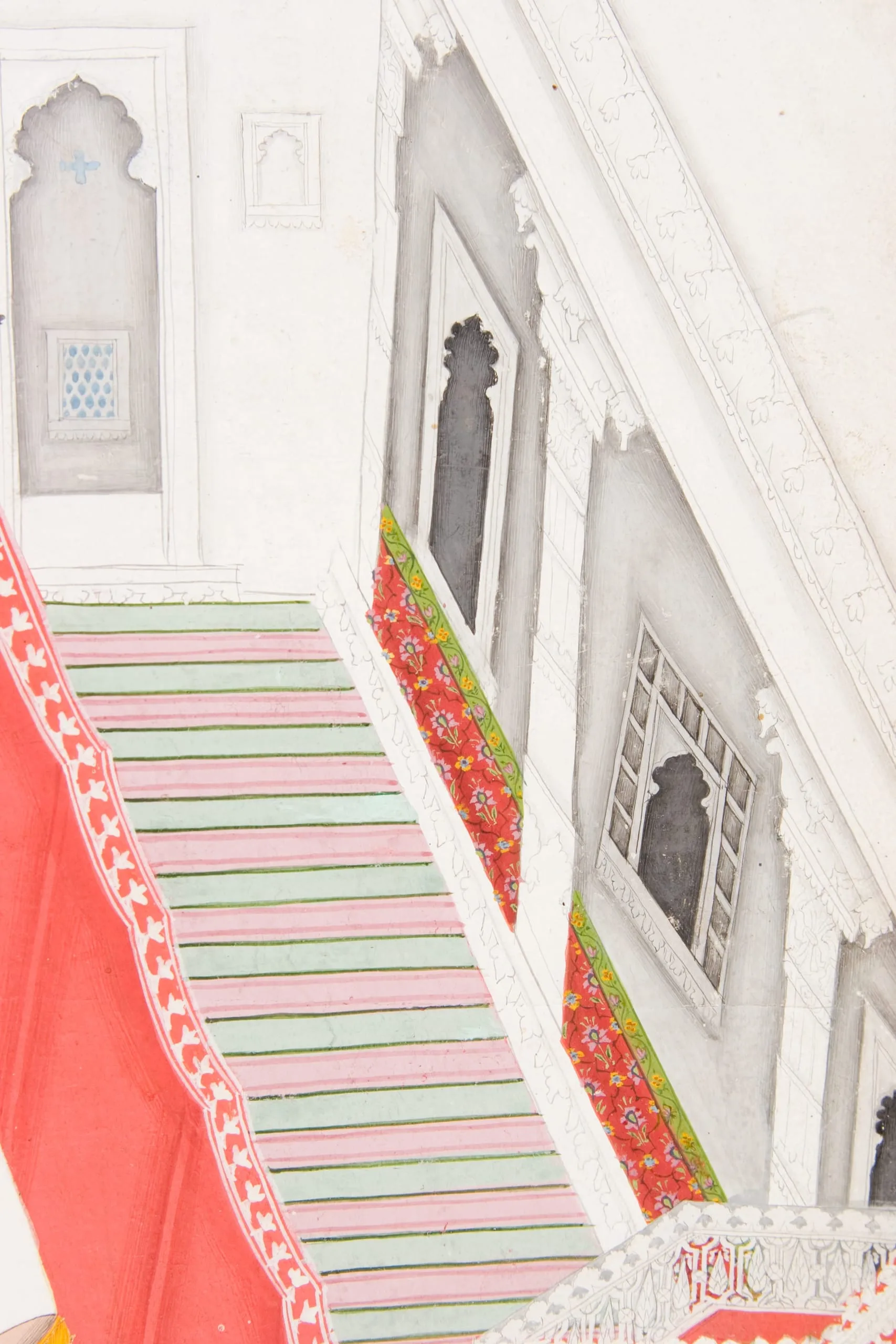
Indian miniature painting depicting an architectural interior with a staircase draped in pink and green striped textile, bordered by red floral fabric, leading toward white plaster walls with arched niches and latticed windows.
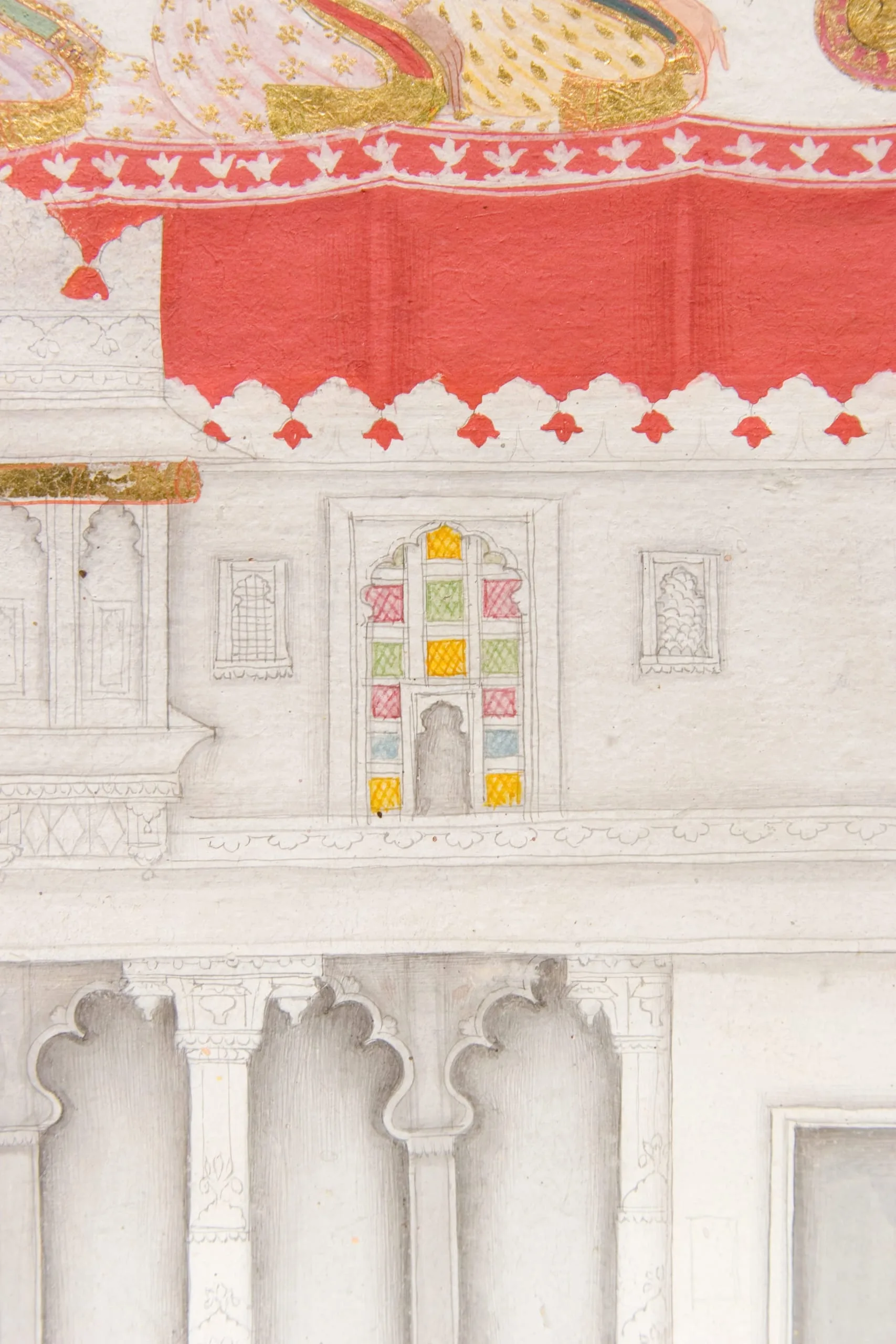
Opaque watercolor and gold painting depicting a Mughal or Rajput palace facade in white with cusped arches and colonnades; a central jharokha window with multicolored panes in pink, green, and yellow; above, a red canopy with scalloped trim and gold decorative elements.
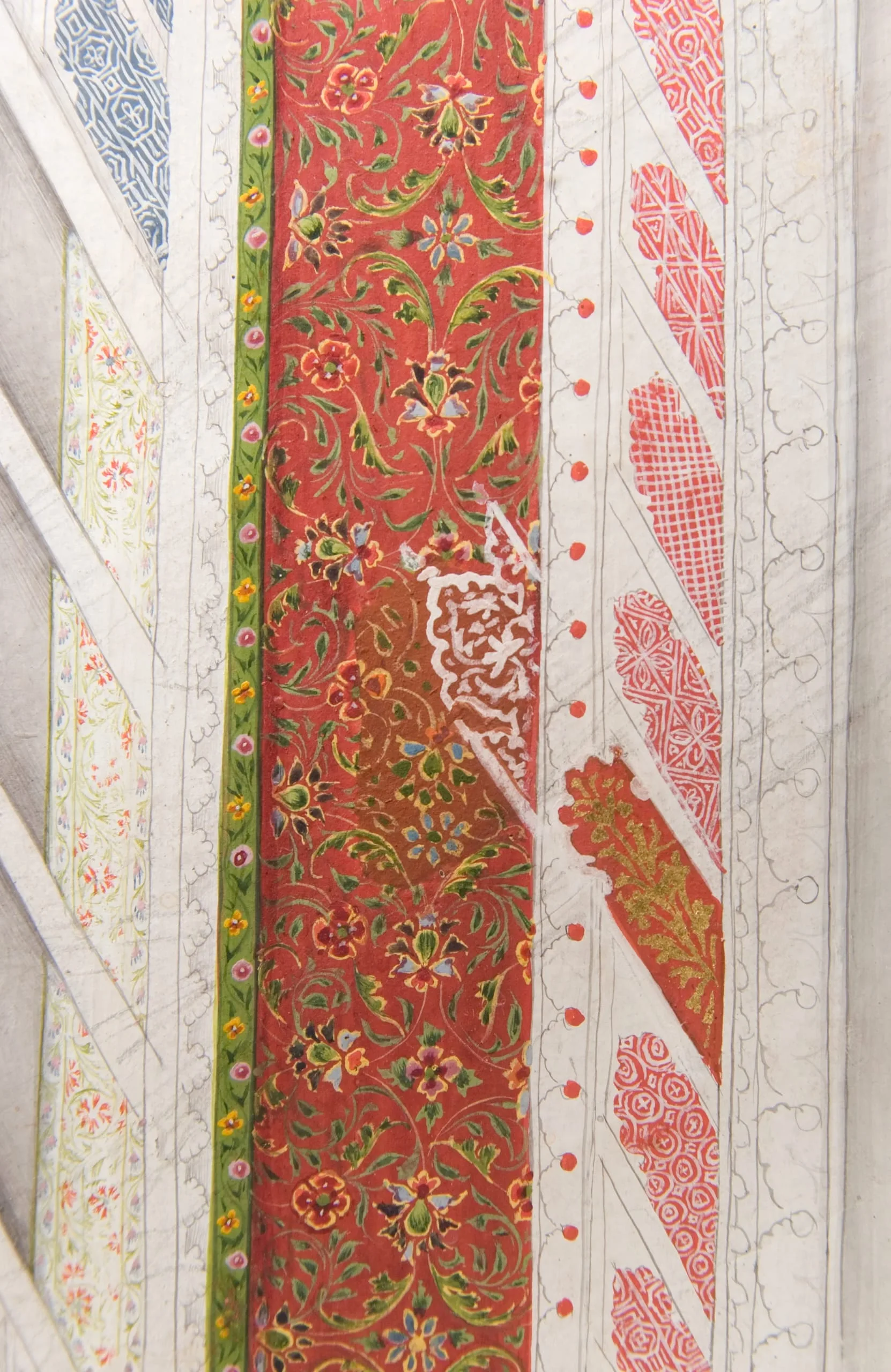
Architectural study or decorative design drawing showing parallel vertical bands of ornamental patterns, including a wide red band filled with dense floral and arabesque scrollwork in green and multicolor, flanked by narrower borders with geometric and floral motifs in blue, pink, and gold on a cream ground.
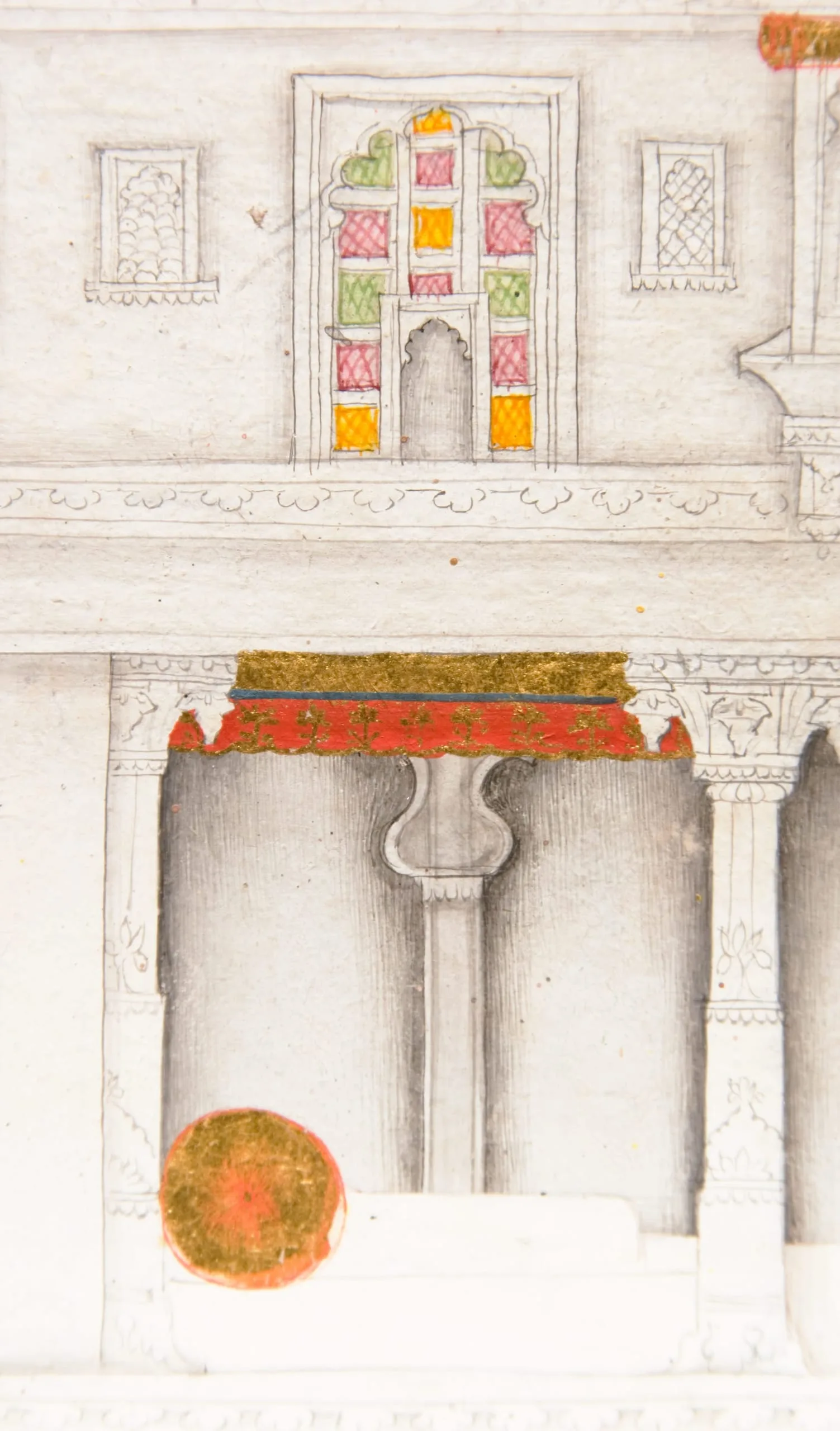
Ink and watercolor architectural drawing of a Mughal-style facade, featuring a multi-paned jali window with panels in red, yellow, and green, above a colonnaded portico with a red and gold canopy frieze; a wax seal in orange-red at lower left.
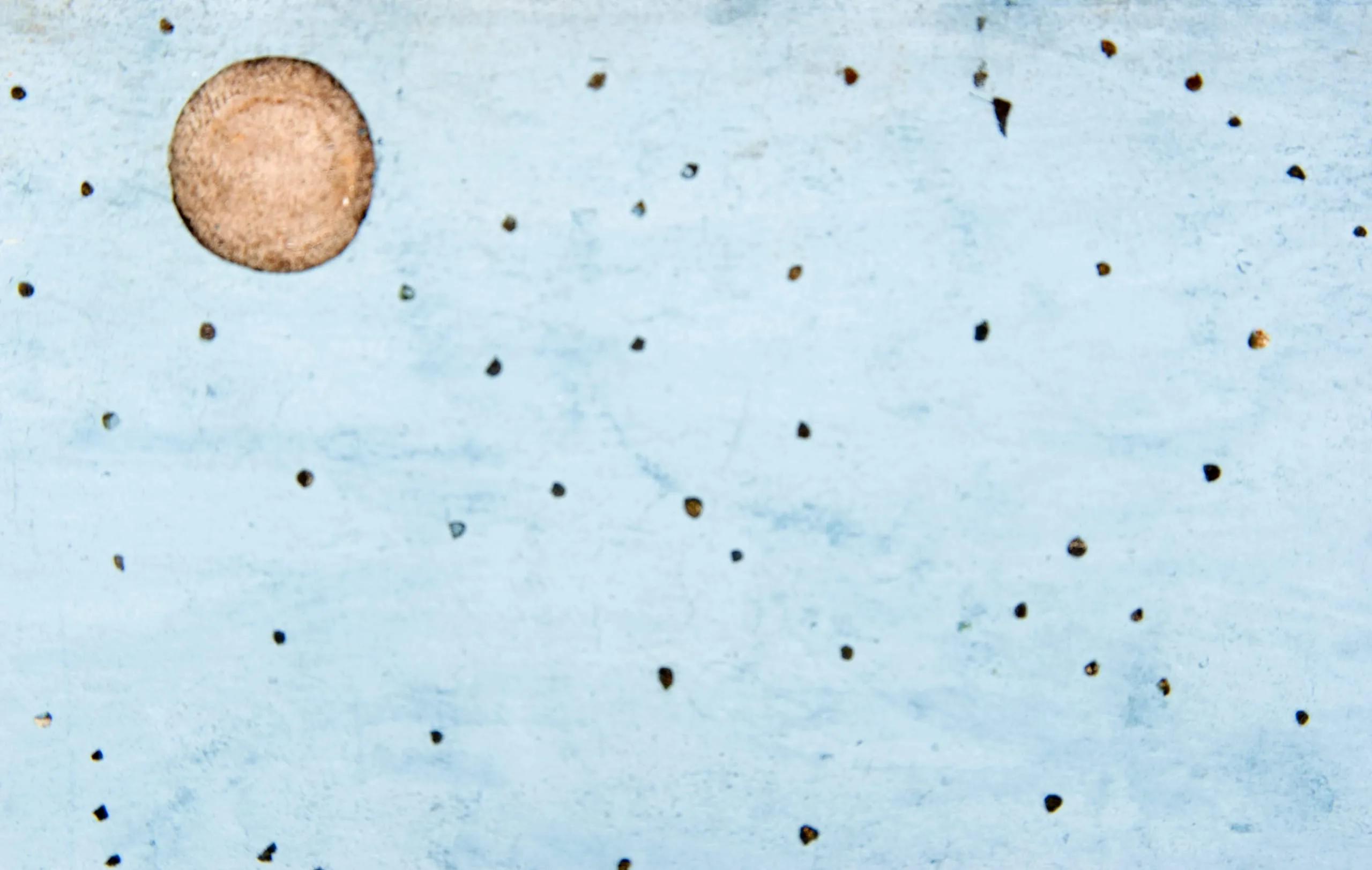
Mixed-media composition on pale blue ground, with a single tan circular form in the upper left and scattered small dark dots and flecks distributed across the surface, showing visible texture and subtle staining in the ground.
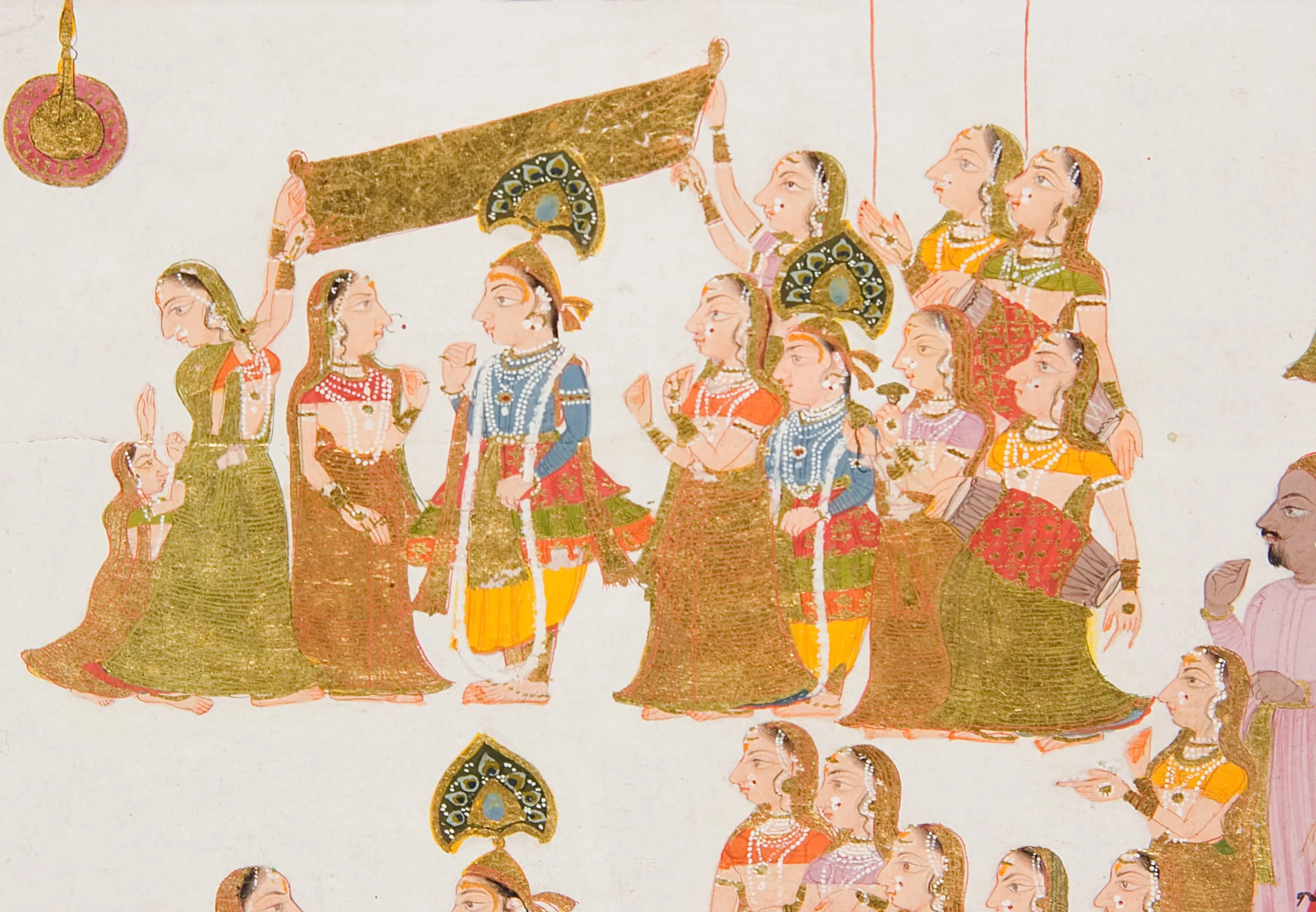
Indian opaque watercolor painting with gold, depicting a group of women in colorful skirts, blouses, and jewelry holding a golden canopy overhead, rendered in flat Rajput style with fine detail on ornaments and garments.
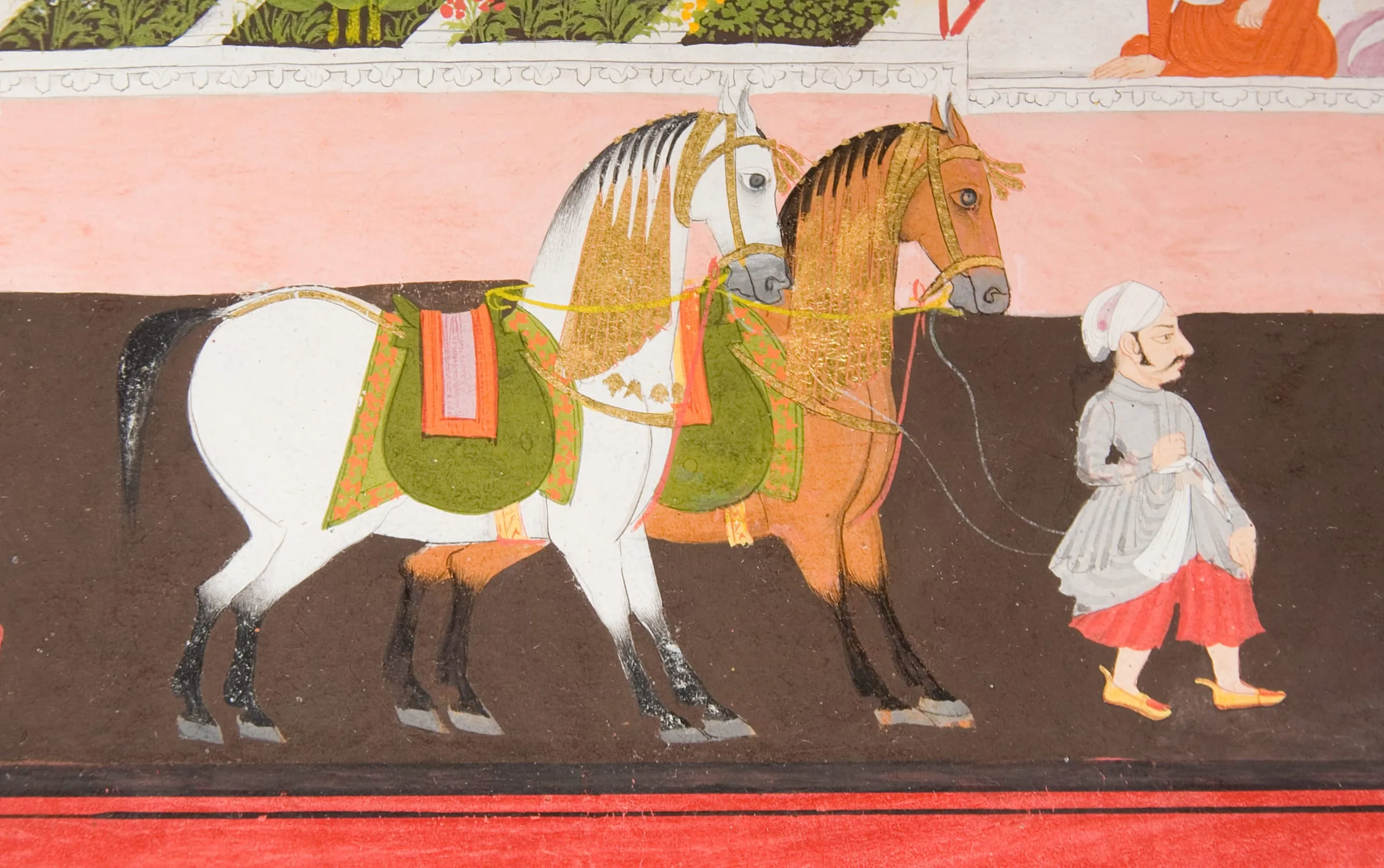
Mughal-style opaque watercolor painting of two horses—one white, one chestnut—adorned with green and orange saddle cloths and gold bridles, led by a male attendant in white turban, gray tunic, and red trousers against a dark ground with pink sky.
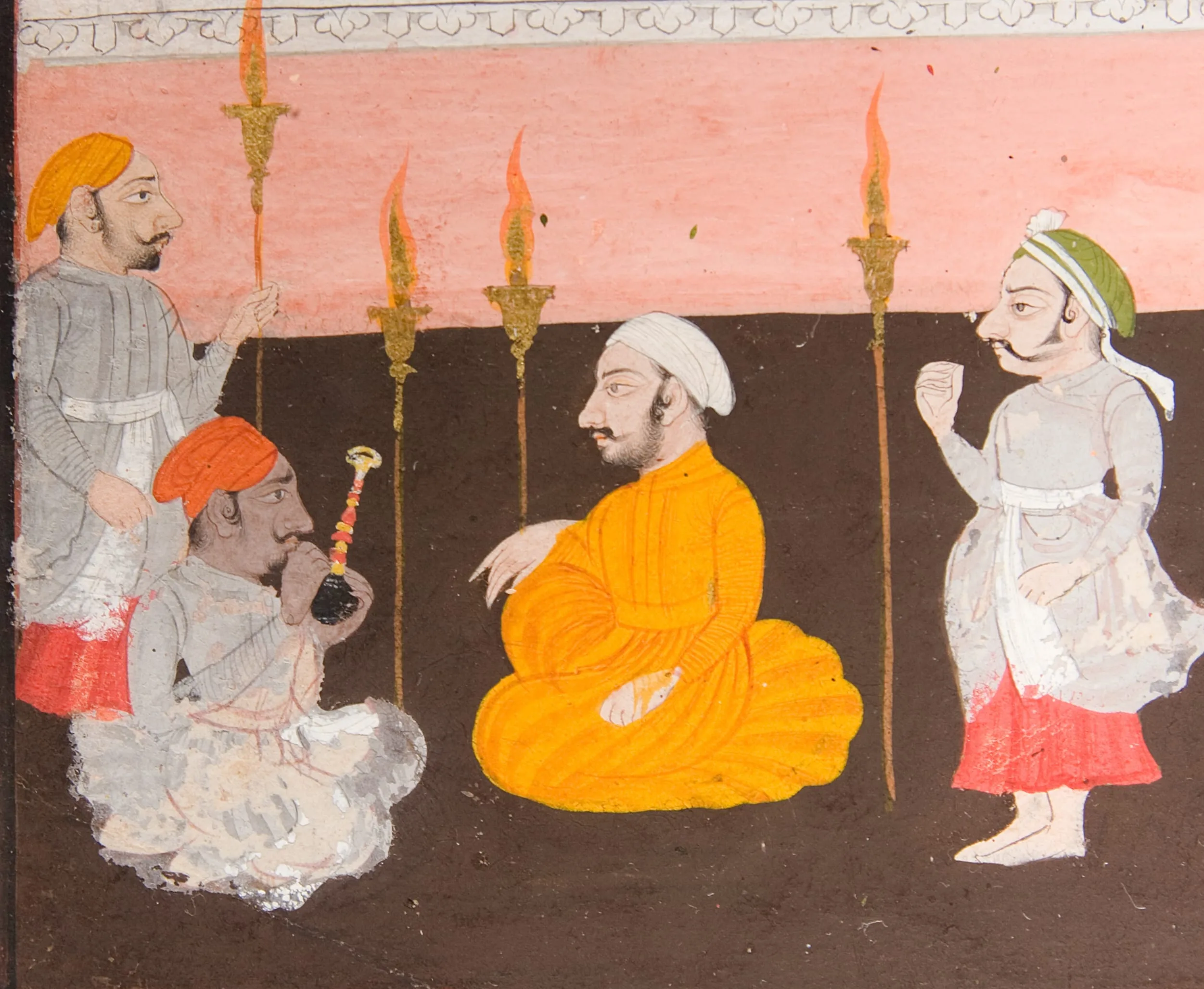
Indian miniature painting, four male figures in a dark interior with a pink upper register. A central seated figure in a saffron robe and white turban faces a kneeling figure smoking a huqqa pipe; two standing attendants flank them, wearing turbans in orange and green. Four gold torch stands with orange flames rise in the background. Flat, opaque pigments with fine detail typical of Rajput or Pahari court painting.
Artist or Maker
Jai Ram (attributed to)
India, active circa 1720-1751 and/or (Jiva) India, active circa 1735-1767
Title
Maharana Jagat Singh II of Mewar (r. 1734-1751) Watching Krishna's Dance of Delight (Rasa Lila) Performed in the Courtyard of the Udaipur City Palace
Place Made
India, Rajasthan, Mewar, Udaipur
Date Made
1736-circa 1740
Medium
Opaque watercolor, gold leaf, and silver on paper
Dimensions
Mat: 30 × 24 in. (76.2 × 60.96 cm) Sheet (Sheet): 26 3/8 × 20 1/8 in. (66.99 × 51.12 cm) Image (Image): 23 7/8 × 17 1/2 in. (60.64 × 44.45 cm)
Credit Line
Purchased with funds provided by The Broad Art Foundation, Carrie and Stuart Ketchum, Nancy and Dick Riordan, the Marc and Eva Stern Foundation, and Suzanne Stern Gilison and Steven Gilison through the 2006 Collectors Committee
Accession Number
M.2006.78
Classification
Drawings
Collecting Area
South and Southeast Asian Art
Curatorial Notes
This large and exceptional painting depicts Maharana (Great King) Jagat Singh II (reigned 1734-51) seated in the Peacock Courtyard of the royal palace in the capital city of Udaipur watching a performance of the Rasa Lila (Krishna's Dance of Delight) under the light of a full moon on November 17, 1736. The opulent kingdom of Mewar in western India was the most prominent Hindu court during the 18th century. It had a rich history of painting and the arts, but under the inspired patronage of Jagat Singh II, an efflorescence of painting, architecture and drama was achieved, with numerous artistic masterpieces created and performed in what was truly a Golden Age. The painting is attributed to the collaboration of the two leading artists of the Mewar court, Jai Ram (active circa 1720-51) and/or Jiva (active circa 1735-67). It features highly refined draftsmanship and a lavish use of gold pigment, all indicative of its superb quality. The painting is also an important historical document, as it is one of a series of only ten paintings portraying this extravagant dance performance. Each painting depicts a different episode of the dance drama, but all are unified through a uniform composition for the settings. This serial multiplicity was a unique experiment in Mewar painting, as it is the only known group of paintings devoted to a single event. A long inscription in Hindi on the reverse documents the performance and identifies all the royal attendees.
Selected Bibliography
  • McGill, Forrest, editor. Beyond Bollywood: 2000 Years of Dance in the Arts of South Asia, Southeast Asia, and the Himalayan Region. San Francisco, CA: Asian Art Museum, 2022.