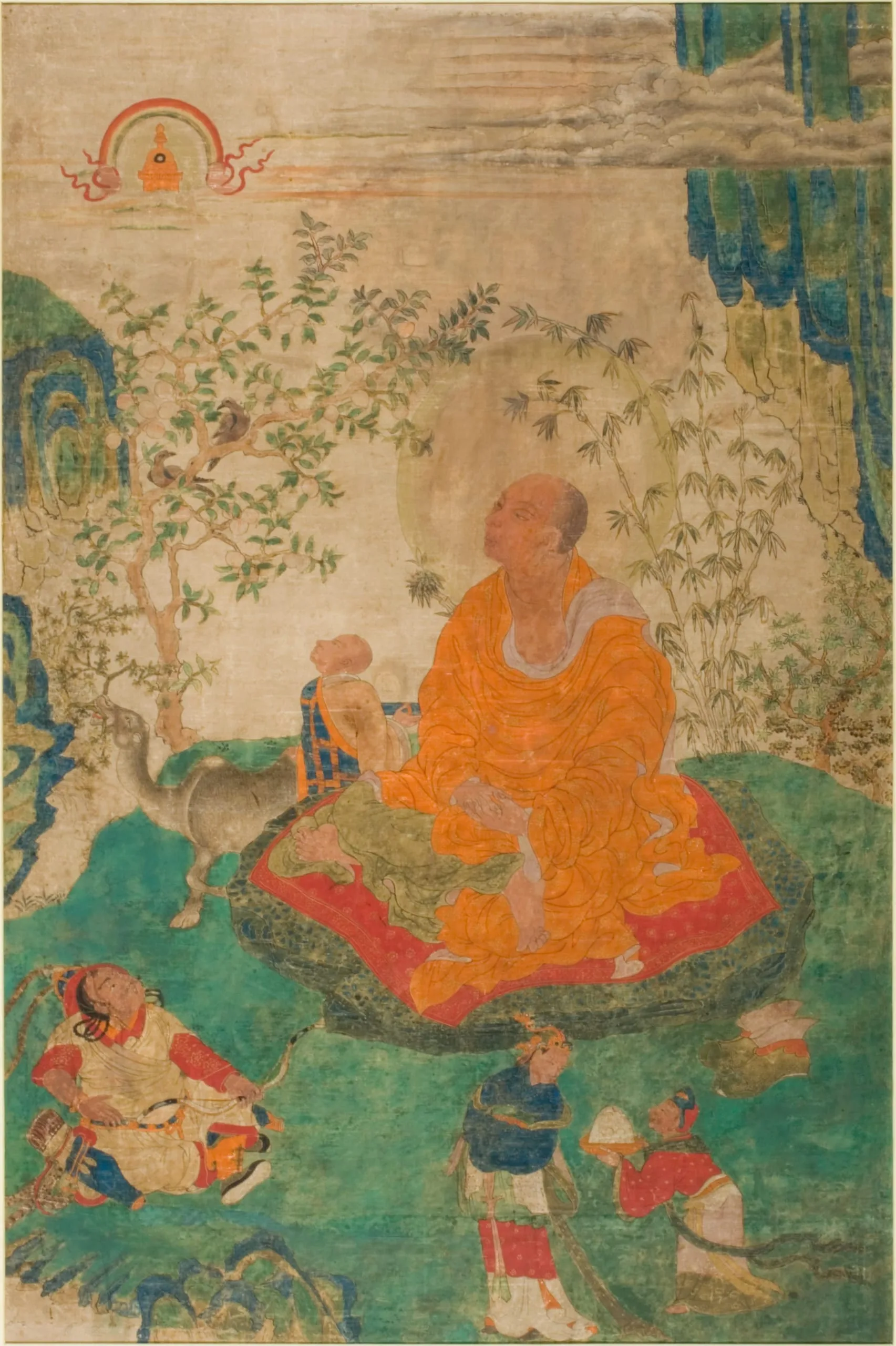
This painting and its five set mates (M.2005.154.1-.6) were originally part of a Tibetan set of the Sixteen Great Arhats (Buddhist saints) reportedly from a Trungpa Monastery in Surmang in the Kham region of northeast Tibet bordering China. Founded in the 15th century by the Mahasiddha Trungmase and now known collectively as the Surmang Monastery, it was a complex of nine monasteries that was the home of the Trungpa tulkus (incarnate lamas) in the Kagyu lineage. The Surmang monasteries were destroyed in 1958 during the Chinese invasion of Tibet.
The six paintings in the LACMA set are important examples of the Sino-Tibetan style of thangka painting that was heavily influenced by Chinese landscape traditions and figural conventions. Five of the paintings portray Arhats inspired by Chinese Ming prototypes, such as the portrait of the Arhat Chudapanthaka attributed to circa 1500 in the Museum of Fine Arts, Boston (08.176). The Arhats or Lohans were first worshiped in China during the Six Dynasties Period (222-589) and were widely depicted in art by the Tang Dynasty (618-906). The sixth painting in the LACMA set depicts two of the Guardian Generals of the Directions (Lokapalas) who were typically included in Tibetan sets of the Sixteen (and later Eighteen) Great Arhats. See also M.71.107, M.77.155.1, M.83.105.18, and M.86.336. A comparable partial set of 18th-century Sino-Tibetan Arhat paintings is in the Museum of Fine Arts, Boston (59.276-.280, .282-.285). See also Stephen Little, "The Arhats in China and Tibet," Artibus Asiae 52:3/4 (1992): 255-281.
This painting portrays the Arhat Abheda (Without Fracture; set no. 16). He is typically represented as holding a stupa or chaitya (reliquary monument) in his hands, but here the stupa is floating in the heavens and the nimbate Abheda is gazing up at it.
A comparable Eastern Tibetan portrait of Arhat Abheda is in the Rubin Museum of Himalayan Art, New York (F1996.4.1).